
The word “agentic” is attached to almost everything in AI right now.
It gets used for chatbots that answer one question at a time, for copilots built into apps you already use, and for autonomous systems that plan and do work on their own.
As a result, the term can mean very different things depending on who is using it. The easiest way to understand it is to compare agentic AI with the traditional AI systems most businesses already rely on.
Traditional AI is already everywhere. It powers fraud detection, recommendation engines, demand forecasting and content generation tools.
Agentic AI works differently. While traditional AI waits for a prompt and returns an answer, agentic AI starts with a goal and takes actions to achieve it.
This piece walks through what that difference means and where each approach fits.
What We Mean by Traditional AI
Before comparing, it helps to define what “traditional AI” actually means.
In this context, we’re referring to the predictive and pattern-recognition models that have powered software for years. These systems detect fraudulent transactions, rank content feeds, forecast demand, route support tickets and make countless other decisions behind the scenes.
They learn from historical data and apply those patterns to new situations, but their role is limited to producing a prediction, recommendation or classification.
Generative AI, which accelerated AI adoption from 2022 onward, extends those capabilities but follows the same basic model.
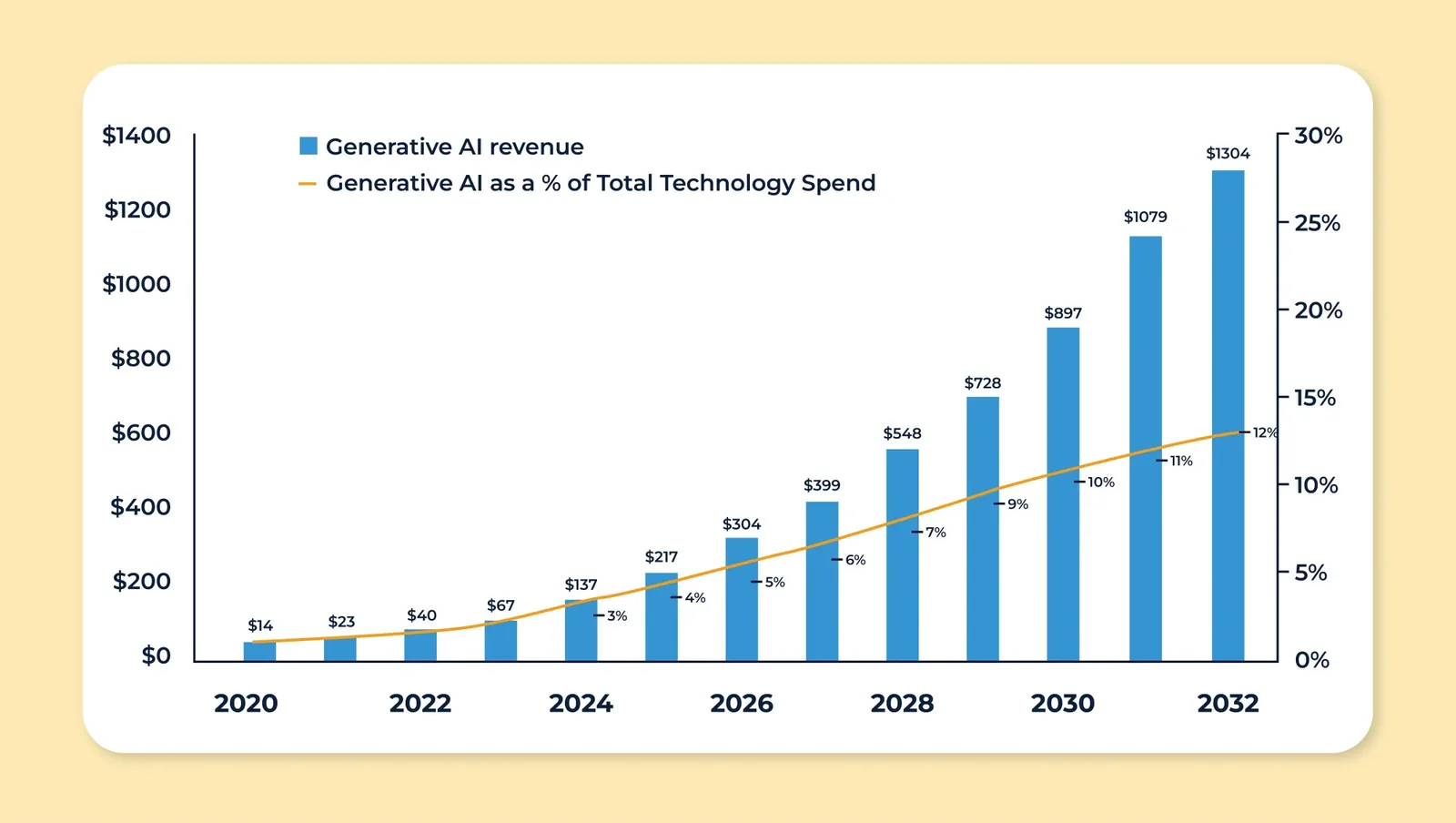
Source: Bloomberg
Instead of identifying patterns, it creates new content whether that is text, images, code or audio. Yet the relationship between user and system remains largely unchanged.
That is the common thread across both predictive and generative AI. The system produces an output, but responsibility for interpreting it, acting on it and deciding the next step remains with the user.
With “agentic” in the picture, that relationship is altered.
What Makes AI Agentic
Most agentic systems are built on the same large language models and machine learning techniques that power today’s AI tools. The difference lies in how those capabilities are used.
One distinction worth clarifying is that an AI agent is the software system itself, while agentic describes the degree of autonomy that system has.
These characteristics define that autonomy:
It Works Toward a Goal
An agent starts with an objective rather than a single task. Once that objective is defined, it breaks the work into smaller steps, determines what needs to happen first and decides how to move from one stage to the next.
For example, if asked to produce a competitive analysis, it might gather data, identify relevant competitors, organize findings, generate a report and flag information that requires human review. The objective remains constant, but the path is determined as the work unfolds.
It Plans, Acts and Adapts
Underneath, agents operate a continuous feedback loop that practitioners describe as perceive, reason, act and learn.
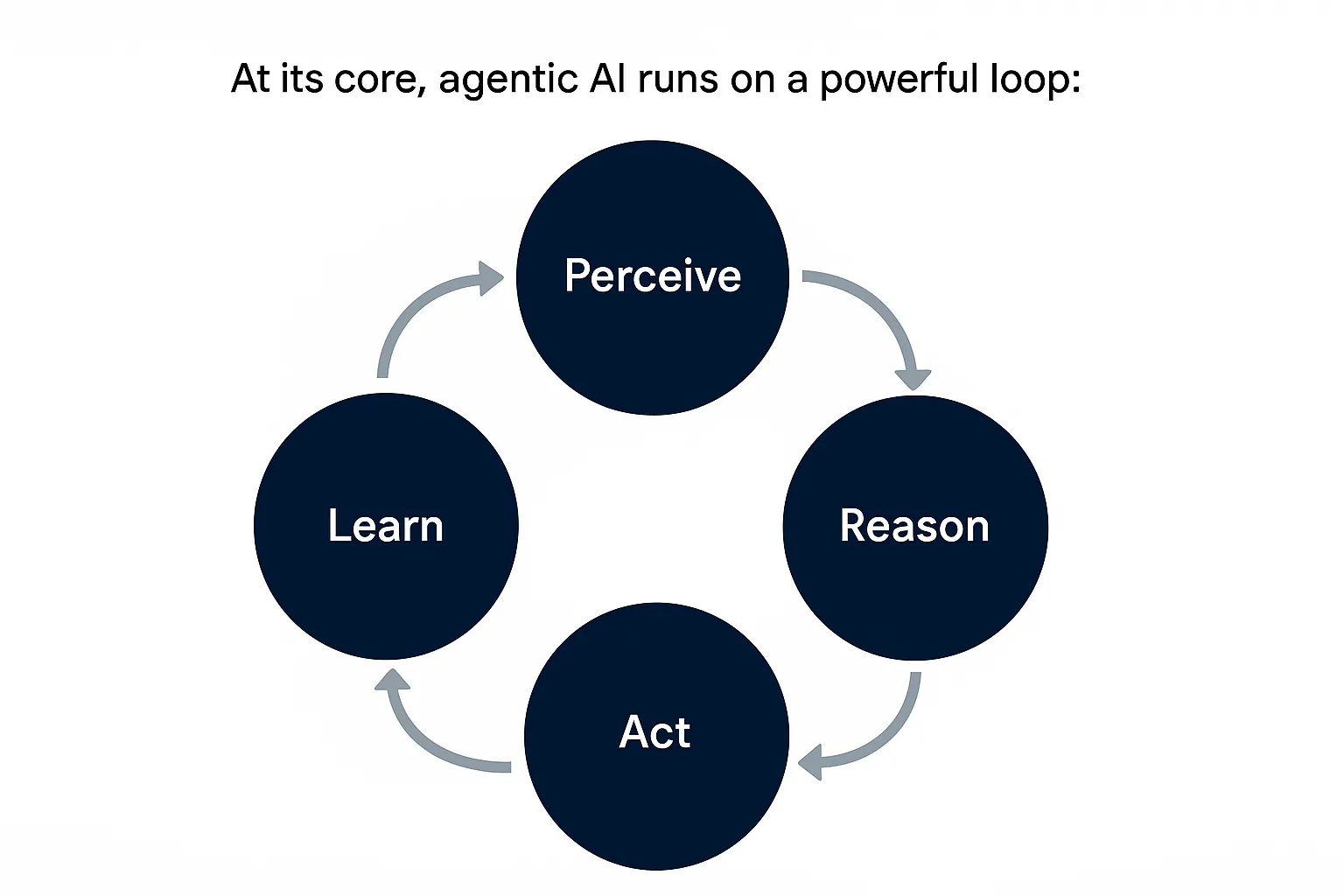
Source: Mediate
In other words, it assesses the situation, chooses a step, carries it out, observes what happened and decides what to do next, repeating until it reaches a stopping point.
Because each step informs the next one, the system can adjust its approach when circumstances change or when new information becomes available. This flexibility makes it better suited to open-ended tasks where every decision cannot be mapped out in advance.
It Can Take Action Across Systems
An agent does more than suggest. It calls APIs, edits files, runs code, queries data, triggers workflows and retrieves information from multiple systems.
Instead of producing a recommendation and waiting for someone else to execute it, the system can carry out part or all of the process itself.
This ability to plan, adapt and act is what moves AI beyond generating outputs and toward completing meaningful work.
The Difference at a Glance
With both sides defined, the contrast is easier to see laid out directly.
| Features | Traditional AI | Agentic AI |
| How you engage it | You give it an input | You give it a goal |
| What it does | Returns an output, then stops | Plans, acts and iterates until the goal is met |
| Default posture | Reactive, waits to be called | Proactive, acts on its own |
| Scope of work | A single, well-defined task | Multi-step, variable workflows |
| Interaction with systems | Returns information or recommendations | Uses tools, APIs, code and workflows to take action |
| Human involvement | Reviews outputs and decides what happens next | Sets objectives, permissions and guardrails while overseeing execution |
| Best suited to | Narrow, high-volume and predictable tasks | Complex work that needs planning and adaptation |
Why Agentic AI Forces Different Decisions Than Traditional AI
Once a system pursues goals and acts on its own, the implications extend far beyond the technology itself.
They also show up in how you supervise it, how you build around it, what you are accountable for when something goes wrong and how you should expect it to pay off.
Oversight Moves From Approving Actions to Monitoring Outcomes
A predictive model needs validation and tuning, but it does not act without you. An agent does, and that reframes the human role.
Teams are moving from approving each decision in real time toward setting policy, watching outcomes and intervening when the system flags uncertainty. The useful mental model is that an agent has to be managed more like a coworker than a tool, with oversight that adjusts to context and risk instead of a fixed set of controls.
Too much supervision erases the value of autonomy, while too little exposes you to operational and compliance risk. Finding where humans belong in that loop is a rather important call.
Architecture Has to Account for Autonomy
Traditional AI usually slots into an existing pipeline as one more component. Agentic systems do not, because acting autonomously depends on infrastructure that predictive models don’t need:
- Orchestration to coordinate steps and agents
- Memory to hold context across a task
- Controlled access to the right tools and data
- Observability to see what the system actually did
These move from nice-to-have to load-bearing the moment an agent is allowed to execute rather than recommend, and underestimating that is a common reason early deployments stall.
Governance Becomes Structural Rather Than Optional
When software takes actions on its own, auditability, permissions and accountability have to be designed in rather than added later.
Someone has to be able to answer which agent did what, under whose authority and against which policy, and someone has to own the result when an autonomous workflow causes harm.
This is why compliance changes once agents write and deploy code, and why governance is increasingly treated as part of the build rather than a review bolted on at the end.
The Return Looks Different, and So Does the Risk
Predictive AI tends to deliver quick, contained gains on a well-understood task. Agentic systems aim at larger, compounding returns by taking on whole workflows and they carry a different risk profile to match.
Adoption is already past the experimental stage, with more than a third of organizations already deploying agentic systems, with many others actively planning to do the same.
But the larger the ambition, the greater the risk. Edge cases, changing conditions, incomplete information and unexpected interactions between systems quickly expose the gap between what works in a controlled setting and what works reliably at scale.
Concluding Thoughts
The honest framing is that agentic AI is not an upgrade you apply everywhere. It earns its complexity on work that is multi-step, variable and verifiable, where a system needs to plan and react to what it finds and coordinate across tools.
For narrow, high-volume, deterministic tasks, a traditional model is usually cheaper, faster and more predictable, and wrapping it in an agent adds cost and surface area for failure without a matching return.
For a lot of organizations, the question is not whether agents can work. It is where they can deliver enough value to outweigh the additional cost, oversight and risk they introduce.
This is the kind of work Growth Acceleration Partners helps organizations navigate. At GAP, we design, build and modernize software, data and AI systems, helping teams identify high-value opportunities for automation while ensuring the architecture, governance and oversight are in place to support them.