
(This is Part 3 of a three-part series exploring what it takes to bring true agentic AI systems into enterprise production. Read Part 1 and Part 2.)
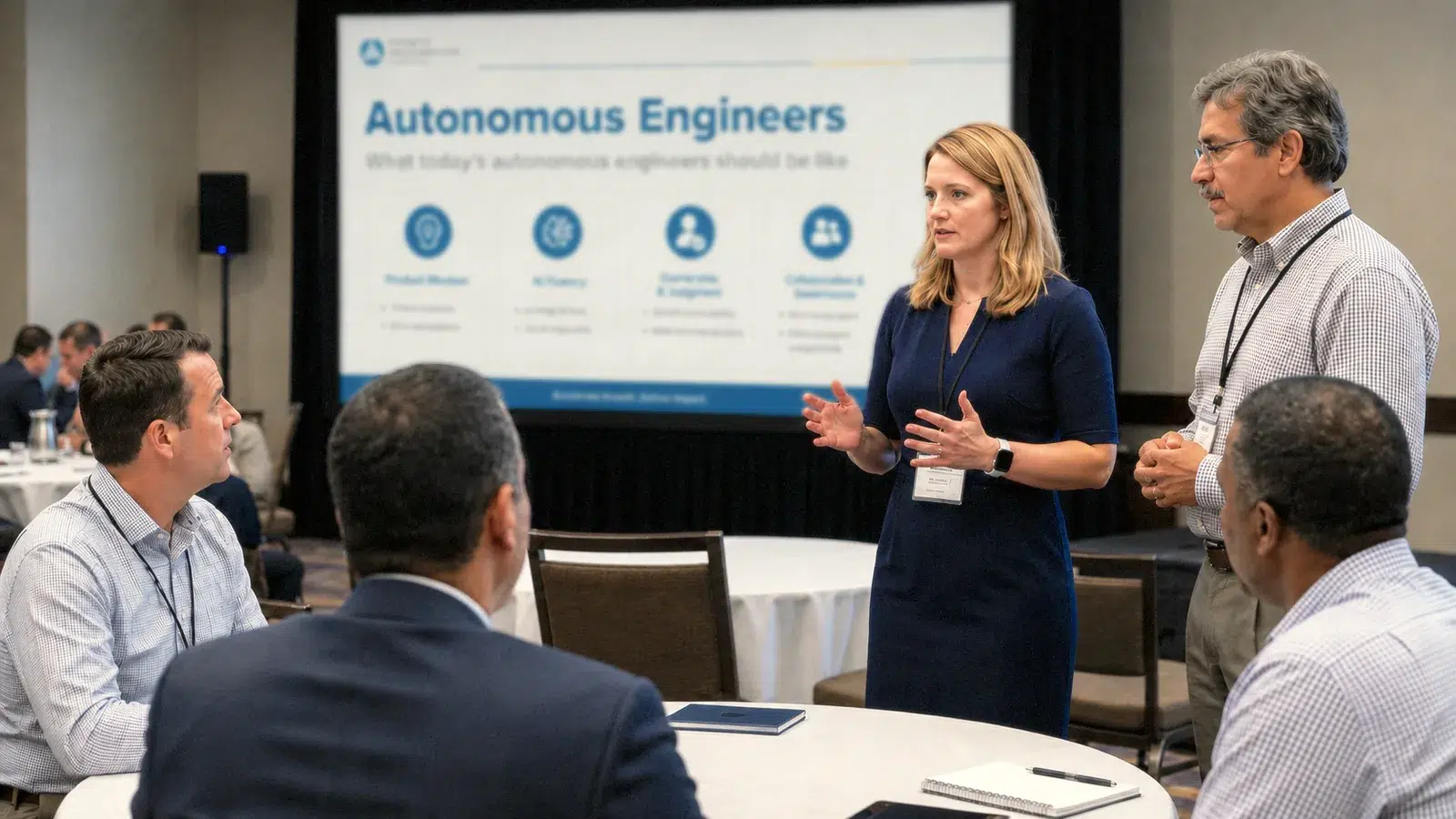
When we gathered with technology leaders at the Chief AI Officer (CAIO) Summit in New York City, one truth eclipsed all others: you can build the most architecturally perfect, data-rich AI agent in the world, but it won’t matter if your organization doesn’t trust it enough to hit deploy.
Moving autonomous engineering and agentic systems from a safe sandbox into true enterprise production isn’t just a technical hurdle. It’s a deep operational transformation. It radically reshapes corporate risk, team culture and the very nature of human-machine collaboration.
In Part 1 of this series, we broke down the stark reality of the PoC-to-Production Engineering Gap, using the aviation autopilot analogy to illustrate that the goal of agentic AI isn’t complete human replacement, but the optimization of human capacity. In Part 2, we opened up the engine room to look at the architectural plumbing, mapping out how to impose deterministic guardrails on top of stochastic models and why true “AI-ready data” requires strict retrievability, trustworthiness and permissioning.
But once you have bridged the engineering gap and built a resilient architecture, you run headfirst into the final, most complex variable in the production equation: the human and operational operating model.
During the final block of our executive roundtable at the CAIO Summit, the atmosphere shifted from technical debate to a raw conversation about trust, systemic risk and organizational anxiety. It became completely clear that while technology is moving at breakneck speed, enterprise AI governance and human adaptability are lagging far behind.
To scale agentic systems safely, organizations must fundamentally restructure how they manage risk, how they evaluate software quality and how human developers collaborate with autonomous non-human entities. That restructuring starts with a real AI governance framework, not a policy document, but a living operational discipline embedded into every deployment decision.
The Enterprise Trust Crisis
Right now, there is a massive delta between the level of access enterprises are granting to autonomous agents and the guardrails they have in place to police them. The statistics we shared from recent 2026 industry data caught many leaders in the room off guard:
- The Audit Anxiety: A striking 78% of business executives admit they lack strong confidence that they could pass an independent AI compliance audit within 90 days.
- The Incident Response Void: Nearly 3 in 4 organizations are already giving agentic AI active access to their enterprise data and corporate processes. However, only 20% possess a tested AI risk management plan for when those systems inevitably fail.
- The “Plug-Pull” Problem: 36% of technology leaders lack any formal plan for supervising AI agents, and 35% admit they couldn’t immediately “pull the plug” on a rogue agent if it started executing erratic actions.
This lack of control is already bleeding into operations. Two-thirds of technology leaders acknowledge that their corporate governance capabilities consistently lag behind the sheer speed of their AI projects. Furthermore, 67% of executives believe their company has already suffered a data leak or operational breach due to the use of unapproved, shadow AI tools.
The Agentic Governance Gap
Giving agents active access to corporate processes & data
Have a tested AI incident response plan
Data Source: Grant Thornton 2026 AI Impact Survey
This governance deficit is creating immense cultural friction. Advanced AI adopters find that the technology exposes the severe limitations of their existing manual, siloed workflows. This friction trickles down to the workforce, where 29% of employees overall and a staggering 44% of Gen Z workers admit to actively sabotaging their company’s AI strategy out of fear or frustration.
It reaches all the way to the top of the corporate ladder, too: 73% of CEOs report experiencing severe stress or anxiety directly related to AI integration, and 64% genuinely fear losing their jobs over failed enterprise AI transitions. These aren’t soft cultural problems;, they’re symptoms of inadequate AI risk management at the organizational level.
Reshaping the SDLC: From Authors to Curators
Against this backdrop of organizational anxiety, we asked the room a crucial question: How is the rise of agentic workflows actively reshaping your Software Development Lifecycle (SDLC) day-to-day?
The data shows that autonomous capabilities are undeniable. AI agent performance on core code challenges like SWE-bench Verified skyrocketed from a measly 1.96% in late 2023 to an impressive 78.4% by April 2026. Anthropic’s research confirms that nearly half (49%) of sampled enterprise jobs are now using AI to execute at least a quarter of their core tasks.
When applied to code delivery, standard AI coding assistants are driving massive efficiency gains, boosting output velocity by 20% to 55% for well-defined, modular tasks. But there is a massive catch: code churn — defined as lines of code reverted or heavily updated within two weeks of being authored — is projected to double compared to pre-AI baselines.
This means agents are writing code faster than ever, but they are also introducing unprecedented volume, noise and subtle regressions into the codebase. Consequently, the day-to-day role of the individual software engineer is fundamentally shifting from author to curator and evaluator. Developers are spending significantly less time writing boilerplate syntax and far more time designing complex evaluation harnesses, prompt engineering and meticulously auditing agent-generated output.
Quality Assurance (QA) is experiencing the most drastic evolution. Traditional test-coverage metrics simply do not map cleanly onto non-deterministic, probabilistic AI systems. To counter this, sophisticated teams are abandoning static testing protocols and standing up “evals”, dynamic suites of representative inputs paired with expected semantic output ranges, a practice borrowed directly from the machine learning operations (MLOps) world. This shift in QA practice is itself a component of mature AI compliance: the ability to demonstrate that agentic outputs meet defined quality and safety thresholds before they reach production.
Furthermore, once an agentic pipeline goes live, it demands continuous, real-time post-release monitoring in a way a static API endpoint never did.
The 2026 Shift: If 2025 was universally recognized as the year of AI speed, 2026 has become the year of AI quality. Review mechanisms and governance frameworks are the true bottlenecks of software delivery today. The gap between what an AI agent can rapidly generate and what a human engineering team can confidently verify is the exact constraint on whether that velocity translates into reliable software or production failures.
Earned Trust: The Criteria for Mission-Critical Autonomy
We pushed the CAIOs and CTOs to answer a hard question: What would have to be true for your organization to trust an autonomous system with a mission-critical workflow? Nobody in the room was willing to trust an agent based on optimism or vendor marketing decks; trust must be systematically earned through cold, hard evidence.
Any credible AI governance framework for autonomous systems must define these prerequisites explicitly, not leave them to individual team judgment. The executives collectively aligned on four strict operational prerequisites that must be met before an agent is granted autonomy over a mission-critical pipeline:
- A Documented Track Record at Lower Stakes: The agentic system must run reliably on non-critical, low-risk workflows long enough to accumulate an audited baseline of evidence.
- Explicitly Tested Failure Modes: The engineering team must thoroughly map out, document and test exactly what the agent does when it is wrong, not just when it goes right.
- A Robust Rollback Mechanism: Autonomous actions cannot be final; there must be a programmatic “undo button” or a strict rollback window where an action can be completely reversed or flagged for manual correction.
- Absolute Human Accountability Ownership: There must be a specific, named human being who owns the ultimate responsibility for the agent’s outputs. Passing off accountability to a nebulous “AI team” or an external vendor turns corporate governance into political theater.
Mapping the Human-in-the-Loop Boundaries
To make these trust conditions actionable, we discussed a simple framework to help leaders draw the hard line between what belongs entirely in an agent’s hands versus what must remain a strict “Human-in-the-Loop” AI gate.
We advise engineering teams to map every single planned agent action across two distinct axes: Reversibility (Can this action be easily undone?) and Consequence Magnitude (How catastrophic is a wrong decision?).
| Consequence / Reversibility | Highly Reversible | Irreversible / Hard to Undo |
| Low Consequence Magnitude | Full Autonomy
Run autonomously with standard telemetry logging. |
Human Observation
Run with rapid automated checks or post-execution review. |
| High Consequence Magnitude | Human Review
Conditional autonomy with strict monitoring and rollback buffers. |
Human-in-the-Loop Gate
Mandatory human sign-off before execution. |
When an agent’s planned action falls into the High-Consequence or Irreversible quadrant, such as blasting out an external communication to customers, modifying core financial records, or triggering an enterprise procurement pipeline, a human gate must be enforced.
The goal of a modern AI operating model isn’t to trap humans in manual loops indefinitely. The goal is to safely and incrementally expand the agent’s boundaries of autonomy over time as trust is structurally earned with empirical data.
Winning is About People, Not Models
As our summit roundtable came to a close, the final consensus was a powerful reminder of an old corporate truth: winning with agentic AI is ultimately an organizational challenge, not a technological one. The frontier models are no longer the core constraint holding back enterprise transformation.
The real work lies in redefining job roles, aggressively upskilling teams and systematically embedding seamless human-agent collaboration into the daily fabric of the business. Progressive technology leaders are already rethinking their entire hiring and talent frameworks. They are moving toward an operating model where autonomous agents are trusted to manage high-volume transactional projects, while human engineers step into elevated roles as system architects, strategic overseers and managers of the agents themselves.
Moving an agentic system from an impressive, isolated demo into a secure, compliant and highly profitable production environment requires an experienced engineering steady hand. It demands a balance of cutting-edge AI orchestration with old-school, disciplined software engineering fundamentals.
Ready to Bridge the Gap?
If your organization is struggling to move past pilot purgatory, let’s talk. Schedule a meeting with a GAP Solution Architect today to pressure-test your current architecture, map out your governance guardrails, and build a practical engineering blueprint to scale your next AI project into a measurable, production-grade success.