
(This is Part 1 of a three-part series exploring what it takes to bring true agentic AI systems into enterprise production.)
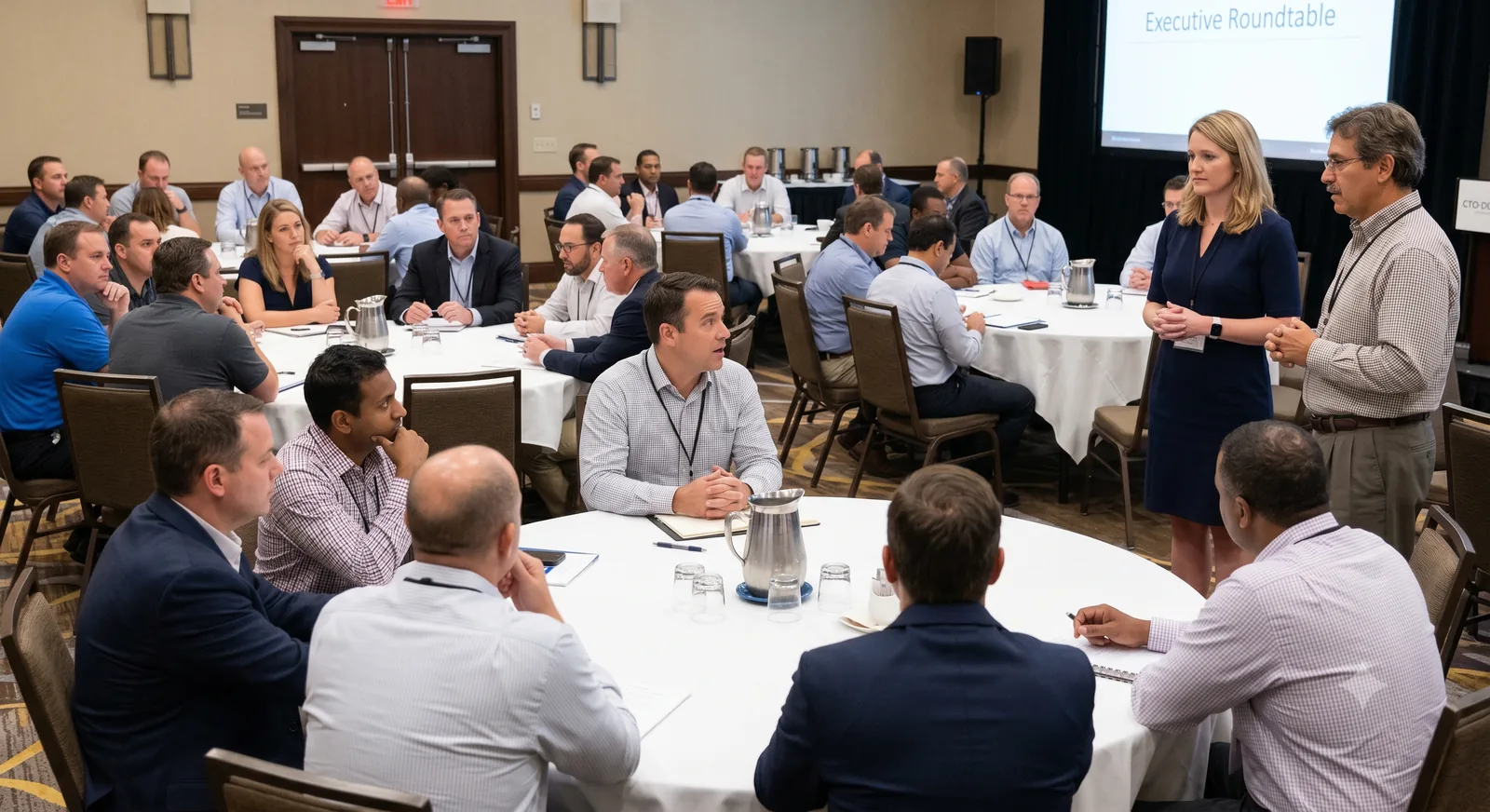
In early June, our team from Growth Acceleration Partners hosted an executive roundtable at the Chief AI Officer (CAIO) Summit in New York City. The room was packed with CAIOs, CTOs and senior technology leaders who are all wrestling with the exact same mandate: move past the proofs of concept (PoCs) and show real business impact.
The collective energy in the room was a mix of intense urgency and deep operational frustration. Everyone is under pressure to transition away from basic, prompt-driven chat interfaces and localized experiments toward fully autonomous engineering pipelines and agentic workflows. Yet, as we looked around the room, a sobering reality settled over the discussion: most agentic AI deployment initiatives are stalling out before they ever cross the production finish line.
We spent our session exploring the “PoC-to-Production Engineering Gap.” (Pun intended with GAP!) We discussed what is actually delivering value in the real world, why promising pilots collapse when exposed to real enterprise traffic, and how leaders are redefining their operating models to survive the shift from deterministic software to stochastic AI systems. The gap between experimentation and production is now one of the defining challenges of enterprise AI adoption, and the stakes have never been higher.
Here is what we learned from the front lines of enterprise AI implementation in 2026.
The Autopilot Reality Check
While preparing for our conversation, I found an analogy about commercial aviation autopilot that I thought might resonate deeply with the technical leaders in the room.
In modern aviation, autopilot systems handle over 90% of total flight time autonomously. Human pilots still maintain absolute ownership over takeoff, landing and any non-standard or emergency situations. Crucially, no one looks at a commercial flight and calls the autopilot a “failed AI initiative” simply because a human being takes the controls to land the plane.
The takeaway for enterprise leadership: The ultimate goal for agentic AI shouldn’t be, “How do we replace human execution entirely?” Instead, the question we must ask is, “Where does human judgment add the absolute most value, and how do we use autonomous workflows to free up capacity for exactly those critical moments?”
When you frame the technology this way, the corporate anxiety shifts from an existential crisis about headcount to a practical engineering problem about workflow design. Unfortunately, most enterprises are still missing this mark entirely. Getting this framing right is the foundation of any effective enterprise AI strategy.
The Cold, Hard Math of Enterprise AI
The data surrounding enterprise AI deployment right now is stark, and the executives in our roundtable felt it acutely. Consider these benchmarks that we laid out on the table:
- The ROI Deficit: According to data from the MIT Project NANDA, a staggering 95% of organizations deploying generative AI enterprise-wide saw zero measurable return on investment. Not a low return of zero.
- The Layering Trap: McKinsey’s State of AI report notes that fewer than 10% of organizations are scaling AI agents in any single function. Worse, nearly 80% are simply layering AI on top of existing legacy processes without taking the time to redesign how the work actually flows.
- The Pilot Purgatory: A joint study by CIO Research and RAND found that 88% of AI pilots never reach production at all, regardless of company size. Furthermore, 80.3% of AI projects fail to deliver their intended business value, a failure rate that has remained stubborn even as the underlying frontier models have vastly improved.
The AI Deployment Funnel
  ├── Exploring / Piloting Agentic Options (68%)
  │     └── Ready to Deploy (14%)
  │           └── Actively in Production (11%)
Data source: Deloitte Emerging Technology Trends Study
This data highlights a massive chasm. Organizations that successfully integrate AI are nearly four times more likely to report significant revenue growth than those stuck in pilot mode (58% vs. 15%). The financial incentive to bridge the gap is massive, but the engineering bottlenecks are real.
The 20/80 Value Strain: Why Roadmaps Are Stalling
During our roundtable, we challenged the technology leaders to look at their current roadmaps honestly and evaluate what percentage of their initiatives are genuinely driving P&L value versus living in the “expensive experiment” phase.
The consensus was an eye-opening 20/80 split. Roughly 20% of enterprise AI initiatives are generating measurable ROI, while the remaining 80% are burning compute budget while waiting for business sponsors to ask hard questions.
When we pushed the room on what separates that successful 20% from the rest, the answer wasn’t technical sophistication or access to superior models. The true filter is whether a success metric was explicitly defined before the first prompt was written.
The organizations winning in production today don’t start with sprawling, overly ambitious autonomous workflows. They start with narrow, deeply instrumented use cases. They solve a specific, high-frequency operational pain point, prove the financial baseline and use those savings to earn their way to a broader scope. This disciplined approach is what separates a mature enterprise AI strategy from an expensive science project. If you don’t build a rigorous filter into your intake process, you are essentially funding science projects.
The Mirage of the Promising PoC
Almost every CTO in the room had a story about a pilot or AI proof of concept that looked incredibly promising in a controlled environment but completely failed to scale when deployed to the wild.
We see a classic, recurring pattern across industries: A data team builds a document summarization or compliance classification agent. In the sandbox, running against a beautifully curated test set of 200 clean documents, the agent performs flawlessly. The board is thrilled, the green light is given for production, and then the system immediately collapses.
Why? Because the real-world production corpus is chaotic. It is filled with inconsistent formatting, low-resolution scanned PDFs, multilingual inputs and hyper-localized internal jargon the underlying LLM has never seen before.
The harsh reality is that the PoC succeeded only because a human engineer silently cleaned the data beforehand. Production didn’t break the AI; production simply exposed the fact that the actual engineering work hadn’t been done yet. This is the most common failure mode in enterprise AI adoption and the most preventable.
Redefining “Done”: The Traditional SDLC vs. Agentic Reality
One of the most profound shifts discussed at the NYC summit was how agentic workflows are fundamentally rewriting the Software Development Lifecycle (SDLC).
In a traditional engineering environment, “done” has a rigid, deterministic definition: the code satisfies a set of static test suites, passes QA and ships as a compiled binary. But with agentic software pipelines, we are dealing with fundamentally stochastic (probabilistic) engines. An agent’s environment changes, user context shifts and the model’s objective can drift over time.
Because of this, “done” is never really done. Software leaders must transition from traditional software management to practices borrowed from machine learning operations (MLOps) — managing a living, breathing system rather than shipping static code.
Right now, the most successful production deployments in enterprise environments sit at Level 1 or Level 2 autonomy. These are systems performing predefined actions with highly rigid, logic-driven sequencing. While venture capital marketing decks imply that enterprises are running Level 3 or 4 completely autonomous agents, the disconnect between what is sold and what is actually shipped is massive.
The teams succeeding today aren’t trying to build Artificial General Intelligence (AGI) to run their operations. They are focusing on the boring, high-volume, well-defined workflows: automated document processing, real-time compliance checks and invoice reconciliation. When it comes to generative AI enterprise deployments, boring use cases executed reliably at scale consistently outperform ambitious ones that never reach production.
The Transition Checklist for Production-Ready Agents
As our roundtable drew to a close, we mapped out the operational criteria that sophisticated technology teams use to determine when an agentic solution is officially ready to cross over from pilot to true production. It mimics traditional SDLC gates but introduces four non-negotiable additions:
- Strict Cost and Latency SLAs: Speed and compute expenses must be rigorously defined and measured against human performance benchmarks, never assumed.
- Documented Failure Modes: You must map out exactly what the agent will do when it inevitably encounters a scenario it does not understand. How does it fail gracefully?
- A Clear Human Escalation Path: Every automated decision must have an explicit, seamless mechanism to loop in human expertise when confidence thresholds drop.
- Proactive Observability and Telemetry: Full logging, token tracking and evaluation frameworks must be embedded into the core pipeline before go-live, not retrofitted as a patch after something breaks in production.
Teams that treat this checklist as optional tend to be the ones whose agentic AI deployment stalls at 80% complete. Teams that treat it as a hard gate tend to be the ones that make it to production.
Looking Ahead to the Tech Stack
When you make the strategic decision to move on from siloed, self-contained AI solutions into deeply integrated agentic orchestrations, you hit an immediate roadblock. You quickly realize that your existing data ecosystem, API structures, governance models and infrastructure are fundamentally misaligned with what autonomous systems require to run safely.
You run headfirst into enterprise APIs with paralyzing 3-second response times. Prompt brittleness shatters a workflow after a minor model update. And you find organizational handoff ambiguities where a broken agent sits in a ticket queue because nobody knows if it’s an infra problem, a data problem or a model problem.
To scale AI from an expensive experimentation phase to measurable business impact, we have to talk about the underlying plumbing. This is where enterprise AI adoption either accelerates or stalls permanently at the intersection of ambition and infrastructure reality.
In our next post, we will dive into Part 2: Architecture, Orchestration and the Illusion of “Clean Data.” We will unpack exactly how to build deterministic validation layers over stochastic models, what “AI-ready data” actually means inside an enterprise stack, and how to manage non-human access controls without completely choking corporate innovation. Stay tuned.