
The term “forward deployed engineer” is everywhere right now. Job postings for this “seemingly new role” grew 729% between April 2025 and April 2026.
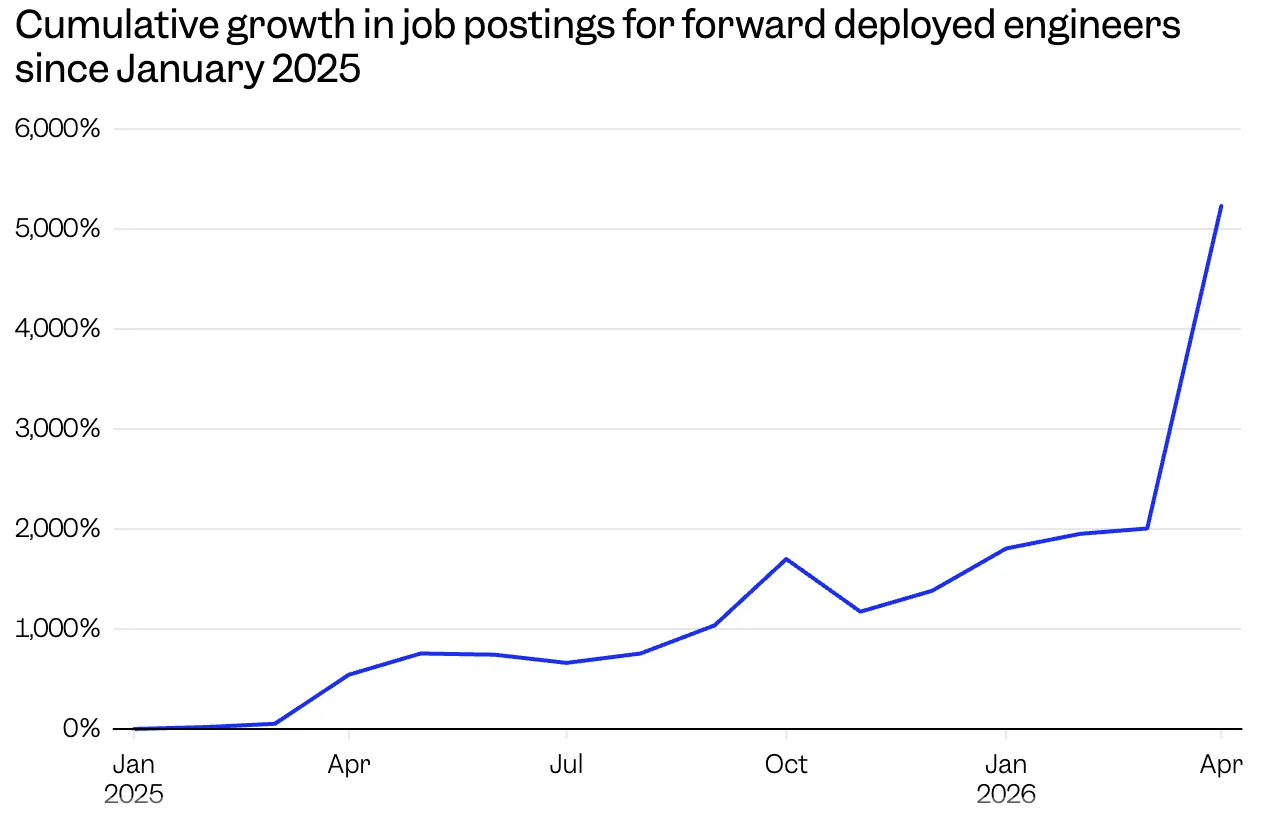
Source: Business Insider
OpenAI has since launched a deployment company backed by more than $4 billion, while forward deployed roles are appearing across other big tech companies.
For some, the term can be quite confusing. That’s because it gets used for everything, from an embedded senior engineer to a solutions engineer running pre-sales demos, or even a sales role with an engineering-sounding title stapled onto it. That’s a large part of why the hype around the role can feel hard to trust.
This piece breaks the topic down properly: what the role actually involves, whether it applies to your company, and, if it does, what hiring for it looks like.
What is a Forward Deployed Engineer?
A forward deployed engineer is a hands-on software engineer who works directly with customer teams and systems, helping scope, build, and ship production software against the customer’s real data, workflows, and infrastructure.
The model was pioneered by Palantir in the early 2010s and has since been adopted across AI labs, consulting firms, cloud providers, and enterprise software companies.
What usually separates the role from consulting or solutions engineering is end-to-end technical ownership. An FDE does not simply deliver a recommendation or demo and move to the next account. They typically remain accountable through technical scoping, system design, development, production rollout, and early adoption.
That wider ownership is also why the role tends to require a broader range of technical skills and more client-facing judgement than a traditional engineering or consulting path demands on its own.
The Skill Set Behind a Forward Deployed Engineer
Most job descriptions for this role read like a long list of tools and platforms. Here is the broader skill set that actually governs the work.
Full-Stack Range Over Narrow Specialization
This is the hard-skill half of the role. An FDE should be able to move across a customer’s frontend, backend, data layer, and infrastructure, often using languages such as Python or TypeScript, integrating with cloud platforms, and building against whichever LLM or agent framework the deployment requires.
A backend specialist who has never touched a frontend, or a data engineer who has never shipped a user-facing feature, will struggle here, because the problems that show up inside a client’s environment rarely respect the boundaries of a single specialty.
Comfort Operating Without a Finished Spec
Many engineering roles begin with a ticket or requirements document that someone else has already written. FDE work often begins with a customer describing a problem and expecting the engineer to help define it.
That means observing how the work is done, asking the right questions, mapping the technical and operational constraints, and turning that ambiguity into something the team can build and measure.
The Judgment to Push Back on a Customer’s Ask
Customers often ask for the wrong thing, or the right thing built the wrong way. An FDE has to be technical enough to know the difference and confident enough to say so, without needing a product manager to run interference.
The role requires both technical credibility and the ability to disagree constructively with a client. The pressure also runs in both directions: the engineer is answerable to the customer asking for a quick fix and to the internal team that may eventually inherit whatever gets built.
Enough Business Fluency to Know When Not to Build Something
ZTABS’ breakdown of the role identifies ownership and influence as some needed soft skills for FDEs. Ownership means remaining accountable for the deployment, while influence means being able to persuade a customer’s engineers and stakeholders to adopt a recommendation.
But both depend on understanding the business outcome behind the request. An FDE should be able to recognise when a workflow needs to change, when a simpler integration would be enough, or when the likely value does not justify a custom build.
Who’s Actually Hiring for This Now
So which companies are actually behind this hiring surge, beyond the handful of AI labs everyone already associates with the term?
The Frontier Labs Are Still the Biggest Single Driver
Anthropic, OpenAI, Palantir, and Stripe are among the companies pushing the fastest growth in postings. Between May and July 2026 alone, four AI companies committed roughly $9 billion combined to standing up or expanding forward deployed engineering functions, including Anthropic at about $1.5 billion and OpenAI at $4 billion.
Consulting Firms Are Retooling Around the Same Profile
FDE Pulse’s review of 202 active postings found Google and Deloitte alone accounted for 40% of active roles, and consulting firms including Accenture, KPMG, and Boston Consulting Group now appear regularly in the same dataset, next to enterprise technology companies.
Enterprise Software Vendors Are Following the Same Logic
Google Cloud’s own CEO has cited growing client demand for the company’s AI products as the reason the company is expanding its forward deployed hiring.
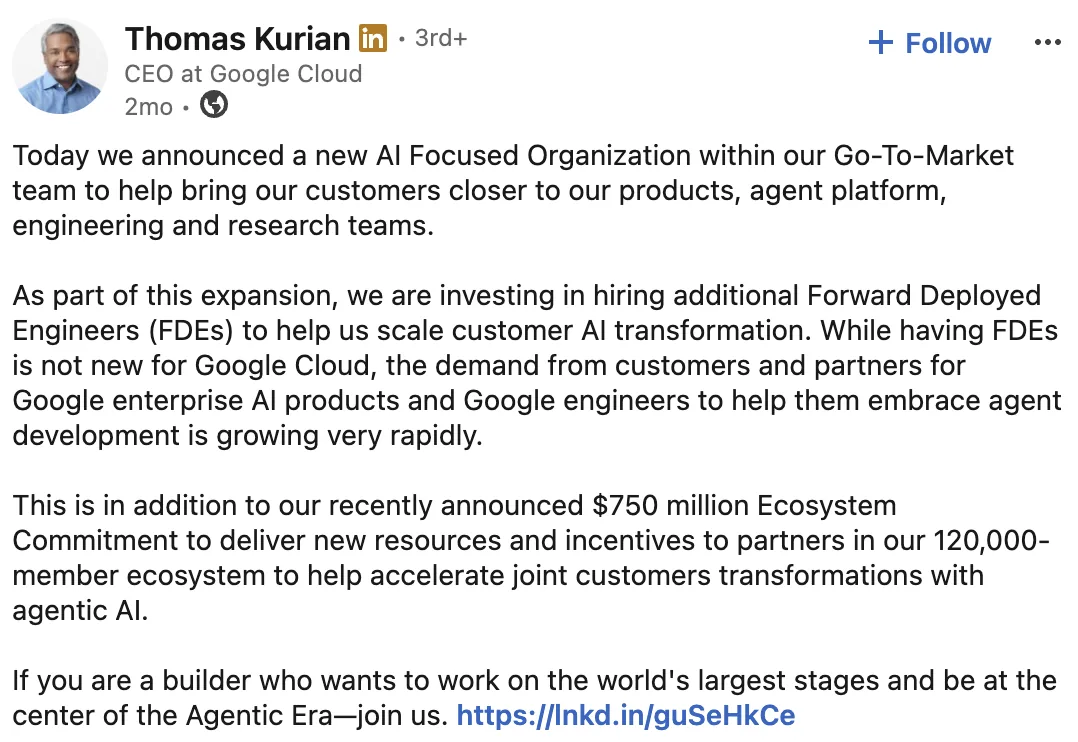
Source: LinkedIn
That is not an isolated case. Salesforce has stated a target near 1,000 forward deployed engineers to staff its Agentforce deployments, while Databricks launched its own FDE organization recently to accelerate customer AI outcomes.
Buying a platform and getting it to work in production are turning out to be two different problems. Vendors are hiring for the gap between them rather than assuming the customer’s own team will close it.
Should You Hire One Right Now?
Whether a company needs a forward deployed engineer isn’t just a yes-or-no question. It comes down to a handful of signals, and they will not always point in the same direction.
How Tangled Your Legacy Systems Actually Are
Many agent or AI workflow failures happen not in the model itself, but where it meets a company’s existing infrastructure: its data silos, authentication layers, legacy applications, and half-documented internal tools. The more complexity that sits between the AI system and the outcome it needs to produce, the stronger the case for embedded engineering rather than a standard platform rollout.
Whether Your Workflow Can Be Fully Specified Up Front
Some processes can be written down cleanly enough that a vendor’s implementation team can build against the spec without ever sitting inside the business. Others can’t, because the people doing the work don’t fully agree on how it happens or the process changes too often to freeze into a document. The second kind of workflow is where an FDE earns their keep.
Whether Anyone Owns the System After Go-Live Today
A working pilot and a system someone is accountable for in production are different things. If a company can’t answer who owns an AI system’s failures six months after launch, that’s usually a sign the delivery model, not the technology, is the actual gap.
What It’s Actually Costing You Not to Close That Gap
A 2024 RAND report noted that, by some estimates, more than 80% of AI projects fail. Gartner’s survey of 782 infrastructure and operations leaders found only 28% of AI use cases fully succeed and meet ROI expectations. Whatever a stalled pilot is already costing in wasted engineering time and unmet expectations, that’s the number worth weighing against the price of embedded delivery.
Concluding Thoughts
Put the pieces together, and the picture is fairly clear. The skill set this role demands is rare, the companies chasing it now span AI labs, consulting firms, and enterprise software vendors alike, and the signal for whether your own company needs it comes down to legacy complexity, unspecifiable workflows, and unclear ownership after launch.
For many companies, the honest answer is that they need what a forward deployed engineer delivers without wanting to run a six-month search for someone with this exact mix of skills, or without having to build and staff the function from scratch. That’s where a nearshore delivery partner tends to fit better than a direct hire.
At GAP, our engineers work embedded inside client teams with exactly the accountability this role is supposed to carry, full-stack range, the judgment to push back on a client’s ask, and ownership that extends well past go-live.
If you’re weighing whether your company needs this kind of embedded engineering, GAP’s team can help you think through where it fits. Talk to us.