
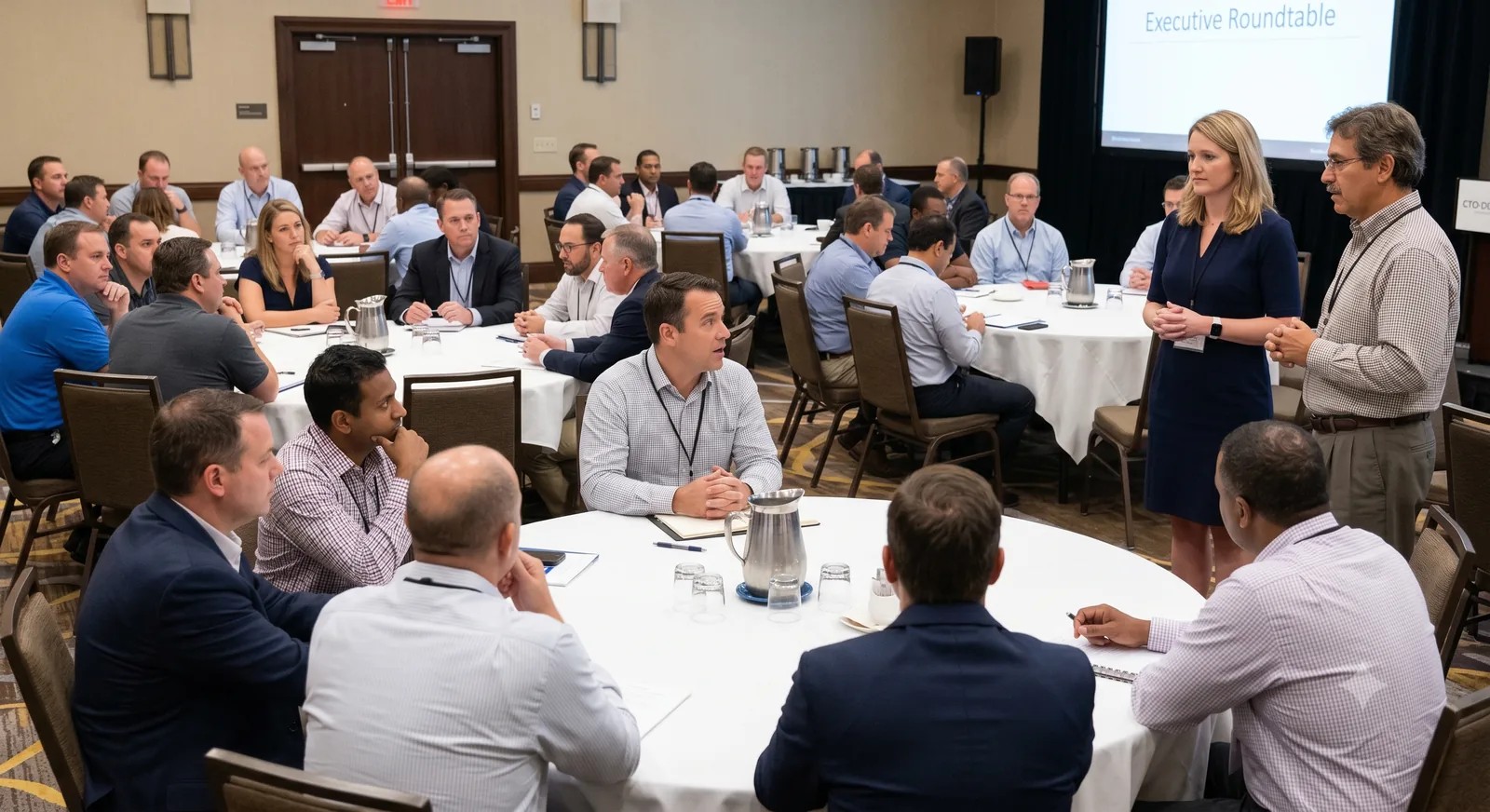
At a recent CTO event in New York City, technology executives across healthcare, wealth management, consumer media and private equity gathered to compare notes on artificial intelligence.
While the public AI narrative remains dominated by flashy agentic demos and claims of automated workforces, the conversation behind closed doors among operating leaders was radically different.
The consensus from the front lines of business execution revealed five hard truths about the current state of AI adoption:
- Nobody can prove AI ROI yet. Organizations can measure hours saved per task, but no one has successfully rolled those operational micro-efficiencies into a credible top-line revenue or EBITDA metric.
- Headcount is not going down. AI is driving capacity and execution speed, not role elimination. In fact, several leaders reported that expanding technological surface areas have actually increased their headcount.
- Quality Assurance (QA) is the ultimate bottleneck. Generative speed has increased tenfold, but verification speed has not. Back-office process automation is delivering measurable wins, but core software engineering delivery remains constrained by testing and validation.
- Process debt beats tool debt. Speeding up an inefficient or flawed business process simply drives an organization in the wrong direction faster.
- Model churn is an architecture problem. To avoid vendor lock-in and unpredictable API token consumption, leaders are hand-building custom “harnessing layers” to isolate their core products from frontier models while balancing cost, governance, and quality.
From Peer Consensus to Production Strategy
At Growth Acceleration Partners (GAP), these findings validate what we see every day in our work with mid-market enterprises and private equity portfolio companies.
Real enterprise AI transformation is not a technology project — it is a fundamental business challenge. Deploying LLMs or distributing AI software licenses does not automatically generate business value. Real transformation pairs high-level strategy with hands-on engineering to reinvent how your products, processes, and people deliver value.
Here is how operating leaders can turn key takeaways into actionable, production-grade strategy:
1. Shift from Selling Headcount Reduction to Building Scale & Capacity
Many vendors pitch AI as a headcount reduction mechanism. However, experienced CTOs reject this framing because real-world value shows up in speed, output quality, and expanded capacity.
When we partner with organizations through our Engineering Process Overhaul and Forward Deployed Engineers (FDEs), our objective is to multiply delivery capacity by 2x to 4x. By embedding AI-proficient engineers and automated delivery pipelines directly into your workflows, your team can execute complex product backlogs and clear technical debt without inflating internal headcount.
2. Solve the QA Bottleneck First
If your AI capabilities generate thousands of lines of code or content per day, but your validation processes remain manual, you have not accelerated delivery—you have simply shifted the bottleneck.
Automated testing and QA are among the highest-leverage investments an enterprise can make. At GAP, we eliminate this bottleneck through our QA Center of Excellence and automated testing frameworks. By combining deterministic validation gates with procedural quality automation, we ensure high-speed generation is backed by high-speed verification.
3. Eliminate Process Debt Before Applying Automation
Automating a broken workflow does not fix the underlying operational friction; it merely accelerates failure.
Through our Business Process Automation (BPA) framework, GAP diagnoses how work actually moves through finance, sales, operations, and HR. We use task-level discovery to pinpoint exact operational friction — eliminating or redesigning bad processes before automating anything. From there, we apply the right tool for the job: reserving AI reasoning for complex judgment tasks and using deterministic software for exact, predictable execution.
4. Architect Against Model Churn and Cost Volatility
Relying on a single frontier model leaves your business vulnerable to API price swings, vendor lock-in and unpredictable performance. Frontier models change rapidly, and hand-coding applications directly to a single provider practically guarantees technical debt. Betting your enterprise on a single frontier model also exposes you to unpredictable token costs and model drift.
GAP solves this architectural challenge through our SaaS to Agentic Evolution and AI & Data Readiness frameworks. We build model-agnostic harnessing layers equipped with validation gates, prompt-injection controls, and cost arbitration. This isolates your software logic from model shifts, keeps token spend predictable, and ensures governance remains built-in rather than an afterthought.
5. Establish a Credible Path to AI ROI
Measuring prompts submitted or licenses assigned is an artificial metric. Real ROI must be proved at the operational level — whether through a faster month-end close, reduced cycle times, accelerated software releases or modernized legacy systems.
GAP bridges the gap between high-level advisory and technical delivery. We partner directly with CTOs, CFOs, CMOs and PE operating partners to establish baseline metrics, execute rapid 90-day production sprints, and deliver auditable business outcomes that compound over time.
From Strategy to Production Execution
Are any of these hard truths hitting close to home for your team? Do these findings match what you’re seeing in the trenches, or is your organization cracking the AI ROI code differently?
Also, how is your executive team bridging the gap between task-level time savings and bottom-line ROI? We’d love to hear how you’re navigating the shift from AI pilots to production execution. Because one big takeaway from NYC is clear: the era of speculative AI pilots is over, and the era of production-grade execution is here.
Whether you are modernizing legacy applications, transforming business processes, or preparing your engineering teams for agentic software delivery, GAP brings strategic consulting and deep engineering execution together under one roof. We don’t just advise on AI — we engineer the workforce, capabilities and architecture that drive it.
Ready to turn AI ambition into measurable business impact and real ROI? Let’s have a conversation.