
Your healthcare AI model cleared validation. Its performance looked strong, the pilot produced the expected results and stakeholders saw enough promise to start talking about production. Then the environment changed. The model had to work with information coming from multiple systems instead of a controlled dataset. It had to operate inside existing clinical and administrative workflows. Identity and access controls became part of the equation. Latency started to matter, outputs moved downstream into other applications and edge cases multiplied.
This distinction between validation and production is becoming increasingly important for healthcare AI leaders. In a 2025 request for public comment focused on AI-enabled medical devices, the U.S. Food and Drug Administration (FDA) noted that retrospective testing and static benchmarks can establish a performance baseline but are not designed to predict behavior in dynamic, real-world environments. The agency is examining how real-world performance can be monitored after deployment, including changes in inputs and outputs that could signal performance drift. Source: FDA — Measuring and Evaluating AI-Enabled Medical Device Performance in the Real World
The FDA discussion applies specifically to AI-enabled medical devices, but the engineering problem extends beyond regulated devices. A successful AI model is not the same thing as a production-ready AI system. Model validation can tell you whether an AI capability performs as expected under defined conditions. Production readiness asks a broader question: Can the entire system continue to behave reliably when those controlled conditions disappear?
The Pilot Tested the Model. Production Tests the System.
AI pilots are constrained by design. Teams reduce variables to determine whether an idea is technically feasible and worth pursuing. They may limit the dataset, narrow the use case, control who has access or manually resolve exceptions that would otherwise interrupt the experiment. Those constraints are useful because they help answer whether an AI capability can work. Production introduces a different problem: whether that capability can keep working as part of the organization’s actual technology and operational environment.
That distinction matters in any enterprise AI implementation, but healthcare adds particular complexity. A production healthcare AI system may consume information from an EHR, retrieve clinical or operational data through APIs, interact with FHIR resources, apply organizational access policies and send its output into another application or workflow. The model is only one component in a chain that includes source systems, data transformations, integrations, applications, users and downstream actions.
A model can therefore perform correctly while the overall system still produces an unreliable result. The wrong context could be retrieved, an upstream source could provide incomplete information or a mapping between systems could change the meaning of a field. An authorization rule could behave differently than expected. An AI-generated output could be technically valid but arrive too late to be useful or a downstream application could process it in a way the AI team never evaluated.
None of those scenarios necessarily means the model failed. They mean the system around the model did. That is why production readiness has to extend beyond model performance.
Model validation and system validation consequently answer different questions. Model evaluation asks whether outputs are sufficiently accurate for the intended use, how the model performs against an appropriate evaluation dataset and where its performance falls below acceptable thresholds. System validation has to ask whether the model received the right information in the first place, whether that information was current and complete enough for the workflow, whether permissions survived the interaction, what happens to the output after inference and whether the organization can reconstruct an unexpected outcome afterward.
These are not simply more model tests. They are tests of the production system in which the model participates.
Healthcare Data Is Part of the System’s Behavior
A controlled AI pilot can work with a well-defined dataset. Production healthcare environments rarely have that luxury. Relevant information may live across EHRs, claims platforms, laboratory systems, operational databases, third-party applications and legacy infrastructure. Even when organizations use standards such as HL7 FHIR to exchange information, standardization does not make every production environment identical.
The FHIR specification explicitly supports profiles, implementation guides, extensions and terminology bindings that allow the standard to be adapted to particular contexts and requirements. That flexibility is necessary because healthcare environments differ. Source: HL7 — FHIR Profiling
This variability introduces an important production concern: drift. Drift occurs when the conditions under which an AI system operates begin to differ from those used to develop or validate it. Data drift occurs when the characteristics or distribution of incoming data change. Concept drift occurs when the relationship between inputs and the outcome the model is intended to predict changes. At the broader system level, system drift can occur when changes to integrations, data transformations, APIs, retrieval logic or downstream workflows alter the behavior of the AI-enabled system, even when the model itself has not changed.
In healthcare, these forms of drift can overlap. A new EHR configuration may change the structure or availability of incoming data. A change in clinical or operational practice may alter the relationship between that data and the outcome of interest. An integration update may change how context is provided to the model or how its output is consumed. As a result, production requires teams to monitor not only whether the model changes, but also whether the environment around it changes in ways that can affect system behavior.
The interoperability challenge is visible in current hospital data. According to an ASTP/ONC analysis of the 2024 American Hospital Association Annual Survey Information Technology Supplement, most hospitals were exchanging clinical data between their EHRs and third-party technologies, but that exchange continued to rely substantially on approaches other than standards-based APIs. Source: ASTP/ONC — Hospital Use of APIs to Enable Data Sharing Between EHRs and Third-Party Technology
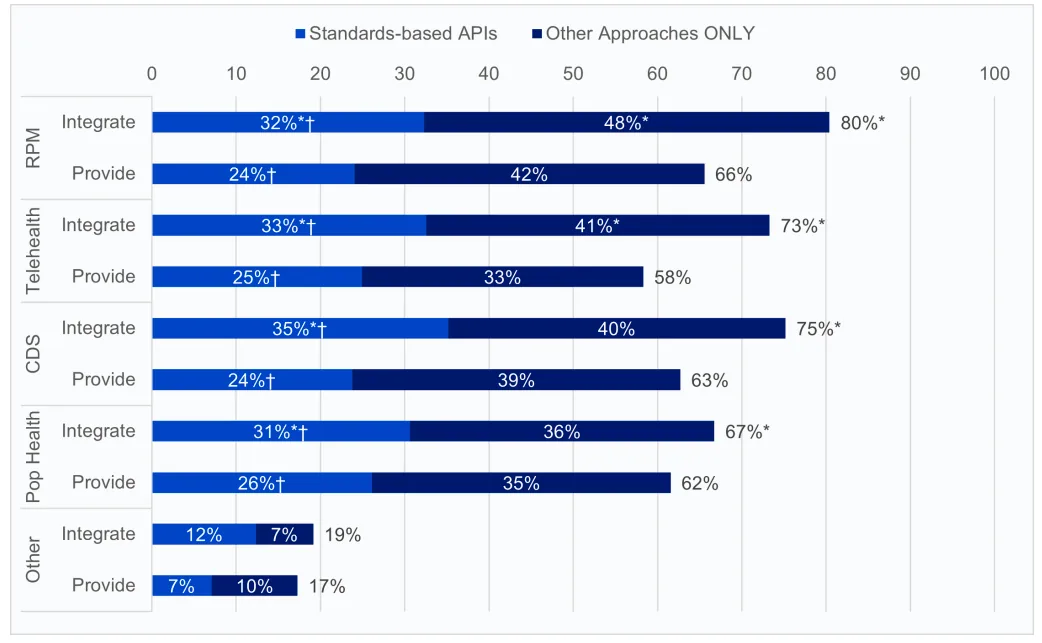
Hospital data exchange with third-party technologies continues to rely heavily on non-standards-based approaches. Source: ASTP/ONC, 2024 AHA Annual Survey Information Technology Supplement.
For an AI system, however, this has an important implication: the model can remain unchanged while the structure, completeness or semantics of the information reaching it change across environments or over time.
Imagine an AI application that performs well during validation but receives incomplete context through one production integration. The model hasn’t changed; its inputs have. That is a form of drift that may not appear as a conventional model failure. The production question, then, isn’t only whether the model performs correctly. It is whether the organization can trust the pathway that supplies the context the model needs to perform correctly and detect when that pathway begins behaving differently.
That makes data mappings, provenance, freshness, completeness and integration behavior part of AI production validation rather than infrastructure concerns that can be considered separately from the model. GAP has seen firsthand the importance of healthcare interoperability. In its work with AristaMD, for example, GAP developed an API based on FHIR resources to make the company’s telehealth application easier to integrate with other systems while supporting healthcare industry requirements.
These concerns also connect production readiness to established MLOps and AIOps practices. MLOps provides operational practices for versioning, evaluating, deploying and monitoring models and the data pipelines that support them. AIOps brings additional operational visibility across the broader technology environment, helping teams identify anomalies, integration failures and infrastructure changes that may affect an AI-enabled workflow. In healthcare AI, both perspectives matter because production behavior depends not only on the model, but also on the data, integrations and operational systems surrounding it.
AI makes this familiar integration challenge more consequential. Traditional applications generally execute predefined logic against the information they receive. AI systems use context to generate, classify, summarize or recommend. When system behavior depends on that context, the data pathway becomes part of the behavior of the AI system itself. Monitoring for drift therefore needs to extend beyond model-level metrics to the systems and workflows that shape what the model receives and what happens to its output.
The same principle applies after inference. An AI output rarely represents the end of a healthcare workflow. A clinician might review generated information, an administrative staff member might act on a classification, another software component might consume structured output or an automated workflow might trigger the next step. Production validation therefore needs to follow an AI output beyond the moment the model generates it.
Consider two systems that achieve the same performance against an evaluation dataset. In the first, uncertain cases are identified and routed to an appropriate person for review. In the second, outputs move directly into a downstream process without an equivalent intervention point. Model performance may be identical, but system-level risk is not. The relevant unit of validation can therefore extend from the model output to the entire pathway from input and context through model behavior, human or system action and eventual outcome.
Production-Ready AI Has to Be Designed for Failure
Traditional software engineering already assumes systems will encounter failure. Services time out, APIs become unavailable, databases lose connections and inputs fail validation. Mature systems define what should happen under those conditions rather than assuming they will never occur.
AI requires the same discipline, but some failures are harder to detect. An AI system can return an answer that is syntactically valid and technically successful while still being inappropriate for the situation. There may be no conventional application error telling the engineering team something went wrong.
Production readiness therefore requires explicit boundaries around AI behavior. Teams need to know what happens when required context is missing or unreliable, which outputs can move downstream automatically, what conditions require human review, how users can override an AI-generated result and whether the underlying workflow can continue safely when the AI component is unavailable. They also need enough traceability to investigate unexpected outcomes and understand which inputs, components and versions were involved.
This approach aligns with the broader risk-management principles in NIST’s AI Risk Management Framework. NIST treats ongoing testing and monitoring as part of evaluating whether deployed AI systems continue to function as intended and recognizes human intervention as one mechanism organizations may need when an AI system cannot detect or correct errors on its own. Source: NIST — Artificial Intelligence Risk Management Framework (AI RMF 1.0)
The objective, then, isn’t to create an AI system that can never fail. It is to engineer the surrounding system so it can recognize, contain and respond appropriately when failure occurs. An AI failure should not automatically be treated as a system failure.
The appropriate boundaries will depend on the use case. An AI system helping categorize administrative documents and one influencing a clinical workflow should not necessarily have the same escalation paths or controls. Production readiness needs to reflect the consequences of failure, not simply whether AI is involved.
Production Readiness Doesn’t End at Launch
Even a system that is thoroughly evaluated before deployment will not remain static. Models change. Data changes. APIs and upstream applications change. Prompts, retrieval logic and knowledge sources change. Operational workflows evolve and the distribution of inputs reaching an AI system can shift over time.
The FDA is already addressing this issue within the narrower context of regulated AI-enabled medical devices. Its 2025 final guidance on Predetermined Change Control Plans recommends that manufacturers describe planned modifications together with the methodology for developing, validating and implementing those changes and assessing their impact. Source: FDA — Predetermined Change Control Plan for AI-Enabled Device Software Functions
Those recommendations apply specifically to devices within the FDA’s scope, but they illustrate a useful engineering principle for healthcare AI more broadly: change should trigger evaluation, not simply deployment.
For AI teams, that means production readiness cannot be treated as a gate the system passes once before launch. It has to become a property the engineering organization maintains. A model update may require evaluation, but so might a meaningful change to retrieval logic, an EHR integration, a data transformation, a prompt or a downstream workflow. The relevant question is not simply whether the model changed, but whether something changed that could materially affect the behavior or consequences of the system.
The same system-level thinking should shape monitoring. Infrastructure observability can tell teams whether a service is available, how long a request took or whether an API returned an error. Model monitoring adds performance and input or output drift. But neither necessarily tells leaders whether the complete AI-enabled workflow continues to behave as intended.
A production healthcare AI system may also need visibility into whether particular integrations are generating more exceptions, whether human overrides are increasing, whether behavior changed after a prompt or retrieval update or whether downstream outcomes are shifting even though model-level metrics appear stable. The purpose isn’t to create more dashboards. It is to detect when the assumptions that made the system acceptable during validation no longer hold in production.
This is also consistent with the FDA’s exploration of real-world performance for AI-enabled medical devices, which includes identifying approaches for detecting and managing performance drift after deployment. Source: FDA — Measuring and Evaluating AI-Enabled Medical Device Performance in the Real World
A Better Definition of Production Ready
For healthcare AI leaders, this requires changing the definition of done. “The model passed validation” should not automatically mean “the system is ready for production.” A stronger production-readiness review examines the complete pathway around the model.
That starts with the context the AI receives. Teams should understand where information originates, how it is transformed and whether it is current, complete and authorized for the intended workflow. Integrations should be evaluated not only when everything works as expected but also when upstream systems return delayed, incomplete or inconsistent information.
Validation should then follow outputs downstream. Teams need to understand who or what acts on AI-generated information and what happens when an output is wrong, ambiguous or unavailable. Failure behavior, escalation paths, human intervention and safe degradation should be defined before launch according to the potential consequences of the use case.
Organizations also need enough traceability to reconstruct unexpected behavior and determine which inputs, integrations, model versions or application changes were involved. An evaluation cannot end with the model. Meaningful changes to prompts, retrieval systems, data sources, integrations or workflows may also require reassessment if they can alter system behavior.
Taken together, these practices create a more useful definition of production readiness: the system can operate within defined boundaries, detect when important assumptions no longer hold and respond appropriately when real-world conditions differ from those used during validation.
For a CDAO or VP of AI, that changes the leadership question from “Did the model work?” to “What has to be true around this model for us to trust the system in production?”
Answering that question requires collaboration beyond the AI team. Data engineering needs to understand how context reaches the system. Software and platform engineering need to design integrations and failure behavior. Security teams need to evaluate identity, permissions and PHI boundaries. Product and operational leaders need to understand downstream workflows. AI teams need evaluation and monitoring that continues after deployment.
The goal isn’t to add bureaucracy between pilot and production. It is to identify production requirements early enough to engineer for them deliberately instead of discovering them one at a time during deployment.
For readers interested in the organizational side of the same challenge, GAP’s existing article From Pilot Purgatory to Production explores the business case, clinical champions and data governance issues that can prevent healthcare AI initiatives from scaling.
A Model Can Pass. The System Still Has to Prove Itself.
Healthcare AI doesn’t become production-ready simply because a model reaches an acceptable performance threshold. Production introduces a larger unit of responsibility. Data has to arrive with the context the system expects. Integrations have to behave under imperfect conditions. Failures need boundaries. Humans need appropriate intervention points. Downstream behavior needs to be understood. Meaningful changes need to trigger evaluation. And teams need enough visibility to recognize when the system begins behaving differently from what they intended.
That’s why a successful AI model is not the same thing as a production-ready AI system.
Organizations that recognize that distinction can shift production readiness upstream, designing and testing the complete system rather than trying to wrap production controls around a successful model after the fact.
GAP helps healthcare organizations bridge that gap by combining AI expertise with the data, software, cloud and integration engineering required to move AI into real operational environments.
For teams preparing to move beyond validation, an AI Production Readiness Assessment can help identify what’s missing between a model that works and a system that’s actually ready to operate.