
Forward deployed engineer is one of the fastest-growing job titles in tech right now, and perhaps one of the most argued about.
Over the past year, demand for the role has climbed by several hundred percent. Frontier AI labs are hiring for it aggressively, while the title has spread into consulting firms and enterprise software vendors.
The scepticism has grown just as quickly. To many people, the role looks like consulting with better packaging, or an existing customer-facing position with a new title attached to it.
“Forward-Deployed Engineer” is just a fancy new name for a high-paid consultant who can code. Change my mind.
Saw a report that ‘Forward-Deployed Engineer’ roles are up 800% because companies can’t integrate GenAI. Palantir tried this years ago. Is this a real specialized role or just another buzzword to make senior devs do customer support and sales demos? Seems like a great way to hit your dev velocity with “client meetings.” Thoughts?
That is why the same questions keep coming up: what exactly is a forward deployed engineer, why is the role suddenly in demand, and does it live up to the hype?
To answer them, it helps to start with where the role came from.
Where the Forward Deployed Engineer Role Comes From and Why Postings Are Suddenly Everywhere
Palantir is widely credited with creating the forward deployed engineer role. The data analytics company, founded in 2003 to help US intelligence agencies make sense of fragmented data, needed a different way to build software for its earliest customers.
The usual model did not work. Palantir could not ask an intelligence agency to write a complete specification, take it back to an engineering team, and return months later with a finished system. The data was highly sensitive, the existing systems were complex, and much of the work was difficult to explain without seeing it firsthand.
So Palantir sent engineers into the customer’s environment. They worked alongside analysts and operators, watched how the job was actually done, and adapted the software around what they learned.
That was the original logic behind forward deployed engineering: put the person writing the code close enough to the customer to understand what really needs to be built.
For years, that model was closely associated with Palantir and a relatively small number of complex deployments. Then AI gave far more companies the same problem.
An AI system can work perfectly well in a demo and still fail inside a real business. It has to connect with old software, inconsistent data, access controls, and processes that may never have been properly written down. These are not problems that can always be solved through a few discovery calls and a requirements document.
Someone has to work inside the environment, see where the deployment is getting stuck, and change the system as those problems emerge.
That is why companies are suddenly looking for engineers who can do more than build the technology. The hiring numbers reflect that shift. One analysis found that FDE postings rose by 1,165% year over year between January and October 2025.
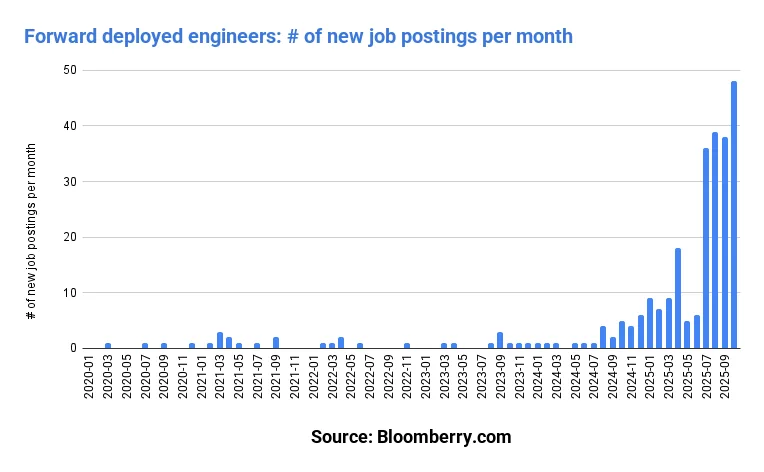
Separate Indeed data reported by Business Insider found that FDE postings rose roughly 729% year over year by April 2026, with companies like Anthropic, OpenAI, and Stripe driving the hiring.
Between May and July 2026 alone, four AI companies committed roughly $9 billion combined to standing up or expanding forward deployed engineering functions, including Anthropic at about $1.5 billion, OpenAI at $4 billion, AWS at $1 billion, and Microsoft at $2.5 billion.
THE FDE WAVE: FOUR COMMITMENTS IN NINE WEEKS, 2026
|
ANTHROPIC
~$1.5B JV + private equity May 4 |
OPENAI
~$4B Deployment Company May 11 |
AWS
$1B dedicated FDE org Jun 30 |
MICROSOFT
$2.5B Frontier Company Jul 2 |
~$9B committed in one nine-week window
Four commitments to embedded AI delivery, May to July 2026. The combined figure is the point: the industry is paying to sit inside the customer.
Source: Building Agentic AI
What’s driving all of this isn’t a shortage of people who can build AI systems. It’s a shortage of people who can get those systems working inside a specific customer’s mess of legacy infrastructure, incomplete data, and unwritten processes.
Half Engineer, Half Consultant, Full Owner
The most useful description of the role floating around the market right now is that a forward deployed engineer is “half engineer, half consultant, full owner”.
The engineer half is straightforward. An FDE writes and ships production code inside the customer’s environment, using the customer’s data, systems, and infrastructure.
On the consultant’s half, an FDE spends a meaningful share of the week in direct conversations with the customer, observing workflows, mapping how work gets done, and asking important questions.
The owner part means responsibility does not end at go-live. An FDE remains accountable for whether the solution works, whether people use it, and whether it produces the intended result.
That is where the role begins to differ from an advisory-first engagement.
What a Forward Deployed Engineer Does All Week
The day-to-day underneath that model tends to look less like traditional engineering and more like a rotating set of context switches.
One part of the day may involve tracing a data-quality issue through a production pipeline. Another may involve interviewing operations staff, reviewing an API with the customer’s engineers, or changing the scope because the original workflow turns out to be different from the one described during procurement.
The table below sets out how that changes the shape of the engagement compared with a traditional consulting model.
| Dimension | Traditional advisory-first engagement | Forward deployed engineering |
| Who does the discovery | A partner or senior consultant, often without writing code | The same engineer who later builds the system |
| What gets delivered | A strategy document or architecture recommendation | A working system running against the client’s own data |
| Accountability when it fails | Diffused across a sales team and a separate delivery team | Held by the person or team that scoped it and built it |
| Tooling | Often whatever the consultancy already sells | Whatever fits the client’s actual constraints |
| When the engagement ends | After the recommendation, implementation or agreed delivery period | Once the system is running and the client’s team can maintain it |
Why Advisory-Only Delivery Keeps Failing to Ship
None of this would carry much weight if moving from an AI strategy to a working deployment were straightforward. The evidence suggests it is not.
RAND found that more than 80% of enterprise AI projects fail to deliver the business value they were sold on. Gartner’s own April 2026 survey of infrastructure and operations leaders arrived at an equally blunt number: only 28% of AI use cases fully succeed and meet ROI expectations.
These numbers do not prove that every failed project needed a forward deployed engineer. They do show how large the gap can be between selecting an AI use case and integrating it successfully into an organisation.
BCG describes successful AI transformation as roughly 10% algorithms, 20% technology and data, and 70% people and processes.
The point is not that the technology is unimportant. It is that much of the work begins once the model meets the organisation around it.
That is where an embedded engineer changes the delivery model. When a plan collides with messy data, unclear ownership, or a workflow that behaves differently in practice, they see it happen in real time.
More importantly, they can change what is being built in response rather than documenting the problem for another team to resolve later.
Concluding Thoughts
The forward deployed engineer title may feel new to many companies. The discipline behind it, though, is not.
Companies have always needed senior engineers who can understand a client’s problem, build inside the real environment, and stay accountable for the result.
That is why an advisory-only model is often no longer enough. Someone has to stay close enough to the work to find the right answers while building, and technical enough to act on what they find.
At GAP, our engineers work embedded directly inside client teams from day one, through a nearshore delivery model built around exactly that kind of accountability.
If you’re weighing whether your organization needs this kind of embedded engineering or a partner who already delivers it this way, our team can help you work out where it fits before you commit to a hire.