

The average data breach in 2025 took 181 days to identify, and another 60 days to contain once it was found (a total lifecycle of 241 days), according to IBM. Organisations spent roughly six months just figuring out whether a breach had happened at all.
The same report put the global average cost of a breach at $4.44 million, and found that breaches taking longer than 200 days to contain cost over a million dollars more than the ones caught within 200 days.
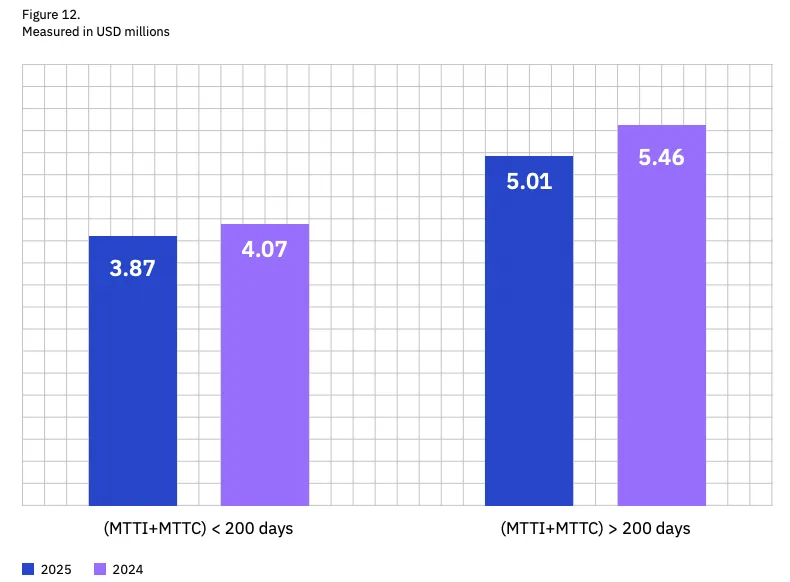
Source: IBM
In other words, the longer it takes to notice that something is wrong, the more expensive the problem becomes.
But noticing problems requires visibility into what is happening across your systems. This explains why terms like security and observability keep getting mentioned in the same breath.
This piece explains both concepts plainly and walks through why they’ve become so hard to separate.
What Is Observability?
Observability is the ability to understand what’s actually happening inside a system from the outside, without already knowing where to look.
In practice, that understanding usually comes from three kinds of data that systems emit as software runs, commonly called the three pillars of observability:
- Metrics are numbers tracked over time, like requests per second or error rate.
- Logs are a record of individual activity, like “user X logged in” or “payment failed.”
- Traces are the step-by-step path a single request took as it moved through a system.
Together, these let a team answer questions like “why did this break” or “why did this get slow” after the fact, rather than needing to have predicted the exact failure in advance.
What Is Security Monitoring, and How Is It Different?
Security monitoring exists to answer a different question using much of the same raw material: not “why did this break,” but “did something happen here that shouldn’t have?”
That could mean someone logging in from an unusual location, a piece of software accessing data it has no reason to touch, or a spike in requests that looks more like an attack than normal customer traffic. The tools built specifically for this job, often called SIEM or security information and event management systems, are designed to flag exactly that kind of abnormal pattern and alert a security team before it turns into a breach.
Security Observability: Where They Meet
Security and observability aren’t really two separate pipelines bolted together. Both depend on visibility into what a system is doing, although they use that visibility to answer different questions.
The point where those two disciplines overlap is called security observability.
Security observability is the ability to understand the security-relevant state of a system using its metrics, logs, traces, and other telemetry, rather than relying only on predefined rules built to catch known threats.
Traditional security tools are built to flag recognised patterns: a login from a blocked country, for example, or a file matching a known malware signature. Security observability goes further, giving teams enough raw visibility to investigate behaviour that does not fit neatly into an existing rule, connect events across different systems, and understand how an incident unfolded.
That distinction matters because of how attacks happen now. Many intrusions do not trip one obvious alarm. They may involve legitimate but stolen credentials, a slightly unusual sequence of actions, and movement across several systems that no individual threshold was designed to catch.
Security observability is what lets a team piece that sequence together after the fact, or catch it while it’s still happening, using the same underlying telemetry an operations team already relies on to keep a system running.
Signs Your Organization Has One Without the Other
A few practical signs tend to show up when a company has invested in one side of this without the other:
Whether a Simple Question Has a Fast Answer
A well-instrumented organization can answer a simple question in minutes: what did a given system, or AI agent, do yesterday? Without that instrumentation, the same question usually means pulling an engineer off other work to dig through scattered logs, assuming the information was even being kept in a usable form at all.
Where Incidents Actually Get Discovered
Strong observability makes it more likely that an organisation will catch problems internally, through an alert or routine investigation. Without it, the first warning may come from a customer complaint, a finance report showing unusual charges, or a regulator, well after the fact.
Whether Security and Engineering Look at the Same Data
If a company’s security team and its operations or engineering team run on entirely separate tools that were never designed to talk to each other, that’s usually a sign the organization has monitoring in the narrow sense, but not the shared visibility that security observability is built to provide.
Why More Tools Usually Make This Worse
The instinctive fix for a visibility gap is to buy another tool. The reality is it rarely works, and often makes the underlying problem harder to solve.
Here’s what we mean: Many engineering teams already run several monitoring and security tools, each with its own bill, dashboard, and alerting rules. When the same event is detected by three of them, it can produce three separate alerts that someone has to reconcile manually.
That is one way alert fatigue develops. When a team is flooded with notifications that mostly turn out to be harmless, people naturally start deprioritising them. Real problems can then disappear inside the same stream of low-value alerts.
The waste runs in the other direction too. Teams may collect huge volumes of telemetry without consistently connecting it across systems or using it during investigations. The problem, then, is not always that a company collects too little data. It is often that the data is fragmented, duplicated, and poorly correlated, which is an expensive way to remain blind.
Why This Matters More Now, With AI in the Mix
AI systems raise the stakes on this gap.
An AI agent that can call APIs, query internal data, and take action independently can create a more complex trail of activity than a traditional application, especially when its work spans several systems. Without security observability built in from the start, a company may struggle to tell whether its behaviour on a given day was normal or a sign that something had gone wrong.
IBM’s report also found that 60% of organizations had already experienced a data compromise linked to AI supply chain or model-related attacks, a lot of it traced back to exactly that blind spot.
The upside is just as concrete. Organizations using AI extensively in their own security operations cut their average breach lifecycle by 80 days and saved about $1.9 million compared with those relying on manual detection.
What Good Security Observability Looks Like
The signs above describe the gap. It’s worth being just as clear about what it looks like when a company has closed it.
The Same Data, Not Just a Shared Policy
When a company gets this right, security and engineering don’t just agree to work together; they look at the same dashboards and the same data. Nobody has to ask the other team for an export, open a ticket, or wait for someone to send a screenshot. Both teams already know where the data is and how to use it.
Open Investigation, Not Just Predefined Alerts
Predefined alerts only catch what someone thought to predict in advance. Good security observability means a team can start with an open-ended question, like “Something about this account looks wrong, but why?” and follow the trail through the actual telemetry until they have an answer, rather than being limited to whatever a rule was written to flag months earlier.
Instrumentation That Ships With the System
The clearest marker of maturity is timing. In a well-run organisation, logging, tracing, and security instrumentation are part of what it means for a system to be finished. Nobody has to circle back later and bolt visibility onto something that’s already live and already being trusted with ongoing work.
Concluding Thoughts
Security and observability are separate disciplines, but they depend on the same underlying visibility into a system. They ask different questions of the same telemetry: one focuses on reliability and performance, while the other focuses on risk, misuse, and threats. Security observability sits at the point where those questions meet.
A company that has one without the other tends to discover the gap at the worst possible time, mid-breach, mid-outage, or both at once.
At GAP, we build observability and security into the systems we design and modernize from the start, rather than treating either as something to bolt on once an AI system is already running in production. When a team cannot confidently explain what an AI system did last week, that is usually the first visibility gap worth closing.