

Getting an agent up and running has never been easier. Off-the-shelf platforms, agent frameworks and foundation models have lowered the barrier to entry, putting a first deployment within reach of almost any organization.
The challenge starts when that agent has to operate inside a real business. It needs access to company data, connections to existing systems and enough reliability to support day-to-day workflows.
That is where many projects stall, and where companies often discover that building an agent is very different from deploying one successfully.
For mid-market organizations, the gap is particularly difficult to close. They are often large enough to have complex processes and fragmented systems, but not large enough to maintain specialized teams focused on AI infrastructure, governance and integration.
Recent research by RSM found that generative AI adoption had reached 91% among middle-market firms, yet many still lacked the in-house expertise needed to realize the full value of those systems.
As a result, many turn to external development partners. The difficulty is that most providers describe themselves in remarkably similar terms, making it hard to separate genuine delivery capability from marketing.
This article examines what mid-market companies should look for in an agentic AI development partner and highlights the firms that stand out for helping organizations move beyond pilots and into production.
What Agentic AI Development Services Cover
Agentic AI development is the work of building systems that can pursue goals and take actions to achieve them.
In practice, that means designing the orchestration that coordinates an agent’s steps, connecting it to the right tools and data, integrating it with existing business systems and putting the evaluation and governance in place needed to operate reliably.
This is different from buying an agentic AI platform. These platforms are prebuilt products designed for common use cases such as customer support or sales assistance. When your requirements align closely with what the platform already offers, they are often the fastest and most cost-effective option.
Development services come into play when the work is more specific.
For example, an organization may need an agent to interact with proprietary data, span multiple internal systems, follow unique business processes or operate under strict governance requirements. In those situations, the challenge is designing and building a system around the way the business already works.
That is typically the point at which companies begin looking for a development partner rather than another AI platform.
What’s Driving Demand for Agentic AI Partners in 2026
Several forces are pushing companies beyond experimentation and toward specialist development partners:
Turnkey Tools Are Reaching Their Limits
The platforms that made agentic AI accessible are excellent at the common case, but limited everywhere else. Once a company needs an agent that reflects its own data, rules and workflows, the configurable product runs out of room and the only way forward is a system built for the specifics. That is the wall most mid-market teams meet first.
Agents Keep Colliding With Legacy Systems
An agent rarely struggles because of the model. More often, it runs into the systems a business already depends on. This includes internal applications, databases, ERP platforms and years of accumulated workflows. Making those systems work together reliably is a major reason companies seek external expertise.
Companies Are Looking for Outcomes
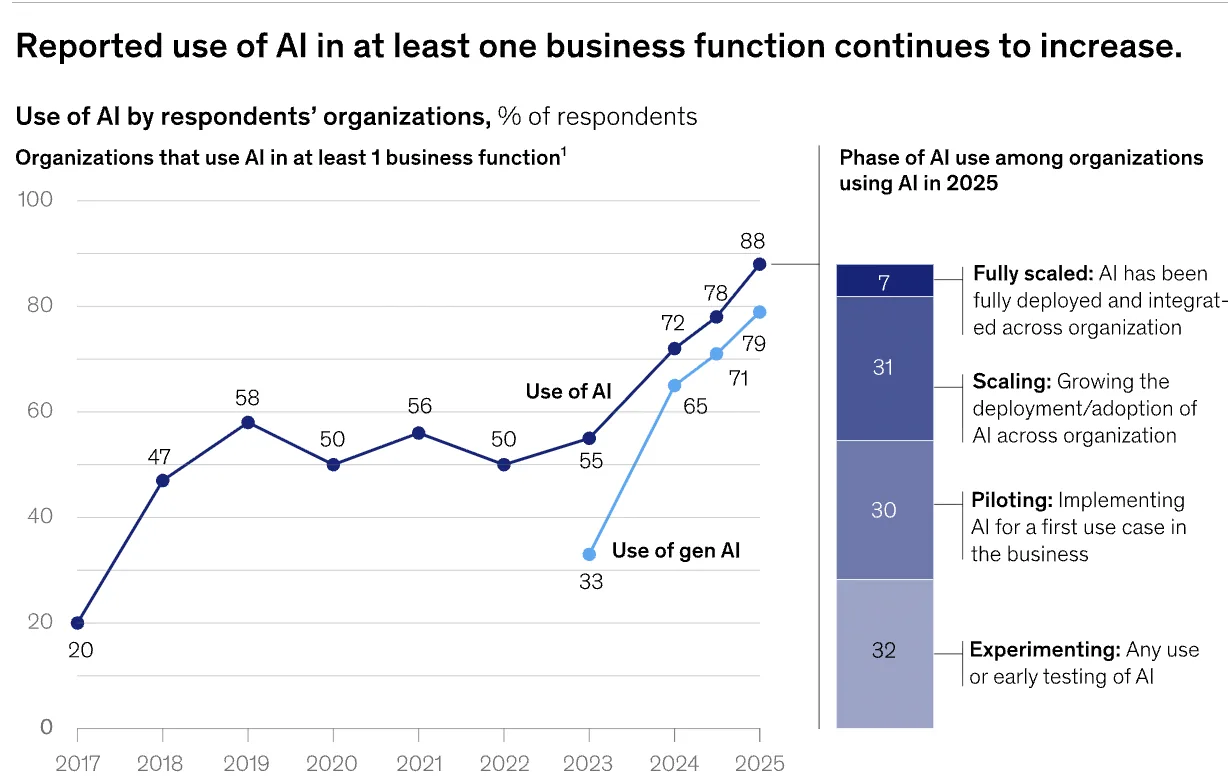
The distance between an agent that performs in a controlled trial and one that holds up under real conditions is wide. McKinsey found that 88% of organizations now use AI in at least one business function, yet only around a third have begun scaling it across the business. That gap is driving demand for partners with experience taking AI systems into production.
Source: McKinsey
Senior AI Engineering Is Hard to Hire
The talent needed to build production agents is scarce and expensive to recruit directly. Rather than compete for it on the open market, mid-market companies are reaching for partners who already have those engineers, which is a large part of why nearshore delivery has become the default route.
What to Look for in an Agentic AI Development Partner
Once you’ve decided external help makes sense, the next question is how to evaluate potential partners. Here are a few important criteria:
A Track Record of Reaching Production
The strongest signal is evidence of agents running inside real businesses rather than a portfolio of prototypes. Look for firms that can explain how they test, evaluate and support systems after deployment, not just how they build them.
Genuine Agentic Expertise
Building agents is its own discipline, distinct from general AI or data science work. A capable partner should be able to demonstrate experience with agent orchestration, tool use, planning, memory and other patterns that allow autonomous systems to operate reliably over time.
Strong Integration Capabilities
Because most mid-market agents have to work against systems that predate them, a partner’s ability to modernize and integrate with existing software often matters more than the sophistication of the underlying model.
A Delivery Model Suited to Mid-Market Teams
Enterprise consultancy rates and structures rarely suit a mid-market program. The better fit is usually a partner offering senior engineering with real-time-zone overlap and cost efficiency, which for North American buyers tends to mean nearshore delivery from Latin America rather than distant offshore teams.
A Practical Approach to Governance
An agent that takes actions on its own needs permissions, auditability and oversight built in from the start. A partner without a clear account of how it handles governance is a risk, since that is exactly where autonomous systems cause damage when they go wrong.
The Best Agentic AI Development Firms for Mid-Market Companies
The firms below stand out for building agentic systems that reach production:
-
Growth Acceleration Partners (GAP)
GAP leads this ranking because it sits exactly where most mid-market agentic projects succeed or fail, at the meeting point of AI and the systems a business already runs on.
The company provides consulting, design, development and modernization for software and data solutions, working with both Fortune 500 companies and growth-stage businesses.
GAP acquired the Application Migration Business Unit of Mobilize.Net in 2023, gaining proprietary tools for migrating legacy Windows and Java applications to modern platforms, and acquired Mission Data the same year for digital product development.
Since agents fail most often where they meet older systems, that modernization heritage is built for the exact problem mid-market teams run into.
The rest of the fit follows from how GAP delivers. It embeds senior engineers directly into a client’s team through a nearshore model that provides time-zone overlap without enterprise overhead. It also organizes specialists into Centers of Excellence around specific platforms and brings the data engineering depth needed to support production AI systems.
-
CI&T
CI&T is a global digital services and consulting firm with a substantial Latin American presence, offering application modernization, cloud, data and AI, digital product design and managed services, positioned around integrating business strategy, technology and AI across end-to-end engagements.
-
N-iX
N-iX centers on pragmatic software engineering for organizations working with data, AI and cloud, spanning custom engineering, application modernization, cloud platforms, data and analytics, AI implementation and cybersecurity.
-
Gorilla Logic
Founded in 2002 and headquartered in Colorado, Gorilla Logic’s work spans the full software lifecycle, including application modernization, platform and DevOps engineering, quality engineering and AI-enabled product development, delivered through embedded Agile teams with live delivery metrics.
-
BairesDev
BairesDev is a large nearshore provider founded in 2009, with more than 4,000 professionals across 50-plus countries and services spanning custom development, dedicated teams, QA, data and AI, mobile and platform support.
-
Azumo
Azumo is a San Francisco firm built around production AI. Founded in 2016, it delivers through nearshore Latin American teams, with work spanning agentic AI, RAG, generative AI, and MLOps, built on models like GPT, Claude and Llama and deployed on AWS, Azure and Google Cloud for large consumer and enterprise brands.
The Right Partner Matters
Most mid-market companies do not need help proving that agents can work. They need help making them work within the reality of the systems, processes and constraints they already have.
At GAP, our team excels at designing, building and modernizing software and data systems, bringing the engineering depth needed to turn promising AI initiatives into production-ready solutions.
We work across application development, data engineering, cloud modernization, machine learning and AI, allowing agentic systems to be built alongside the infrastructure they depend on rather than in isolation.
Ready to take the next step? Contact a GAP expert to evaluate where agents can create real value for your business.