

On April 23, 2026, ServiceNow had one of its worst trading days, the morning after its Q1 earnings release. Shares fell roughly 17–18% in a single session, triggering a wave of analyst downgrades and wiping tens of billions from its market value in hours.
The convenient explanation, amplified by CNBC and echoed across the trade press, was that conflict in the Middle East delayed several large enterprise deals and shaved roughly 75 basis points off subscription growth.
The numbers checked out, but they didn’t justify a move of that scale. That headwind was a footnote inside a much larger repricing that had already been underway for months.
Across enterprise software, investors have been rotating away from a model that once commanded premium multiples: predictable, per-seat subscription growth.
Not because performance collapsed, but because confidence in the durability of that model has weakened under AI disruption, tighter budgets and slower expansion cycles.
For C-suite leaders, this is the signal. The software stack you already own is being re-evaluated in real time, and that repricing is beginning to influence everything downstream, from vendor negotiations to internal build-versus-buy decisions.
Inside the Sector-Wide Selloff Investors Have Been Calling the SaaSpocalypse
The phrase SaaSpocalypse has been circulating since early February, when Anthropic announced Claude Cowork, an autonomous agent product designed to perform end-to-end business workflows without human supervision. Software stocks lost roughly $285 billion of market value in the day that followed.
The SaaSpocalypse, as traders started calling it, became shorthand for this thesis: that the entire enterprise software business model was about to be repriced on the assumption that AI agents would compress, cannibalize or replace the workflows that traditional software monetizes.
What mattered was not Cowork itself, but what it made easier to imagine. We’re looking at a world where:
- Workflows are executed without adding headcount
- Output scales without a corresponding increase in licensed users
- Software value moves from access to outcomes
That runs directly into the assumption the SaaS model was built on. For decades, enterprise software scaled on a simple equation. A company hires an employee, that employee needs an account, and that account becomes a paid seat. Headcount growth drove license growth. Companies like Workday, Salesforce, ServiceNow and Atlassian built compounding revenue on top of that relationship, and it held consistently enough to support premium valuations.
AI agents do not fit into that equation. They neither require accounts nor appear in headcount systems. A team that replaces part of its workflow with agents reduces the number of seats it needs, regardless of which vendor provides the tooling.
Reading the Exposure in Your Own Software Portfolio
It’s tempting to read the SaaSpocalypse coverage and assume every piece of enterprise software is exposed equally.
The market has been making careful distinctions between software companies whose work an AI agent could plausibly do and those that are protected by regulation, deeply embedded data, or operational moats that do not break easily.
Four questions are worth taking into your next portfolio review:
-
Seat exposure
Which platforms charge you per seat, and how many of those seats could an AI agent realistically replace in the next two years? This is the dollar question. If your finance, support or operations teams are likely to run with fewer people, the platforms that charge for those people are the ones most exposed at renewal.
-
Positioning
When AI agents start doing work inside your company, do they have to go through this vendor’s system, or can they go around it? Some platforms sit at the coordination layer of the enterprise, and these vendors get more central as AI adoption grows. Other platforms sell a specific, contained workflow that an agent can replicate directly or bypass entirely by going to the underlying data.
-
Commoditization
Where in your stack are you paying premium prices for capabilities that AI is actively making commoditizable, including document automation, basic analytics, content generation and simple customer support workflows? These are the line items most likely to be repriced or replaced over the next renewal cycle.
-
Proprietary capability
What does your business need that no software vendor will ever build for you? The horizontal software industry, by definition, sells to many customers at once, which means the work it can do is the work that generalizes. The work shaped by your competitive position, proprietary data and the specific way your business creates value is one no vendor has the incentive or context to deliver well. That category of work is where durable advantage gets built in this cycle.
Where Strategic Capital Should Be Going Instead
The four questions above map directly onto four workstreams.
Modernizing the Data Foundation Your Agents Will Actually Run On
Most enterprise data is not in a state where AI agents can use it well. It’s fragmented across dozens of systems, structured inconsistently, and full of lineage and quality gaps.
While these gaps might not matter much when humans were sitting between the data and the decisions, they matter a lot when agents are.
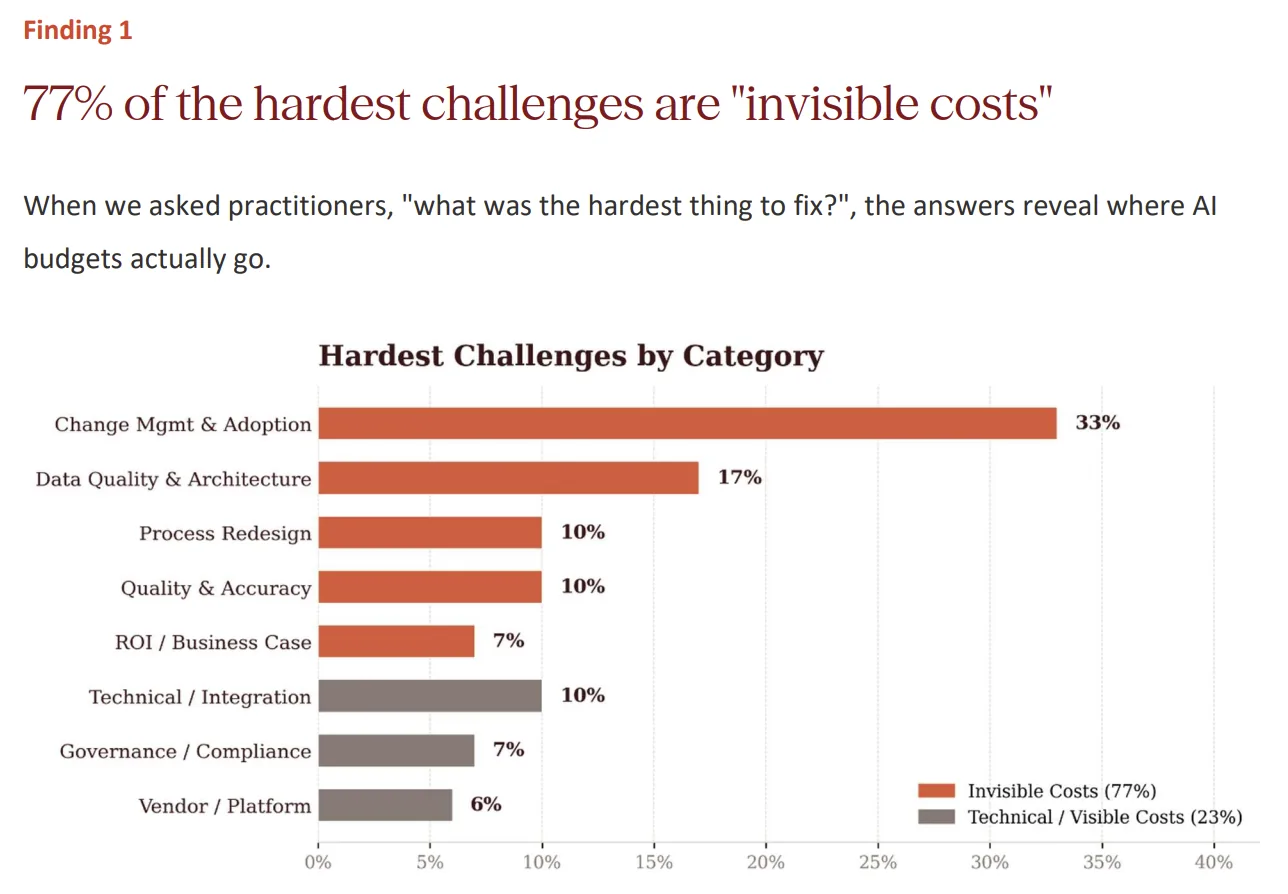
The Stanford Enterprise AI Playbook, based on 51 enterprise AI deployments, carried out a study based on the fact that most AI failures trace back to organizational factors, rather than model quality.
The report found 77% of the hardest challenges in successful deployments were invisible costs, such as change management, data quality and process redesign.
With model choice increasingly becoming a commodity, the durable advantage shows up in the orchestration layer, rather than the foundation model.
That orchestration layer is built on data, which makes data modernization one of the highest-leverage investments most enterprises can make this year. And almost none of it gets delivered out of the box by a SaaS vendor.
Federating data across systems of record, building the pipelines that move it cleanly between operational systems and AI workloads, and instrumenting the governance that lets agents act on sensitive information without creating compliance gaps — all of this is custom engineering work.
It needs people who know your business and your data well. Without it, the AI strategy stalls at the proof-of-concept stage. With it, the rest of the agenda starts to compound.
Threading AI Into the Workflows You Already Run
A meaningful share of the AI value enterprises capture in 2026 will not come from buying new platforms. It will come from threading AI capability into the workflows already running inside the systems they already own.
Doing the integration work properly requires:
- Understanding the business logic in detail
- Designing agent boundaries carefully
- Building human-in-the-loop controls where the cost of error is high
- Instrumenting monitoring, rollback and audit trails into every connection point
Vendors will deliver some of this inside their own platforms, but they will not deliver the cross-platform integrations, custom guardrails, rollback logic specific to your operations, or controls that match your regulatory environment.
Those are exactly the parts of the integration where most of the operational risk lives. And they are also exactly the parts that determine whether the AI strategy produces measurable value or not.
Building the Capabilities No Horizontal Vendor Will Give You
The competitive advantage at the top of every industry over the next few years will be built on proprietary data, sit inside proprietary workflows and be shaped by competitive logic no horizontal vendor can copy.
Custom digital products, internal AI applications and agent systems built around how your company actually runs are how lasting advantage gets created in this cycle.
Companies that try to outsource this work will end up with the same capabilities as their competitors, on the same timelines, at roughly the same cost. That might be fine for some things. But it is the definition of parity, not advantage.
This is also where build-versus-buy decisions get most consequential. Buying feels faster because vendors move quickly and shipping a feature looks like progress. Building is harder to commit to because the timelines are longer and the value is less visible up front.
The logic, though, is simple. The things that make your business different cannot, by definition, be sold to your competitors. If a SaaS vendor will build it, your competitors can buy it six months later, and whatever advantage that capability promised is gone with it.
Rationalizing the Software You Already Bought
Most enterprise software portfolios have built up overlap, duplicate tools and unused licenses for years.
According to Zylo’s 2026 SaaS Management Index, the average enterprise now spends $55.7 million a year across 305 applications, an 8% rise even though portfolios have stopped growing.
That growth is coming from price hikes, AI tier upcharges and consumption add-ons, rather than new tools, which means a meaningful percentage of current SaaS spend is recoverable through proper rationalization. The recovered budget is exactly the capital that funds the modernization, integration and build work that actually creates advantage.
What Kind of Partner This Moment Actually Demands
The instinct in a moment like this is to call the biggest systems integrator you know, or the most well-regarded AI consultancy around.
Both options have problems. Big integrators tend to be slow, expensive and rarely set up to work alongside internal teams as engineering partners, rather than vendor staff billed by the hour. Fashionable AI consultancies often have the strategy depth but lack the engineering bench to actually build, integrate and run the systems they recommend.
The work this moment calls for has three traits, and most providers in the market have one or two of them, but rarely all three:
-
Deep engineering bench
Across data, AI/ML and modernization, not just AI advice.
-
The discipline to embed alongside internal teams
Rather than work from the perimeter.
-
Experience taking systems from validation through production into ongoing operation
Because most of the AI value gets captured in the operate phase, not the build phase.
Growth Acceleration Partner (GAP) is built for this combination. Founded in 2007, GAP helps PE-backed SaaS companies transform legacy and traditional applications into AI-first, agentic-ready platforms. Backed by 13 Centers of Excellence (CoE) across data engineering, AI/ML and modernization, GAP’s delivery teams embed alongside client engineering teams, rather than work at arm’s length.
GAPVelocity AI brings 35 years of legacy modernization heritage, including building Microsoft’s original Visual Basic Upgrade Wizard. VELO, an agentic AI platform built on Microsoft Foundry, delivers VB6, PowerBuilder, MS Access, Clarion and WebForms applications fully modernized to .NET and Blazor at a fixed price.
GAP’s autonomous engineers — senior software engineers who orchestrate AI agents to deliver at the speed and scale of much larger teams — bring years of production-scale AI engineering experience to every engagement. From modernizing revenue-critical codebases to deploying intelligent automation into live products, GAP combines deep technical expertise with rigorous human governance to help SaaS companies ship faster, reduce technical risk and reach their next milestone.
The point is not that GAP is the only option. The point is that this moment calls for a specific mix of strategy, engineering and operational depth, and that mix is harder to find at scale than it should be.