
From Pilot Purgatory to Production: How Healthcare Organizations Win with AI
About This Document
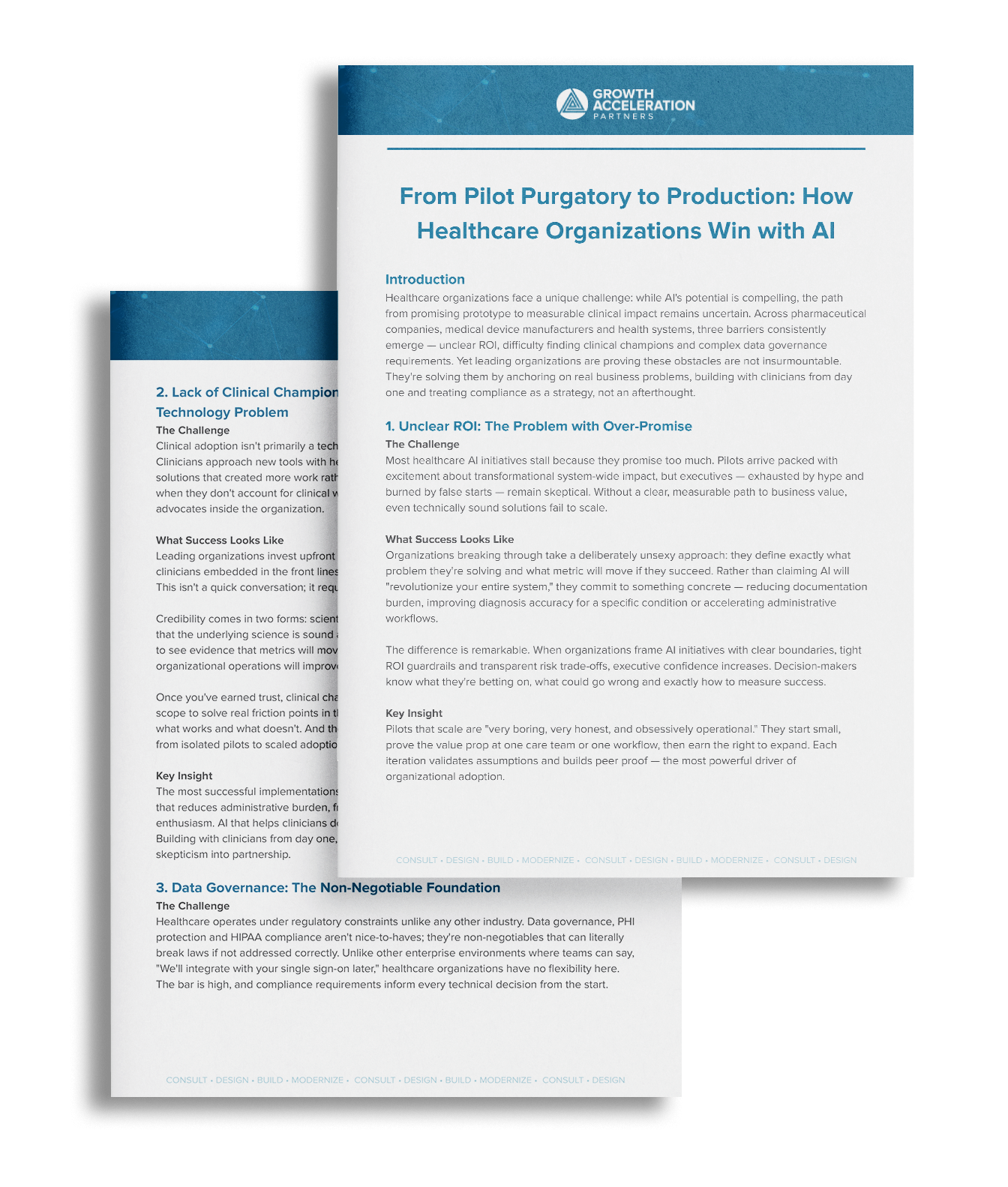
Most healthcare AI initiatives never make it past pilot purgatory. They promise transformation but stall when confronted with unclear ROI, skeptical clinicians, and non-negotiable compliance requirements. Across pharmaceutical companies, medical device manufacturers, and health systems, three barriers consistently emerge—yet leading organizations are proving these obstacles aren’t insurmountable.This white paper reveals how healthcare organizations move AI from prototype to measurable clinical impact. You’ll discover why successful pilots are “very boring, very honest, and obsessively operational,” how to build with clinical champions from day one, and why compliance strategy must be inseparable from technology strategy. The organizations breaking through aren’t choosing between innovation and compliance—they’re solving for both by anchoring on real business problems, treating pilots as validation checkpoints, and choosing partners with the same rigor they’d choose clinical staff.
Full Content Below
Read the Full Document
Explore the complete publication below
Introduction
Healthcare organizations face a unique challenge: while AI’s potential is compelling, the path from promising prototype to measurable clinical impact remains uncertain. Across pharmaceutical companies, medical device manufacturers and health systems, three barriers consistently emerge — unclear ROI, difficulty finding clinical champions and complex data governance requirements. Yet leading organizations are proving these obstacles are not insurmountable. They’re solving them by anchoring on real business problems, building with clinicians from day one and treating compliance as a strategy, not an afterthought.
1. Unclear ROI: The Problem with Over-Promise
The Challenge
Most healthcare AI initiatives stall because they promise too much. Pilots arrive packed with excitement about transformational system-wide impact, but executives — exhausted by hype and burned by false starts — remain skeptical. Without a clear, measurable path to business value, even technically sound solutions fail to scale.
What Success Looks Like
Organizations breaking through take a deliberately unsexy approach: they define exactly what problem they’re solving and what metric will move if they succeed. Rather than claiming AI will “revolutionize your entire system,” they commit to something concrete — reducing documentation burden, improving diagnosis accuracy for a specific condition or accelerating administrative workflows.
The difference is remarkable. When organizations frame AI initiatives with clear boundaries, tight ROI guardrails and transparent risk trade-offs, executive confidence increases. Decision-makers know what they’re betting on, what could go wrong and exactly how to measure success.
2. Lack of Clinical Champions: The People Problem Behind the Technology Problem
The Challenge
Clinical adoption isn’t primarily a technology challenge; it’s a people alignment problem. Clinicians approach new tools with healthy skepticism, shaped by years of experience with solutions that created more work rather than relieving it. Even well-intentioned innovations fail when they don’t account for clinical workflows or when they’re introduced without trusted advocates inside the organization.
What Success Looks Like
Leading organizations invest upfront in identifying and partnering with clinical champions — clinicians embedded in the front lines who understand both the problem and the opportunity. This isn’t a quick conversation; it requires building trust and credibility over time.
Credibility comes in two forms: scientific rigor and demonstrated impact. Clinicians want proof that the underlying science is sound and that your solution targets a real, unmet need. They want to see evidence that metrics will move — that patient outcomes, clinician efficiency or organizational operations will improve in measurable, meaningful ways.
Once you’ve earned trust, clinical champions become advocates. They help shape the pilot scope to solve real friction points in their workflow. They communicate honestly with peers about what works and what doesn’t. And they provide the organizational credibility required to move from isolated pilots to scaled adoption.
3. Data Governance: The Non-Negotiable Foundation
The Challenge
Healthcare operates under regulatory constraints unlike any other industry. Data governance, PHI protection and HIPAA compliance aren’t nice-to-haves; they’re non-negotiables that can literally break laws if not addressed correctly. Unlike other enterprise environments where teams can say, “We’ll integrate with your single sign-on later,” healthcare organizations have no flexibility here. The bar is high, and compliance requirements inform every technical decision from the start.
What Success Looks Like
Organizations that navigate this complexity treat regulatory and compliance strategy as inseparable from technology strategy. Before writing a single line of code, they map out the regulatory landscape, define data access policies and identify compliance trade-offs.
This doesn’t mean projects move slowly. It means teams are intentional about scope and build in phases. Rather than demanding full EHR integration or comprehensive data access upfront, successful pilots demonstrate value within constrained boundaries. They use creative approaches — pilot-specific data sets, limited integration, proof-of-concept architectures — to validate assumptions while building toward compliance-ready infrastructure.
The payoff is significant: by addressing data governance constraints early, organizations avoid expensive retrofits, reduce implementation risk and build infrastructure that scales reliably.
The Common Thread: Problem-First, Partner-Driven Implementation
Across all three barriers, organizations breaking through share a mindset shift:
Fall in love with the problem, not the technology. The job to be done in healthcare hasn’t changed — it’s about delivering safe, efficient care that improves patient outcomes. The tools evolve (sketches → EHRs → AI-enabled sensors), but the core mission remains constant. When teams anchor on this reality, they build solutions that clinicians want to use.
Choose your partner with the same rigor you’d choose clinical staff. AI in healthcare is still in its early days. Unlike mature technologies, success depends heavily on having a business partner who understands healthcare’s unique complexities, can navigate regulatory constraints and will help you solve problems that extend far beyond the technical. Look for partners with healthcare case studies, references you can speak to directly, honest conversations about limitations and a multi-year commitment to your success.
Treat pilots as earning the right to scale. Each pilot is a validation checkpoint. Success means proving you can deliver measurable value to one care team, one workflow or one patient population. That proof becomes the foundation to expand — to the next department, the next metric, the next opportunity. This iterative approach builds momentum internally and creates organizational credibility that sustains scaled adoption.
Where Growth Acceleration Partners Fits
Healthcare organizations wrestling with these three barriers need more than technology — they need a partner who understands healthcare’s operational realities, regulatory requirements and the critical importance of clinical alignment.
Growth Acceleration Partners brings a distinctive combination of capabilities:
End-to-End Technology Consulting and Delivery: From initial strategy and assessment through architecture, build and managed services, GAP works as an extension of your team. Rather than handing off requirements and disappearing, GAP remains invested in your success throughout the pilot and into scaled adoption.
Deep Healthcare Expertise: GAP’s experience spans healthcare’s most complex challenges — working with health systems, pharmaceutical companies, medical device manufacturers and healthtech innovators to navigate the intersection of innovation, compliance and clinical adoption. We’ve helped teams move AI from pilot to production in environments where missteps can cost millions and timelines matter.
Pragmatic Approach to Risk and Compliance: We treat regulatory strategy as inseparable from technology strategy. We help you identify which compliance trade-offs make sense for your current stage, design architectures that scale reliably and avoid expensive retrofits. We work with your teams to ensure technical and clinical stakeholders are aligned on risk boundaries from day one.
Real-World Validation and Credibility: We bring proven methodologies for clinical engagement, pilot scoping and evidence-based implementation. We help identify the right clinical champions, shape pilots around real clinical workflows, and ensure metrics are meaningful to clinicians and executives alike.
True Partnership, Not Vendor Relationship: Unlike traditional outsourcing relationships, GAP functions as a fully-integrated extension of your technology and clinical teams. Our engineers and consultants bring decades of healthcare experience and stay invested in your organization’s long-term success — not just project delivery.
Next Steps
If your organization is stuck in the pilot-to-production gap or if you’re planning your first AI initiative and want to avoid common pitfalls, we’d welcome a conversation.
The organizations achieving measurable results aren’t choosing between innovation and compliance, clinical adoption and technical rigor, speed and safety. They’re solving for all of it — by choosing the right partner and embracing the disciplines that work in regulated, complex environments.
Let’s talk about how to move your AI initiatives from purgatory to production.