
Best Practices for Charting a Strategic Roadmap
About This Document
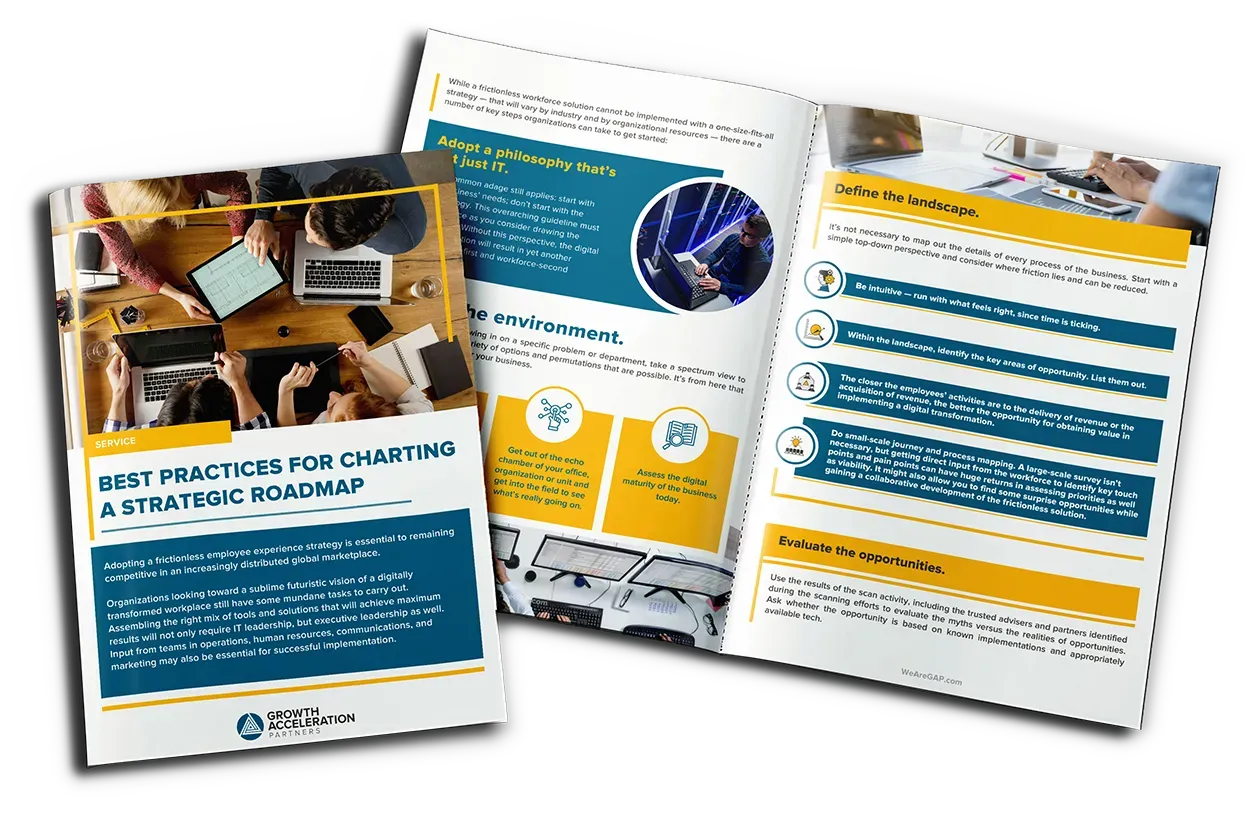
Join the exploration of strategic practices in the eBook “Best Practices for Charting a Strategic Roadmap.” This guide focuses on crafting a digital transformation roadmap to improve employee experience across a global distributed landscape. By adopting a holistic approach that involves collaboration from IT, HR, and marketing, the roadmap prioritizes business needs over technology, emphasizing a broad environmental scan, digital maturity assessment, and competitive analysis. It encourages starting with commercial off-the-shelf technology for early experiments to validate ROI before advancing to custom solutions, advocating for agile methods and ongoing iteration guided by KPIs and MVPs.
Full Content Below
Read the Full Document
Explore the complete publication below
Adopting a frictionless employee experience strategy is essential to remaining competitive in an increasingly distributed global marketplace.
Organizations looking toward a sublime futuristic vision of a digitally transformed workplace still have some mundane tasks to carry out. Assembling the right mix of tools and solutions that will achieve maximum results will not only require IT leadership, but executive leadership as well. Input from teams in operations, human resources, communications, and marketing may also be essential for successful implementation.
While a frictionless workforce solution cannot be implemented with a one-size-fits-all strategy — that will vary by industry and by organizational resources — there are a number of key steps organizations can take to get started:

Adopt a philosophy that’s not just IT.
The common adage still applies: start with the business’ needs; don’t start with the technology. This overarching guideline must be in place as you consider drawing the roadmap. Without this perspective, the digital transformation will result in yet another technology-first and workforce-second initiative.

Scan the environment.
Rather than narrowing in on a specific problem or department, take a spectrum view to consider the full variety of options and permutations that are possible. It’s from here that you find what fits for your business.
- Look at competitors and adjacent markets.
- Get out of the echo chamber of your office, organization or unit and get into the field to see what’s really going on.
- Assess the digital maturity of the business today.

Define the landscape.
It’s not necessary to map out the details of every process of the business. Start with a simple top-down perspective and consider where friction lies and can be reduced.
- Be intuitive — run with what feels right, since time is ticking.
- Within the landscape, identify the key areas of opportunity. List them out.
- The closer the employees’ activities are to the delivery of revenue or the acquisition of revenue, the better the opportunity for obtaining value in implementing a digital transformation.
- Do small-scale journey and process mapping. A large-scale survey isn’t necessary, but getting direct input from the workforce to identify key touch points and pain points can have huge returns in assessing priorities as well as viability. It might also allow you to find some surprise opportunities while gaining a collaborative development of the frictionless solution.

Evaluate the opportunities.
Use the results of the scan activity, including the trusted advisers and partners identified during the scanning efforts to evaluate the myths versus the realities of opportunities. Ask whether the opportunity is based on known implementations and appropriately available tech.
- The myth versus reality evaluation should include input and/or participation from the key constituents — IT, operations, HR, etc. — to ensure the opportunity is viable. Look for speed bumps and reality checks. If implementing new tech might require retraining under a union contract or might disrupt a long-term contract with a supplier, then you can better assess the realities.
- The costs of investing in and implementing each opportunity should be modeled. In some cases, the ROI is obvious, such as technology that opens new revenue streams. In others, the benefits are more intangible, such as increased opportunities for worker collaboration.
- Beyond the investment costs and benefits, a consideration of the opportunity costs is also essential—the potentially missed chance for workers to do something else that would save the organization time and money. Consider all usage outcomes as potential sources of value. How will the technology increase efficiency by improving ease of use? How will fewer errors and consistent task execution lead to more profits? Is the solution expected to reduce attrition?

Want to Learn More?
Download the complete guide to charting your strategic roadmap.
Take stock of infrastructure and security.
Important factors to consider in your costs and logistics assessment are computing power, bandwidth and data storage capacity. The influx of data delivered from new connected devices and platforms will require flexible networking solutions that can scale along with technology expansion.
- Don’t stick to one POC. A roadmap depends on considering all of the potential opportunities from the landscape and then determining which ones have the greatest near term value, which ones may be best as markets and workforces mature and which ones are actually dependent on one another. The POCs reveal the viability of all of the opportunities charted on the roadmap.
- Look to consumer-based tech to start before diving into custom-engineered solutions for your organization. Experimentation with implementations that use commercial off-the-shelf tech are invaluable in clarifying if there’s really any opportunity to reduce friction and achieve ROI.
- Increment swiftly. Learn, record, adjust measures or KPIs and then iterate. Once an MVP can be defined, move out of experimentation toward implementation.
- Consider whether your organization has the skills required to implement new technologies. Key positions for your organization moving forward may include data scientists, R&D engineers and managers trained in advanced analytics.
Whereas a lab study provides insight on the viability of the tech and provides first principle experiential learning, building a concept requires more of a product perspective. It is at this point that metrics are identified, verified and established. The POC is a business moment in which the solution is evaluated to determine how it reduces friction for the intended workforce members and whether that leads to increased friction for IT or operations. Such friction may come from reliability and availability.
- Don’t stick to one POC. A roadmap depends on considering all of the potential opportunities from the landscape and then determining which ones have the greatest near term value, which ones may be best as markets and workforces mature and which ones are actually dependent on one another. The POCs reveal the viability of all of the opportunities charted on the roadmap.
- Look to consumer-based tech to start before diving into custom-engineered solutions for your organization. Experimentation with implementations that use commercial off-the-shelf tech are invaluable in clarifying if there’s really any opportunity to reduce friction and achieve ROI.
- Increment swiftly. Learn, record, adjust measures or KPIs and then iterate. Once an MVP can be defined, move out of experimentation toward implementation.

Create a clear and formal technology roadmap.
There’s value in producing a living document that can be used for communication purposes and obtaining feedback. The roadmap should record the process, technology and organizational architectures that are needed to support the change. Using a table of contents view of what’s in the roadmap, consider the following:
- Overarching guidelines
- Business and architectural principles
- Domain model — define the entities and users that have control of the distinct technology and data
- Map of the target landscape and architecture
- Map of the current landscape and architecture
- Implementation and change management roadmap
- Break down the stages of product management, including milestones, KPIs and investments

Take the leap!
With your roadmap in place, you now have a plan of action. Be sure to set achievable business goals and set measurable metrics to continuously track your company’s progress.