
One critical challenge that keeps many tech founders up at night, beyond securing funding, product innovation, and achieving faster time-to-market, is finding, hiring, and retaining the right talent.
Although this isn’t a new problem, recent shifts in global policies, rising labor costs, and the rapid pace of AI innovation have intensified it. The demand for technical skills is rising, while the availability of those skills is shrinking.
Right now, 87% of technology managers admit it’s increasingly difficult to find skilled professionals. And if the landscape already feels this tight today, what happens in 2026 and the years beyond?
You cannot build for the future with yesterday’s hiring strategy. A smarter, more proactive approach is needed for any founder who wants to stay competitive.
This article provides a clear roadmap to help you attract and hire the right tech talent and build a tech team that is prepared for the pace and complexity of the years ahead.
5 Key Trends From 2025 Shaping the Tech Industry
Throughout 2025, several major trends have emerged that are already shaping the talent environment for 2026.
Here are the key trends redefining the future of tech teams.
1. Government Policy, Rising Tech Labor Costs, and the Shrinking Talent Pool
One of the biggest surprises this year was Trump’s proposed $100,000 Fee for H-1B Visas in the United States. This single policy update highlighted the fragility of global hiring pipelines. In fact, our team recently analyzed the implications of this update, and the conclusion was that founders cannot afford to rely solely on traditional international hiring routes.
In a few words, this means:
- Hiring becomes significantly more expensive.
- Recruitment timelines stretch more than expected.
- Retention turns into a competitive advantage.
This is forcing companies to rethink how they access talent; global recruitment strategies now require support from stronger local and nearshore hiring models to maintain stability and speed.
We have already seen this play out when some German startups experienced product launch delays because visa approvals for their international hires stalled for months. When a policy change can halt an entire product roadmap, founders need to consider more resilient hiring options.
2. The Skill Gap Is Growing Faster Than the Market Can Respond
In 2025, the gap between the skills demanded and those available in the market continued to widen. IDC estimates that by 2026, 9 out of 10 organizations will face major skill shortages, putting an estimated $5.5 trillion in revenue at risk.
The World Economic Forum also reports that 59% of workers will need significant upskilling to keep pace with advancing technologies.
One major reason behind this change is that new technologies, such as AI, automation, and big data, are evolving at a speed that most tech teams find difficult to keep pace with.
Some companies are already facing this reality. Northvolt AB, a Swedish battery startup, struggled for years to hire enough skilled workers. The ongoing talent shortage disrupted its production timelines, strained investor confidence, and contributed to its eventual collapse.
3. Zero Patience for Slow Hiring Processes
Hiring has become more challenging, even in a year marked by layoffs. According to McKinsey’s 2025 HR Monitor Survey, offer acceptance rates continue to decline, and 18% of new hires leave during their probation period. This creates a major setback for founders who need stability, not turnover, especially when building product momentum.
At the same time, candidates today expect hiring processes to move quickly. They are becoming accustomed to faster hiring processes, timely communication, and prompt feedback.
When hiring cycles drag on, companies often lose highly qualified talent to competitors who move faster. Slow processes also affect internal teams, who end up carrying extra workload or pausing critical projects while waiting for roles to be filled.
4. Human and Machine Collaboration Is Now a Core Team Advantage
AI is becoming an active part of how modern tech teams work. Developers, product managers, and data teams are now collaborating with AI agents to handle tasks that range from code generation and testing to research and data processing. Instead of replacing people, these tools are expanding what teams can accomplish in a shorter time.
This means tech teams need to operate in an environment where humans and machines work together naturally. With this new work model, AI handles repetitive and time-consuming tasks, while human team members focus on strategy, complex problem-solving, and customer-focused innovation.
5. Digital Trust Has Become a Hiring Requirement
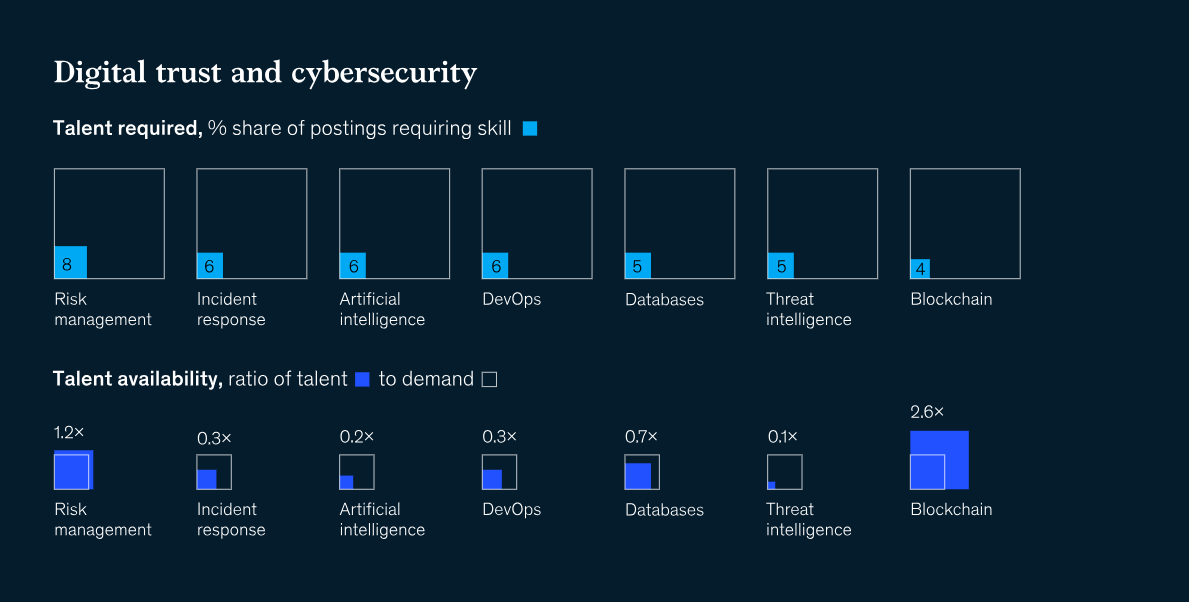
Digital trust has moved from a compliance task to a core expectation in product development. Customers, partners, and regulators now evaluate products based on how well they protect data, manage AI responsibly, and maintain system integrity.
As a result, there’s a greater emphasis on hiring engineers who understand security, privacy, governance, and responsible innovation from the very beginning.
The growing accessibility of AI tools and the rise in insider threats have also contributed to this demand. Companies across the AI and software ecosystem are experiencing increased scrutiny as concerns around security and privacy continue to grow.
Source: McKinsey’s Technology Trends Outlook 2025
This change is reshaping talent needs. For example, threat monitoring, incident response, secure DevOps, and automation-focused engineering are now among the most critical roles in the tech industry. These skills are in short supply, yet they are essential for teams that want to maintain reliability, protect user data, and stay compliant in an environment where trust directly influences adoption.
The Strategic Moves Founders Must Make to Stay Ahead in 2026
Scaling a tech team in 2026 will require more than good intentions. It calls for a deliberate strategy.
Below are some practical steps that will help you grow your team with clarity and stay ahead of the shifts reshaping the industry.
1. Rethink Your Hiring Model (From Local to Global and Hybrid Talent)
Traditional hiring strategies, such as relying mainly on US-based engineers or sourcing talent from a single region, often slow down growth and increase operational costs. To scale efficiently in 2026, founders need to adapt a global, hybrid, and flexible hiring model that strikes a balance between speed, expertise, and budget.
This approach works best when teams stay adaptable. Some seasons may demand global hiring. Others may require contracting, hybrid work models, or freelance support. The key is to build a hiring strategy that can shift as product priorities and timelines evolve.
Comparison of different hiring models
| Factor/ Hiring Models | Local Hiring | Offshore | Nearshore (LATAM) |
| Cost of talent | High | Low | Moderate |
| Time zone gap | None | High | Low |
| Communication | Easy | Needs time to adapt sometimes fully | Smooth |
| Speed | Moderate – fast | Slow due to coordination | Moderate – fast |
One of the most effective models for US-based tech founders is nearshoring. It offers a middle ground between the expenses of local hiring and the operational challenges of offshore outsourcing.
LATAM talent, in particular, provides strong cultural alignment, overlapping time zones, and the engineering skill sets needed for fast-moving product teams.
GAP has partnered with thousands of US organizations through its LATAM engineering teams, helping them scale quickly with highly skilled, vetted tech professionals. Nearshoring gives you the agility of a local team while expanding your talent pool and reducing hiring friction.
If you want to explore how nearshoring can support your next phase of growth, feel free to contact GAP for a complimentary consultation.
2. Build a Continuous Learning and Upskilling Culture
As AI innovation increases, it puts greater pressure on engineering teams to evolve at a similar rate. Skills that were considered current two or three years ago can now hinder product velocity. If your team previously upskilled once or twice a year, the new reality may require a quarterly rhythm. Continuous learning is now a key part of staying competitive.
A practical way to build this culture is by applying the 70–20–10 learning framework for your tech teams. This model keeps learning embedded in their day-to-day work rather than treating it as a separate activity.
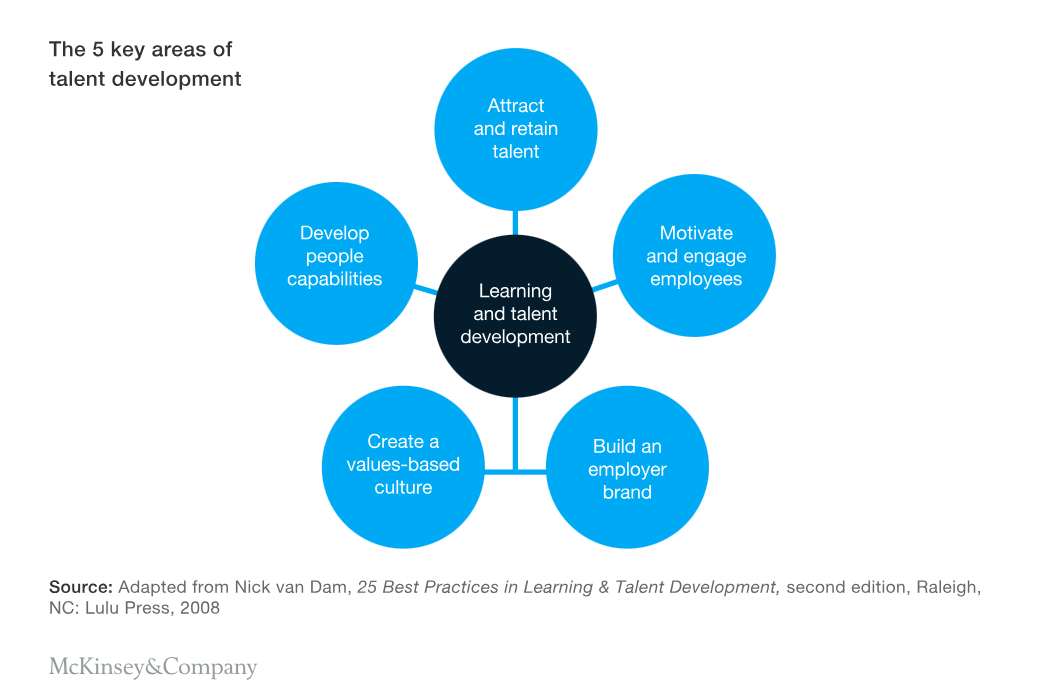
According to McKinsey, a structured Learning and Development (L&D) initiative in an organization addresses five critical elements.
Source: McKinsey
Here’s how the 70-20-10 rule looks for your team:
- 70% on-the-job learning: Hands-on exposure is where most growth happens. This includes working on new product features, experimenting with AI tools, improving automation, participating in internal build challenges, pair programming, and solving real production problems.
- 20% social learning: This involves mentorship, code reviews, architecture deep dives, cross-team collaboration, and knowledge-sharing circles. Senior engineers can run AI tool demos or share best practices, helping the entire team level up together.
- 10% formal training: This includes providing access to structured programs such as AI and data certifications, DevSecOps training, MLOps courses, responsible AI workshops, and advanced engineering bootcamps. This is where your team members deepen their expertise in emerging areas.
3. Integrate AI Agents Into Your Organizational Design Early
The trend started with AI, and now, AI agents are becoming an integral part of everyday engineering team workflows. They are helping teams accomplish more by taking on tasks like code generation, QA automation, research, and data processing. This is also turning into a clear competitive advantage for companies that adopt early.
Major players, including Microsoft, Google, JPMorgan, and Unilever, are already developing workflows that integrate humans and AI systems to enhance speed and accuracy.
For small and mid-sized teams, budget constraints are often a major concern that hinders technology modernization. However, this should not prevent you from taking the first steps.
Strategic adoption starts with understanding what your current systems can support and where the biggest ROI opportunities exist.
At GAP, we help organizations through modernization and technology advisory services that start with a full audit of your existing stack. This includes your technical architecture, applications, cloud infrastructure, and data environment. We do all of these to identify the areas that matter most for scaling your team and allocate your budget where it drives the highest return.
4. Bake Trust and Ethics Into Your Product and People Strategy
Trust is a core requirement for fast-growing businesses. As you bring in new skill sets, integrate responsible practices into hiring, team culture, and product development from the outset. A simple first step is to establish internal AI usage policies that protect sensitive data, guide the adoption of tools, and maintain product integrity.
You can also define responsible AI principles to support transparency, privacy, and careful model oversight. These guardrails help your team move quickly without exposing your business data to unnecessary risks.
Prioritizing trust early also strengthens customer confidence, supports long-term adoption, and positions your team to scale safely and sustainably.
Conclusion
The truth is, hiring isn’t getting easier. The market is shifting rapidly, and that’s why it’s crucial to establish a robust internal talent strategy now.
Take a moment to revisit your 2025 hiring approach, identify what’s no longer serving you, and apply the strategies we’ve shared in this guide to stay ahead.
And if you ever need extra support, we’re here for you. Our nearshore staff augmentation services provide access to over 500 skilled tech experts across AI, data engineering, cybersecurity, cloud, DevOps, front-end development, and UI/UX, all vetted, reliable, and ready to integrate into your team.
That means, regardless of the role you’re trying to fill, we help you bridge the talent gap more quickly and efficiently, saving you time, resources, and stress.