

The software engineering talent shortage shows no signs of easing.
Global reports project a shortfall of millions of developers as demand continues to outpace supply, particularly in areas such as cloud, AI/ML, cybersecurity, and data engineering.
With 74% of employers reporting difficulty hiring skilled workers, companies are facing longer recruitment cycles, higher salaries, and intense competition for the same limited talent pool.
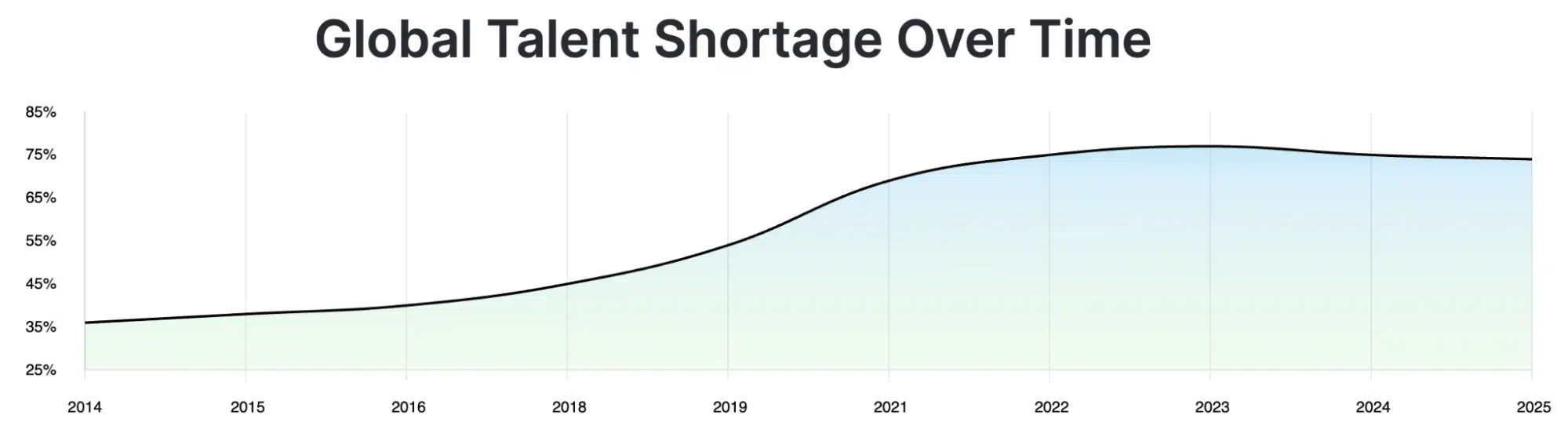
Source: Manpower Group
For many teams, these constraints translate directly into delayed roadmaps, missed release windows, and slower execution on critical initiatives.
In response, many teams are turning to the nearshore delivery model which can provide faster access to experienced developers while maintaining better timezone overlap, communication, and collaboration quality than more distant offshore relationships.
In fact, data seems to suggest that most organizations considering new outsourcing destinations in 2026 are evaluating Latin America.
The region’s combination of technical talent, favorable time zones, and cultural alignment has established it as the default option for U.S. companies looking to expand their engineering capacity.
In this piece, we’ll look at the trends accelerating nearshore adoption in 2026, what companies should evaluate when selecting a partner, and the nearshore outsourcing companies that stand out.
What is Nearshore Outsourcing and Why?
Nearshore outsourcing is the practice of working with service providers in nearby countries, typically within the same or similar time zones, to access skilled talent more efficiently.
Businesses choose it because it’s often faster and more practical than hiring locally when talent is hard to find, and easier to work with than far-off offshore teams. The close time zone overlap makes communication smoother, decisions quicker, and collaboration more natural, while still keeping costs lower than building the same team in-house.
What’s Shaping Nearshore Outsourcing in 2026
A few major trends have accelerated nearshore adoption over the past year, and they’re worth understanding if you’re evaluating partners:
Immigration Rules Are Tightening
The proposed increases to H-1B visa fees (with a $100,000 fee) is fundamentally changing the economics and timelines of international hiring within the U.S. Companies that previously relied heavily on visa-sponsored employees are diversifying their talent strategies, and quickly.
Remote Work Lowered the Barrier
Organizations that successfully managed distributed teams during the pandemic discovered that geographic proximity matters less than they initially thought. If your engineering team is already spread across different states and time zones, adding a team in Bogotá or Mexico City feels less like a risky experiment and more like a natural extension of how you already work.
Latin America’s Talent Has Matured
Latin America now supports thousands of tech startups and a growing base of unicorns, anchored by mature hubs in São Paulo, Mexico City, Bogotá, Buenos Aires, and Guadalajara. These cities have developed active developer communities, and engineers with real experience building enterprise-scale products, narrowing the gap between onshore and nearshore teams.
Costs of Nearshore Outsourcing
Understanding the typical costs of nearshore outsourcing is key to evaluating its true value. According to Near’s 2026 State of LatAm Hiring Report, nearshore developers typically cost 30–70% less than U.S.-based engineers, making it a cost-effective solution without sacrificing quality or collaboration.
| ROLE | LATAM AVERAGE SALARY | US AVERAGE SALARY | SAVINGS BY HIRING NEARSHORE |
| Accountant | $37,800 | $84,000 | 55% |
| Bookkeeper | $28,800 | $66,500 | 57% |
| SEO Specialist | $33,000 | $74,500 | 56% |
| Executive Assistant | $22,200 | $81,000 | 72% |
| Full-Stack Engineer | $69,000 | $126,000 | 45% |
| SDR | $27,000 | $61,000 | 56% |
Salaries are in USD. Compensation depends on the level of seniority.
Source: The State of LatAm Hiring 2026 Report
But companies are increasingly focused on total value rather than just hourly rates. The ability to scale teams quickly, maintain real-time collaboration, and avoid the communication delays common with offshore partners often justifies the investment.
What Companies Are Looking For in Nearshore Partners
Based on what we’re seeing across the industry, here’s what matters to companies evaluating nearshore partners in 2026:
Full-Cycle Development Capabilities
Organizations want partners who can manage complete product development cycles, from initial requirements gathering through deployment and ongoing maintenance. While staff augmentation still has its place, the market has tilted toward firms that can take ownership of outcomes rather than simply providing extra development capacity.
AI Literacy Across the Team
Having a few AI specialists is no longer sufficient when AI touches nearly every part of the product lifecycle. For example, developers need to be comfortable working with LLM APIs, QA teams need to understand how to test non-deterministic systems, and product managers need a grounded sense of what’s technically feasible versus what’s hype. The strongest nearshore companies recognize this shift and invest in AI training across roles.
Security and Compliance Requirements
Companies in regulated industries need partners who genuinely understand frameworks like HIPAA, SOC 2, GDPR, and industry-specific compliance standards. This knowledge needs to be embedded in development practices from day one, not treated as an afterthought.
Legacy System Modernization Expertise
Many companies are maintaining aging applications that desperately need migration to modern platforms. The nearshore firms gaining traction are those with proven experience updating old systems without disrupting production environments. This requires knowledge of both legacy technologies and current architectural patterns.
Data Engineering Capabilities
Organizations need teams that can build data pipelines, implement cloud data platforms, ensure data quality, and create analytics infrastructure. Basic software development skills alone don’t suffice when projects involve complex data architectures or processing massive datasets.
The Top 10 Nearshore Outsourcing Companies for 2026
Here are the top nearshore companies that have distinguished themselves through delivery quality, technical depth, and client satisfaction.
1. Growth Acceleration Partners (GAP)
GAP provides consulting, design, development, and modernization services for software and data solutions. The company focuses on revenue-generating and mission-critical applications, working with both Fortune 500 companies and growth-stage startups across multiple industries.
Their modernization capabilities represent a particular strength. GAP acquired the Application Migration Business Unit of Mobilize.Net in 2023, gaining proprietary tools and deep expertise for migrating legacy Windows and Java applications to modern platforms. They also acquired Mission Data that same year, adding digital product development capabilities with particular strength in retail and consumer brands.
The company’s service portfolio is comprehensive: Custom software development, Data engineering and analytics, Cloud and SaaS application development, Mobile development, UI/UX design, QA automation, and Managed services.
They organize their tech teams into Centers of Excellence around specific platforms and technologies, which provides subject matter expertise and continuous improvement in their respective practice areas.
GAP works particularly well for companies that need both strategic technology guidance and hands-on engineering execution. Their consultative approach involves helping clients identify where technology investments will generate the most business value, rather than simply implementing whatever features get requested.
2. BairesDev
BairesDev is a large nearshore software development and technology services provider founded in 2009, with a team of over 4,000 professionals in 50+ countries.
The company offers services spanning custom software development, staff augmentation, dedicated teams, QA and testing, data and AI services, mobile development, UX/UI design, and platform and infrastructure support.
3. Mismo
Mismo is a nearshore talent platform that helps U.S.-based companies hire remote software developers from Latin America. The company focuses on staff and team augmentation, supporting clients through the sourcing, vetting, hiring, and onboarding of engineers who work in or near U.S. time zones.
Mismo operates on a managed hiring model in which it handles recruitment, onboarding, HR administration, equipment provisioning, and ongoing talent support. Engagements follow a monthly pricing model, with engineers sourced and onboarded to integrate directly into a client’s existing team.
4. CI&T
CI&T is a global digital services and consulting firm that provides technology, design, and business transformation services with a significant presence in Latin America. Its service portfolio includes application modernization, cloud services, data and AI, digital product design and development, customer experience, and managed services.
The company positions its work around integrating business strategy, technology, and AI, and supports clients through end-to-end engagements ranging from consulting and design to implementation and ongoing operations.
5. Gorilla Logic
Gorilla Logic focuses on engineering services for organizations building and operating complex digital platforms and products. Its work spans the full software lifecycle, including application modernization, platform and DevOps engineering, quality engineering, and AI-enabled product development.
Engagements are structured around embedded teams working closely with client organizations, supported by standardized workflows and live delivery metrics that track predictability, flow, and quality over time.
6. Softtek
Softek delivers enterprise applications for large organizations, particularly in established industries. Their expertise includes application development and modernization, testing, IT infrastructure management, security, and business process outsourcing.
The company serves enterprise clients across more than 20 countries and maintains partnerships with platforms like SAP, Microsoft, AWS, and others. Its operating model combines regional delivery centers with proximity-based nearshoring for U.S. and international clients.
7. N-iX
N-iX positions itself around pragmatic software engineering for enterprises working with data, AI, and cloud technologies. Its work spans custom software engineering, application modernization, cloud platforms, data and analytics, AI implementation, embedded systems, and cybersecurity.
The company supports long-running engineering initiatives rather than short-term experimentation, often operating inside complex, regulated, or infrastructure-heavy environments.
8. Dreamix
Dreamix is a nearshore software development company that supports organizations through custom software delivery, team augmentation, and legacy system modernization.
Its services include application development, IT consulting, QA and testing, cloud and DevOps support, and modernization of existing systems. Dreamix emphasizes a structured delivery approach covering requirements analysis, team selection, agile execution, quality assurance, and deployment.
9. Mobilunity
Mobilunity operates as a global tech talent and team-building partner, focused on helping companies assemble and manage remote engineering teams with minimal internal overhead.
Its model centers on dedicated development teams, staff augmentation, and technical recruitment, alongside complementary services such as IT consulting, CTO support, and technical interviewing.
10. Nexton
Nexton operates as a nearshore tech staffing and recruiting partner focused on placing engineers with U.S.-based companies through a curated matching process.
Nexton manages the administrative aspects of hiring, including contracts and ongoing coordination, allowing client teams to focus on integration and delivery rather than recruitment operations.
Why Choosing the Right Nearshore Partner Matters — and Why Many Teams Turn to Growth Acceleration Partners (GAP)
The firms profiled here have built genuine engineering expertise through years of delivering production systems. However, technical capability alone doesn’t determine success.
You need partners who communicate clearly, adapt when priorities change, and understand enough business context to make sound technical decisions.
That’s the gap GAP is built to fill. We combine strategic technology guidance with hands-on engineering execution, helping teams modernize legacy systems, build scalable platforms, and integrate data and AI into production environments that matter to the business.
By working across the full delivery lifecycle, GAP helps organizations reduce execution risk, accelerate delivery, and focus technology investment where it creates the most value.
Ready to take the next step with nearshore delivery? Contact a GAP expert to discuss a nearshore approach aligned with your needs.