
A lower-priced AI model can prompt an engineering team to reconsider tools it already uses. Before switching, teams need to understand how much work the transition will require and how the savings might change once the model is in everyday use.
We recommend comparing models on completed work that has passed review. The evaluation should account for the time developers spend correcting the output, as well as computing charges. A cheaper run may still leave the team with more work to do.
The September 22 releases of Claude Opus 5.5 and GPT-6 Sol and Luna gave teams a reason to revisit those comparisons. One week later, OpenAI introduced GPT-6.1 Sol, an upgrade that keeps Sol’s standard API rates while improving capability and reducing cached-input pricing. We examine how to test a candidate against an existing workflow and decide where a change is justified.
Lower prices create a reason to reevaluate
Anthropic’s Opus 5.5 announcement lists lower input, output and cache-read prices than Opus 5. It also reports approximately 40% lower costs on typical workloads at default settings, combining pricing changes with reduced token consumption. That is a vendor-reported result under its evaluation conditions.
OpenAI’s GPT-6.1 Sol announcement emphasizes a similar balance between capability and cost. GPT-6.1 Sol replaces GPT-6 Sol in this comparison because it is the newer release and retains the same standard input and output rates. The providers’ published API rates put these models at different price points:
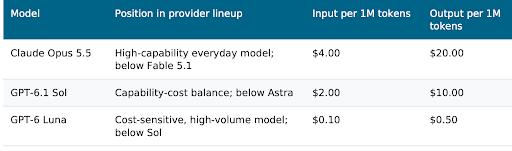
These are standard API rates listed in the linked announcements, checked September 29, 2026. They exclude caching adjustments, special execution modes and other charges. The rows are not equivalent capability tiers: Claude Fable 5.1 remains above Opus 5.5 in Anthropic’s lineup at 10/50 per million input/output tokens, while GPT-6 Astra remains above Sol and Luna in OpenAI’s lineup.
By these list prices, GPT-6.1 Sol’s input and output rates are half those of Opus 5.5, while Luna’s are one-fortieth. That makes Sol 2 times cheaper and Luna 40 times cheaper per token. It does not establish the cost of completing the same task: models can produce different amounts of output, take different paths and need different levels of correction.
For a team with an established workflow, this presents an opportunity for evaluation. Work that previously required a costly model may now be economically viable elsewhere. A more capable model may also become affordable enough for tasks where its predecessor was difficult to justify. The price establishes a starting point for testing.
How we assess an initial result
When we evaluate a new model, we want to know what happened after it produced its first response. The code may look promising, yet it still needs changes before it can be merged. That review effort belongs in the assessment.
A shorter run is worth investigating, especially if the developer needed fewer follow-up prompts. We would check that the model completed the required validation, then compare the total time through review. We would also repeat the task before treating the improvement as dependable.
The field observations below were shared in September 2026. We treat them as hypotheses for further testing, not as controlled benchmarks.
In an early comparison of Sonnet 5 and Opus 5.5, Juan Camilo Martínez, Senior Mobile Engineer, described his experience identifying and fixing a bug:
“The task was to identify the root cause of a bug and implement the fix. With Sonnet 5, it required several code searches, comparisons, analysis iterations and follow-up prompts; with Opus 5.5, it took only a few targeted searches and analysis steps to identify the root cause and implement the solution. I saw the same pattern in subsequent tasks, which highlighted how the improvements built into Opus 5.5 around context handling, together with its stronger focus on software development, can help it reason over the codebase more efficiently and arrive at a solution with less work.”
This gives us a hypothesis to test: whether Opus 5.5 consistently requires fewer follow-up prompts and less total time to produce an accepted fix under comparable conditions.
We also distinguish between the quality of the result and the experience of using the tool throughout the day. Strong output can coexist with usage limits that interrupt a workflow. Understanding that tradeoff requires clarity about what we are observing: API charges, subscription allowances or the effects of a particular configuration.
Personal experimentation can help identify a promising use case. Before recommending a change to a team, we need evidence from work that resembles its own, with the acceptance criteria established in advance.
For agentic coding, we would examine how the model moves through the work: gathering context, making changes, running checks and responding to failures. Fewer steps matter when they reflect a more effective path to a validated result. The evaluation should help us explain why the result improved. If the new run used different tools or skipped a test, the model alone may not account for the difference.
Define the result before comparing the models
Choose tasks from the team’s actual workload. A bounded bug fix can test how well a model diagnoses a known failure. A change across several files can reveal whether it correctly follows
dependencies. Report results by task category so that numerous easy successes do not hide failures on more consequential work.
Before running a comparison, define what completion means. A bug fix might include reproducing the issue, implementing the correction, adding an appropriate regression test and preserving existing behavior. A refactor might include passing tests, maintaining interfaces and staying within the agreed scope.
Review the code and execute the relevant checks even when the explanation sounds convincing. Pay particular attention to changes in tests: an agent may have adjusted an assertion to fit its implementation. Unrelated edits also need scrutiny because they expand the scope of review.
For a legacy modernization task, include compatibility constraints and behavior that must survive the change. An attractive rewrite has limited value if it changes an undocumented dependency that the business still relies on.
Give each candidate the same starting repository state, task description and acceptance criteria. Record differences in tools, permissions, context and effort settings. Where the surrounding coding environments differ, describe the result as a comparison of those environments rather than attributing everything to the model alone.
Measure the whole task, including human effort
For this evaluation, we recommend tracking cost per accepted task: the resources required to produce work that passes the agreed quality checks. Include unsuccessful attempts in the evaluation cost, even when another model eventually completes the work.
A related quality criterion appears in OpenAI’s description of FrontierCode: the benchmark assesses whether generated changes are suitable for merging, including test quality and adherence to codebase standards. That supports checking acceptability alongside correctness; cost per accepted task remains our recommended operational measure.
Record the following for each task:
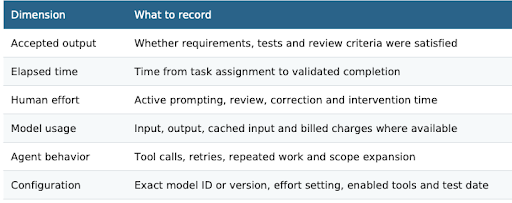
Keep elapsed time and active human time separate. A developer may do other work while an agent runs, so an additional minute of execution does not necessarily consume another minute of labor. Conversely, a fast result may require substantial inspection before anyone can trust it.
Consider a hypothetical comparison in which model execution is followed by human review, with no overlap. One model runs for five minutes and needs twelve minutes of correction, taking seventeen minutes overall. Another runs for twenty minutes and needs four minutes of review, taking twenty-four minutes overall. The first finishes seven minutes sooner; the second requires eight fewer minutes of engineering attention. Assuming both results pass the same checks, the choice depends on the team’s delivery constraints. These numbers illustrate a trade-off.
Keep three kinds of costs separate
API spending, subscription limits and engineering labor answer different questions:
- API spending: Billing records show what you pay for model usage. A lower API bill does not necessarily mean lower overall costs if engineers spend more time correcting the output.
- Subscription limits: Usage meters show consumption against a plan’s allowance. Reaching a cap can interrupt work, but it does not reveal the equivalent API cost.
- Engineering labor: Time spent reviewing and correcting output affects delivery capacity and should be factored into the model’s value assessment.
In an observation shared on September 23, 2026, Alejandro Bastidas, Staff Software Engineer, described how reaching a usage limit interrupted his personal testing on a Plus subscription:
“There is a limit included in the plan, but it is reached much faster compared to Claude. That is, the tokens included in the Plus plan I was using run out very quickly, which doesn’t happen with Claude. In my experience, Claude is more efficient and offers better value for money. How did it affect my testing? I used up the weekly limit in 3 days and had to wait 5 days for it to renew. This impacted what I was doing because waiting 5 days is a long time.”
The hypothesis to test: whether the plan’s allowance would repeatedly interrupt comparable work under the same model and configuration. It does not establish API cost per task or a general cost advantage for Claude. Limits can change, and OpenAI positions Sol as providing more room to iterate through higher usage limits and lower cost.
Before a rollout, also account for tool integration, developer training, evaluation and workflow maintenance. Separate one-time setup or migration costs from recurring operating costs to keep the comparison clear.
For API integrations, a same-provider upgrade can require code changes. Anthropic’s Opus 5.5 migration guide states that adaptive thinking is always on: requests that disable thinking or set a manual thinking budget are rejected. It also removes forced tool calls; tool_choice types any and tool return an error and must be replaced with automatic selection plus strict tool use or structured outputs. Budget for finding and updating affected calls, revisiting token limits and testing the integration before counting any savings.
Treat caching and configuration as test variables
Anthropic lists Opus 5.5 cache reads at $0.20 per million tokens. OpenAI reports improved prompt caching across GPT-6, with 90% discounts on cached input-token reads. The newer GPT-6.1 Sol prices cached input at $0.10 per million tokens, 95% below its standard input rate. These changes make the reuse of context relevant to the economics of longer workflows.
In your own evaluation, record actual cache usage rather than inferring it from a faster run. Separate a first run from subsequent runs with a reusable context. A favorable repeated-session result may not represent workloads that start fresh each time.
OpenAI also reports that changing reasoning effort or tool availability can preserve earlier context for cache reuse. Record changes made during a session, so the comparison reflects the configuration actually used.
Record effort settings, too. A comparison between a predecessor at high effort and a new model at medium effort can be relevant to everyday use, but it changes more than the model. Label that comparison clearly and test the intended deployment configuration.
This matters when interpreting Anthropic’s 40% figure above. The migration guide identifies medium as Opus 5.5’s default effort, compared with high for Opus 5. A default-settings comparison therefore does not hold that variable constant. The sources do not isolate how much of the reported saving comes from this difference. Test the effort settings intended for deployment.
Give each model a job it can justify
Published pricing can help us build a shortlist for a specific workload. We recommend testing each candidate against that workload’s acceptance criteria before choosing one.
For a more expensive model already in use, identify the tasks where its additional capability earns the premium. A difficult diagnosis may justify a higher computation cost if it reduces substantial human investigation. Routine work may offer fewer opportunities to recover that premium.
Agentic development makes this distinction especially important. An agent may inspect files, edit code, execute tests, interpret failures and revise its approach. When assessing such a workflow, look for purposeful progress through those stages. Fewer steps are valuable only if the agent still performs the checks the task requires.
You can test a simpler model first and escalate when it fails to meet the defined criteria. Track the entire path, including the failed first attempt. Otherwise, the apparent savings from inexpensive initial calls can conceal the cost of repeated escalation.
Keep the operational design proportionate. A team with a single clear workflow may gain little from a complex model router. Introduce additional choices when the evidence shows meaningful differences by task category and the team can maintain them.
Our GAPVelocity AI hybrid approach illustrates another design choice. Its core transformation engine uses structured rules and Abstract Syntax Tree analysis to translate legacy code. Generative AI supports surrounding engineering work, including planning and test generation, under human oversight.
This separates repeatable transformation from tasks that benefit from a language model’s flexibility. When assessing a workflow, we recommend identifying steps that can use established transformation rules or conventional automation before choosing an LLM for them. The architecture is a concrete example; quantifying its token or labor savings would require a project-specific baseline.
Our discussion of runaway token costs covers the broader spending problem. For model selection, the narrower goal is to document a choice that explains why the model suits the workload.
Make a model change earn its place
Before testing, write down what would justify a switch. Require an acceptable quality level, then compare cost, human effort and delivery time within that boundary. A critical correctness failure should not be averaged away by strong performance on easier tasks.
Repeat representative tasks enough to understand whether the initial result holds. Preserve the starting state and record the model version and date. Report the spread of outcomes alongside typical results, especially when occasional long runs create budget or scheduling problems.
Then pilot the candidate on a limited portion of real work. Keep the current option available and define the conditions for reverting. This turns an enthusiastic first impression into a decision you can review and reverse if the workflow behaves differently in practice.
Address model lock-in during that pilot. Keep acceptance tests, evaluation cases and important workflow rules accessible outside one provider’s interface where practical. Document provider-specific dependencies and the effort required to change them. Portability has costs, but an explicit view of those costs is better than discovering them during a forced migration.
Revisit the decision when the workload, pricing, model version or tool environment changes materially. A monthly review, with an interim check after a major model or pricing release, is a
practical cadence. A successful evaluation should leave behind reusable evidence and a repeatable process, making the next decision easier.
Turn lower prices into a better engineering decision
The useful outcome of a model evaluation is a clear operating decision: retain the current choice, replace it with a defined workload or reserve a stronger model for tasks that justify its cost. That gives finance an explanation of the spend and engineers a practical reason for the tool they are using.
GAP is an AI transformation company that helps organizations modernize software, reinvent business operations and build intelligent products. We bring strategic guidance and hands-on engineering together to assess, validate and implement AI in ways that deliver measurable business value.
For model optimization, that means connecting architecture choices to representative tasks and measurable outcomes. The same discipline applies when adding agents to a SaaS product or evaluating AI assistance for a legacy upgrade: establish what must work, assess the full delivery effort and scale based on evidence.
Let’s chat. Schedule an AI assessment and working session with GAP.