
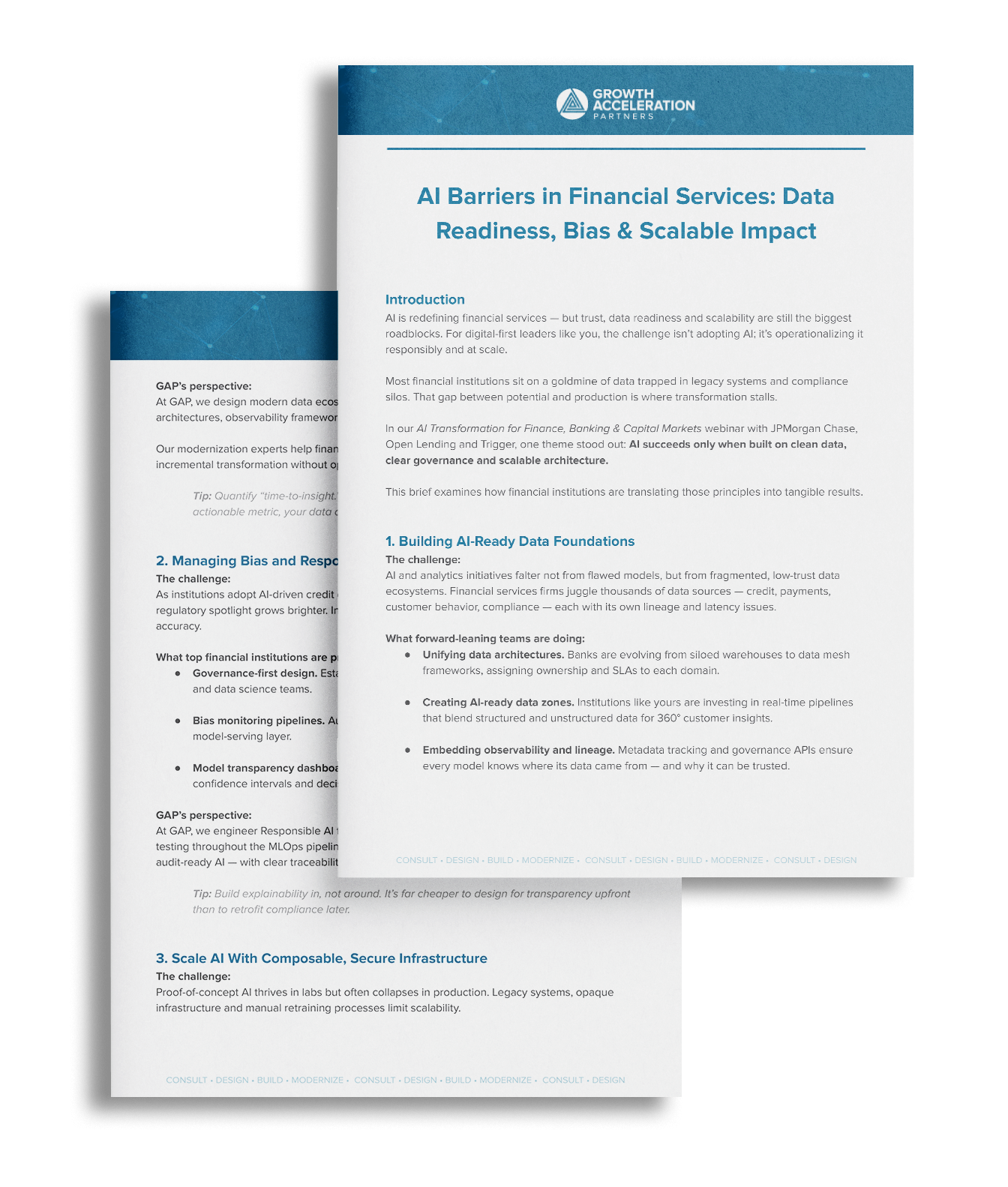
AI Barriers in Financial Services: Data Readiness, Bias & Scalable Impact
About This Document
Financial services teams are investing heavily in advanced analytics, but many still face persistent barriers that limit meaningful progress. Data remains fragmented, oversight is inconsistent and promising ideas often stall before they reach production. This brief explores how forward looking institutions are addressing these challenges by modernizing their data environments, building clear governance practices and strengthening fairness and transparency across the decision cycle. It outlines the architectural patterns that support scale and reliability and offers guidance on how to turn complex data into trusted insight. The piece closes with practical recommendations for organizations that want to move from exploration to measurable outcomes with confidence.
Full Content Below
Read the Full Document
Explore the complete publication below
Introduction
AI is redefining financial services — but trust, data readiness and scalability are still the biggest roadblocks. For digital-first leaders like you, the challenge isn’t adopting AI; it’s operationalizing it responsibly and at scale.
Most financial institutions sit on a goldmine of data trapped in legacy systems and compliance silos. That gap between potential and production is where transformation stalls.
In our AI Transformation for Finance, Banking & Capital Markets webinar with JPMorgan Chase, Open Lending and Trigger, one theme stood out: AI succeeds only when built on clean data, clear governance and scalable architecture.
This brief examines how financial institutions are translating those principles into tangible results.
1. Building AI-Ready Data Foundations
The challenge:
AI and analytics initiatives falter not from flawed models, but from fragmented, low-trust data ecosystems. Financial services firms juggle thousands of data sources — credit, payments, customer behavior, compliance — each with its own lineage and latency issues.
What forward-leaning teams are doing:
- Unifying data architectures. Banks are evolving from siloed warehouses to data mesh frameworks, assigning ownership and SLAs to each domain.
- Creating AI-ready data zones. Institutions like yours are investing in real-time pipelines that blend structured and unstructured data for 360° customer insights.
- Embedding observability and lineage. Metadata tracking and governance APIs ensure every model knows where its data came from — and why it can be trusted.
GAP’s perspective:
At GAP, we design modern data ecosystems built for AI acceleration — combining cloud-native architectures, observability frameworks and compliance-first governance.
Our modernization experts help financial clients create AI-ready data zones that allow incremental transformation without operational risk.
Tip: Quantify “time-to-insight.” If it takes more than one business cycle to get an actionable metric, your data architecture — not your analysts — is the bottleneck.
2. Managing Bias and Responsible AI Governance
The challenge:
As institutions adopt AI-driven credit decisioning, fraud prevention and personalization, the regulatory spotlight grows brighter. In finance, explainability and fairness are now as critical as accuracy.
What top financial institutions are prioritizing:
- Governance-first design. Establishing AI governance councils that unite risk, compliance and data science teams.
- Bias monitoring pipelines. Automating drift detection and fairness scoring at the model-serving layer.
- Model transparency dashboards. Integrating tools that visualize feature influence, confidence intervals and decision paths in real time.
GAP’s perspective:
At GAP, we engineer Responsible AI frameworks that embed explainability, lineage and bias testing throughout the MLOps pipeline. For clients in regulated sectors, our approach ensures audit-ready AI — with clear traceability from input data to model output.
Tip: Build explainability in, not around. It’s far cheaper to design for transparency upfront than to retrofit compliance later.
3. Scale AI With Composable, Secure Infrastructure
The challenge:
Proof-of-concept AI thrives in labs but often collapses in production. Legacy systems, opaque infrastructure and manual retraining processes limit scalability.
What’s working:
- MLOps automation. Standardizing model deployment, monitoring and retraining across teams and environments.
- Composable architectures. Modularizing pipelines so models, APIs and datasets can evolve independently without costly refactoring.
- Business-aligned metrics. Tying AI outcomes to measurable KPIs — loan approval velocity, fraud detection lift, credit risk reduction.
GAP’s perspective:
GAP helps financial institutions scale AI from prototype to production through cloud modernization, automation frameworks and data lifecycle engineering.
Our approach unites AI governance, secure infrastructure and performance observability — turning innovation into a sustainable operational capability.
Tip: Treat AI platforms as living systems. Continuous monitoring, retraining and governance loops turn model performance into a predictable business process.
Conclusion
The financial industry is moving fast toward AI-driven decisioning, but sustainable innovation depends on more than just new technology — it requires trustworthy data, transparent models and modernized infrastructure that can evolve as quickly as the markets do.
If your focus includes operationalizing intelligence responsibly across the enterprise, GAP would welcome a brief, practical exchange to compare patterns we’re seeing across your peer set — and identify a few high-leverage actions for the next 90 days.
Let’s talk about how we can help your team take the next step.