
Overcoming Legacy Code, Technical Debt & AI Integration at Scale
About This Document
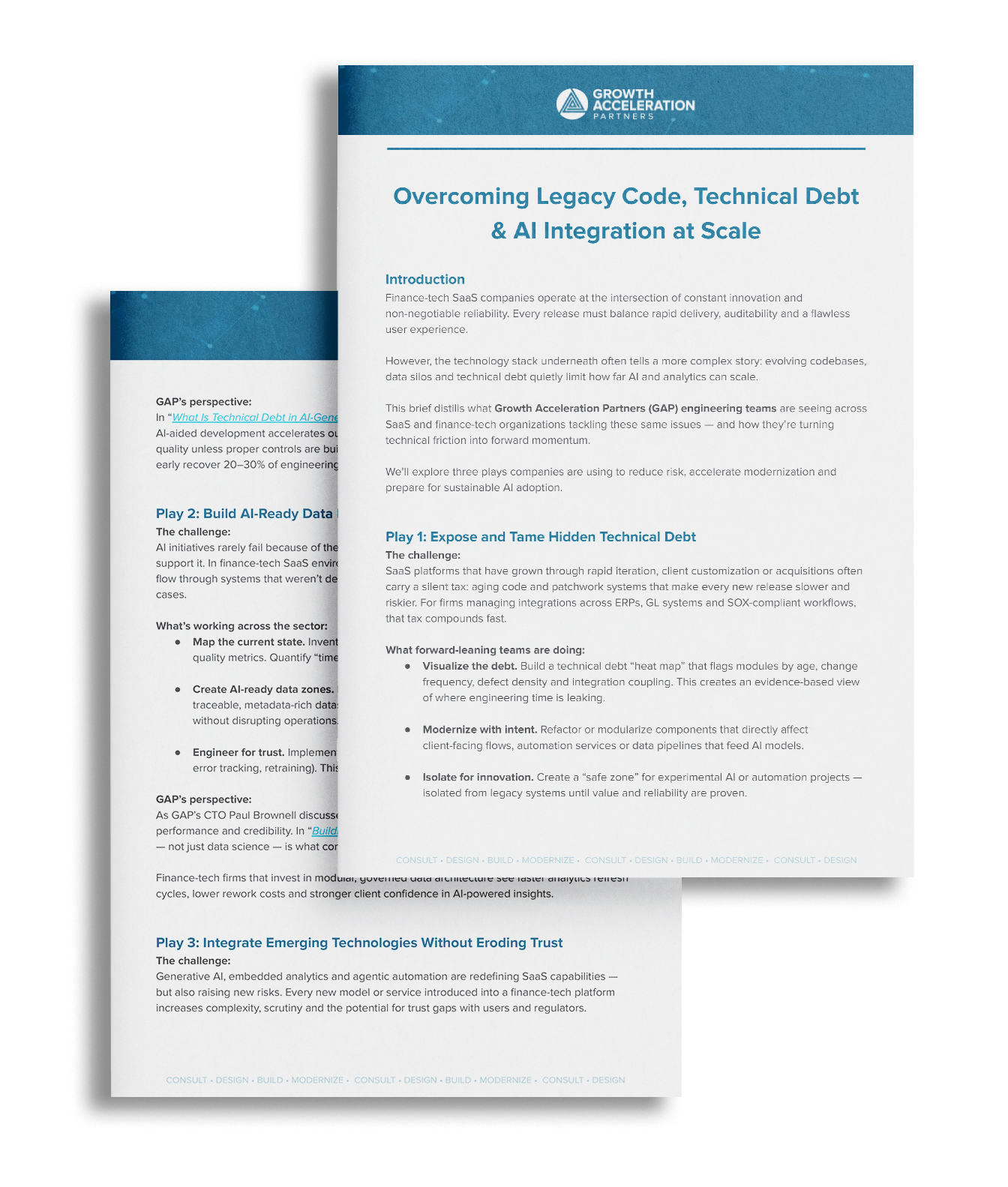
Legacy systems, evolving codebases and data silos create a silent tax on engineering velocity—making every release slower and riskier. For finance-tech SaaS companies managing integrations across ERPs and compliance workflows, that friction compounds fast. This brief examines three plays forward-leaning teams are using to tame technical debt, build AI-ready data infrastructure and integrate emerging technologies without eroding trust. From creating technical debt heat maps to establishing governance frameworks that accelerate adoption, you’ll see how companies are converting technical constraints into momentum—recovering 20–30% of engineering bandwidth, achieving faster analytics refresh cycles and scaling AI capabilities with confidence. Whether your focus is accelerating insight delivery, improving release velocity or safely operationalizing AI, these patterns offer practical next steps for the next 90 days.
Full Content Below
Read the Full Document
Explore the complete publication below
Introduction
Finance-tech SaaS companies operate at the intersection of constant innovation and non-negotiable reliability. Every release must balance rapid delivery, auditability and a flawless user experience.
However, the technology stack underneath often tells a more complex story: evolving codebases, data silos and technical debt quietly limit how far AI and analytics can scale.
This brief distills what Growth Acceleration Partners (GAP) engineering teams are seeing across SaaS and finance-tech organizations tackling these same issues — and how they’re turning technical friction into forward momentum.
We’ll explore three plays companies are using to reduce risk, accelerate modernization and prepare for sustainable AI adoption.
Play 1: Expose and Tame Hidden Technical Debt
The challenge:
SaaS platforms that have grown through rapid iteration, client customization or acquisitions often carry a silent tax: aging code and patchwork systems that make every new release slower and riskier. For firms managing integrations across ERPs, GL systems and SOX-compliant workflows, that tax compounds fast.
What forward-leaning teams are doing:
- Visualize the debt. Build a technical debt “heat map” that flags modules by age, change frequency, defect density and integration coupling. This creates an evidence-based view of where engineering time is leaking.
- Modernize with intent. Refactor or modularize components that directly affect client-facing flows, automation services or data pipelines that feed AI models.
- Isolate for innovation. Create a “safe zone” for experimental AI or automation projects — isolated from legacy systems until value and reliability are proven.
Play 2: Build AI-Ready Data Infrastructure
The challenge:
AI initiatives rarely fail because of the model — they fail because the data foundation can’t support it. In finance-tech SaaS environments, vast amounts of transactional and close-cycle data flow through systems that weren’t designed for real-time, lineage-tracked or multi-tenant AI use cases.
What’s working across the sector:
- Map the current state. Inventory data sources, transformations, latency, ownership and quality metrics. Quantify “time-to-insight” and rework frequency.
- Create AI-ready data zones. Establish architectural segments optimized for clean, traceable, metadata-rich datasets. These can run in parallel with legacy batch pipelines without disrupting operations.
- Engineer for trust. Implement governance, observability and feedback loops (model drift, error tracking, retraining). This ensures AI doesn’t operate on “invisible sand.”
Play 3: Integrate Emerging Technologies Without Eroding Trust
The challenge:
Generative AI, embedded analytics and agentic automation are redefining SaaS capabilities — but also raising new risks. Every new model or service introduced into a finance-tech platform increases complexity, scrutiny and the potential for trust gaps with users and regulators.
What leading teams are doing:
- Start with a hypothesis. Define the business metric an integration should move — e.g., “reduce month-end close cycle time by 15%.” Prototype, measure, iterate, then scale.
- Engineer for explainability. Build governance and traceability from day one: consider audit logs, model lineage, human-in-the-loop review and clear escalation paths.
- Design for resilience. Instrument models and services monitor latency, bias and drift so small issues never become systemic risks.
Conclusion
Across the finance-tech SaaS landscape, legacy code, technical debt and fragile data foundations are often blamed for slowing innovation. But the companies that face them head-on — with disciplined modernization, data readiness and engineered trust — are transforming those same constraints into competitive accelerators.
If your focus includes accelerating insight delivery, improving release velocity or safely integrating AI capabilities, GAP would welcome a brief, practical exchange to compare patterns we’re seeing across your peer set — and identify a few high-leverage actions for the next 90 days.
Let’s explore what’s working.
Book a 20-minute conversation