
GAP’s Application Assessment
About This Document
Gain insights into GAP’s Technology Application Assessment service, meticulously designed to assist organizations in making informed decisions about licensing, purchasing, or building software applications. This service utilizes a detailed evaluation process through an Assessment Matrix Chart, ensuring that decisions are strategically tailored to fit the organization’s needs and capabilities. With expert analysis and comprehensive reporting, GAP equips companies with the necessary tools to effectively manage their digital transformation strategies.
Full Content Below
Read the Full Document
Explore the complete publication below

Evaluating whether to license, buy or build a software application to include as part of your product or judging the strength of your current offerings requires thoughtful decisions. If you get it right, you win big. If you get it wrong, well, you know the rest.
Technical due diligence is a must. Many companies may not have the time, tools or talent to quickly and effectively analyze the opportunity. They want a trusted, unbiased partner to provide a thoughtful and comprehensive report and to assist them in the decision-making process.
When evaluating a partner, ask yourself:
- What gives me confidence I can trust them?
- Do they have example deliverables I can see/share?
- Do they have a one-size-fits-all model, or can they handle my organization’s unique needs?
- Can they do it in a timely manner and present their findings effectively?
GAP’s evaluation utilizes thorough criteria to strategically align needs with capabilities.
Key Insight
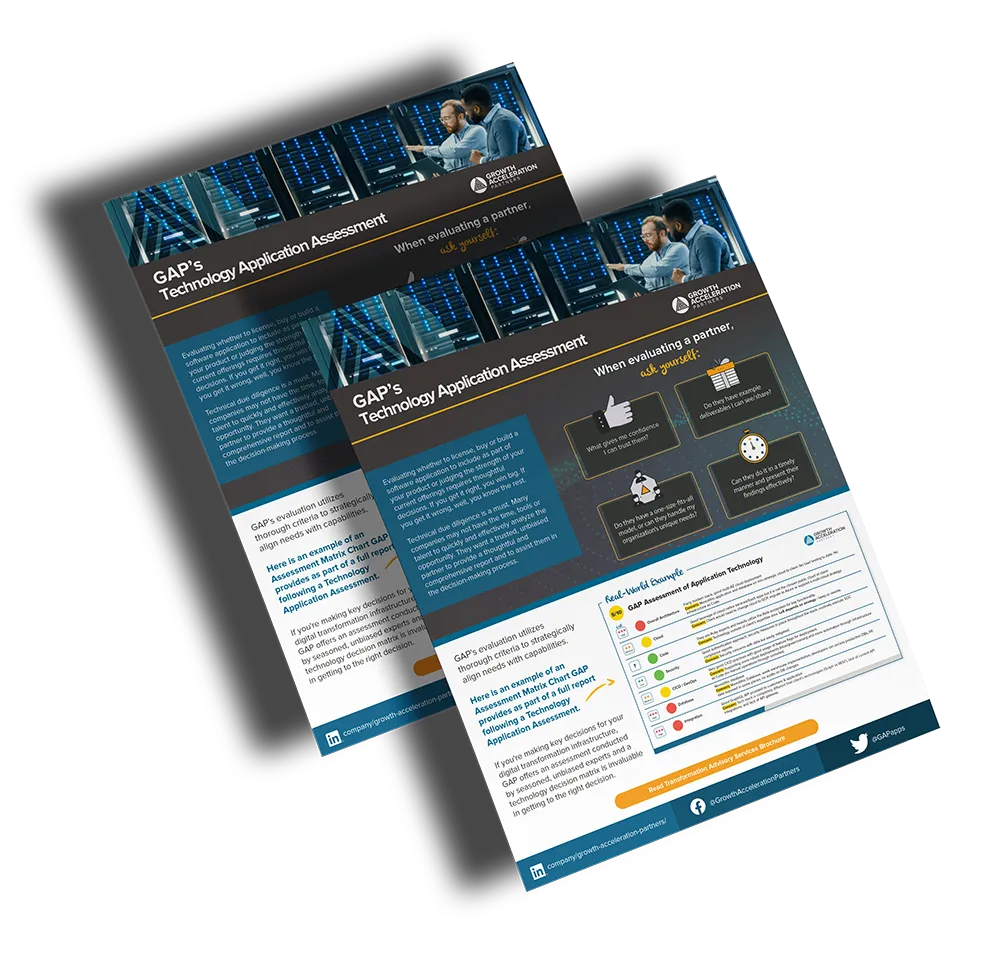
Here is an example of an Assessment Matrix Chart GAP provides as part of a full report following a Technology Application Assessment.
If you’re making key decisions for your digital transformation infrastructure, GAP offers an assessment conducted by seasoned, unbiased experts and a technology decision matrix is invaluable in getting to the right decision.
Real-World Example
GAP Assessment of Application Technology — 5/10
| Category | LoE | Assessment |
|---|---|---|
| Overall Architecture | High | Fairly modern stack, good multi-AZ cloud deployment. Concern: Monolithic application and database on non-strategic cloud to client. No load testing to date. No infrastructure as Code. |
| Cloud | Medium | Good leverage of cloud native services/SaaS apps but it is not the chosen public cloud of client. Concern: Client would need to change cloud to GCP, migrate to Azure or support a multi-cloud strategy. |
| Code | ? | They are Ruby experts and heavily utilize the Rails ecosystem for key functionality. Concern: Technology outside of client’s expertise area. LoE depends on strategy — keep or rewrite. |
| Security | Low | Good authentication approach, security measures in place throughout the stack, routinely execute SOC compliance reports. Concern: Security concerns with data but easily mitigated. |
| CICD / DevOps | Medium | Very good CICD practices with good usage of feature flags for deployment. Concern: Supporting more robust deployments (blue/green/canary) and more automation through Infrastructure as Code (no manual operations through consoles). |
| Database | High | Monolithic database. Concern: Monolithic Database, weak warehouse implementation, developers can access production DBs, PII data exposed in some places, no audits on DB changes. |
| Integration | High | Good GraphQL API provided to customers & application. Concern: Integrations, and lack of API gateway. |
Read Transformation Advisory Services Brochure