
7 Actionable Strategies to Help CIOs Deliver Real Value
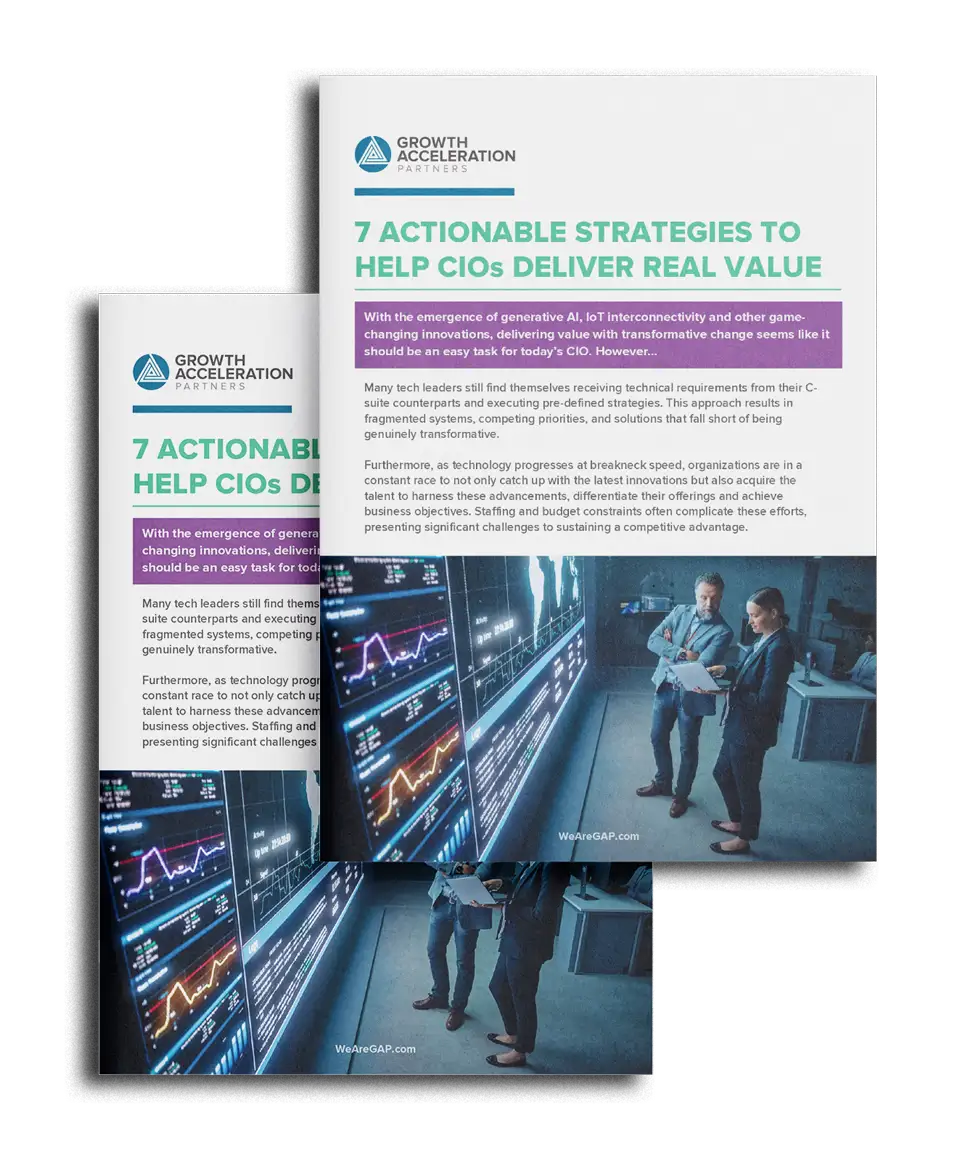
About This Document
Gain valuable insights with the seven actionable strategies designed to help CIOs enhance their strategic influence and deliver real business value through technology. This white paper by Growth Acceleration Partners addresses critical areas such as aligning technology with business goals, fostering cross-functional collaboration, driving digital transformation, and leveraging strategic partnerships. It provides practical advice and success stories to illustrate the positive impact of these strategies on organizational growth and competitiveness.
Full Content Below
Read the Full Document
Explore the complete publication below
With the emergence of generative AI, IoT interconnectivity and other game-changing innovations, delivering value with transformative change seems like it should be an easy task for today’s CIO. However…
Many tech leaders still find themselves receiving technical requirements from their C-suite counterparts and executing pre-defined strategies. This approach results in fragmented systems, competing priorities, and solutions that fall short of being genuinely transformative.
Furthermore, as technology progresses at breakneck speed, organizations are in a constant race to not only catch up with the latest innovations but also acquire the talent to harness these advancements, differentiate their offerings and achieve business objectives. Staffing and budget constraints often complicate these efforts, presenting significant challenges to sustaining a competitive advantage.
To propel business growth and boost your competitive advantage, CIOs and CTOs must turn up their influence and demonstrate how holistic tech transformations deliver real value. Top technology leaders achieve success when they operate as change agents, working with other executive decision-makers to develop strategies that improve productivity, scalability, profitability and customer experiences.
This resource is presented by Growth Acceleration Partners (GAP), a consulting and technology services company deeply engaged with CIOs and their challenges. It outlines strategies to help CIOs cultivate strategic skills, boost CxO-level collaboration, and drive overall business results with technology. Relevant success stories exhibit the value of engaging a collaborative business partner to build custom solutions, speed up implementations and optimize resources.

YOUR ACTIONABLE STRATEGIES
- Be a Strategic Leader
- Collaborate to Architect Aligned Strategies
- Deliver on Digital Transformation
- Demystify the Value of Infrastructure
- Engage with Customers
- Communicate and Maintain Visibility
- Leverage a Strategic Partner to Bridge Talent Gaps
1. BE A STRATEGIC LEADER
CIOs must be strategic, aligning and melding transformative technology solutions with the business’s overall strategic imperatives. This endeavor doesn’t happen in a vacuum, and the best ideas won’t come from a one-hour meeting. Well-thought-out strategies culminate from a series of conversations.

Start by nurturing an open dialogue with the CEO. You should gain a clear understanding of the CEO’s vision and the organization’s strategic priorities to best determine how technology can drive business value.
According to GAP’s CEO and Cofounder Joyce Durst, “The most effective tech leaders excel in actualizing strategic vision by skillfully infusing the power of transformative technology solutions. They tell the story — and sell the vision, thereby turning ambitious goals into tangible realities.”
Initiate conversations with C-level peers to discuss how the overall company objectives relate to their departmental goals. Gather diverse perspectives from cross-functional managers, learning about day-to-day priorities, challenges and how technology may be able to facilitate (or hinder) success.
By expanding your knowledge and network across the business, CIOs can transition from being viewed as an IT leader to becoming highly-respected as a well-rounded strategic executive.
2. COLLABORATE TO ARCHITECT ALIGNED STRATEGIES
By intimately understanding strategic requirements, departmental goals and pain points, CIOs can collaborate with leaders to build aligned technology strategies centered on business needs. When you are actively engaged in proactively shaping and architecting holistic solutions, you avoid getting flooded with disjointed initiatives from each department.
The big picture lens and cross-functional perspectives also allow CIOs to identify force multipliers, which are single initiatives that address multiple issues, benefiting the overall organization. For example, connected systems can mitigate errors, improve productivity and boost satisfaction across multiple departments.

In these discussions, CIOs face the crucial challenge of striking a balance between demonstrating technical expertise and effectively communicating strategies, while keeping the audience’s wants and needs in mind. Avoid alienating non-technical colleagues by translating complex concepts into clear, accessible language to facilitate smooth collaboration.
A business-savvy CIO bridges the gap between technology and strategic priorities, demonstrating how tech initiatives impact business results. GAP’s CTO Paul Brownell draws clear connections to show how strategic priorities are supported by IT, and likewise, how each IT initiative drives value by advancing organizational goals. This exercise helps him highlight links to top business objectives, identify gaps, and resolve competing priorities to enhance strategic coherence across the organization.
Besides collaborating cross-functionally, be sure to connect with your technology-focused peers and colleagues. Communicating with your CTO, CDAO, CISO and CPO — and collaborating with other tech-savvy leaders who see the value of digital innovation — can give you a well-rounded view of the potential risks and benefits before making decisions on increasingly complex topics.
Identify where projects, resources and goals might intersect (or conflict), and determine how synergies can improve outcomes. Sharing knowledge and diverse perspectives can lead to novel solutions and accelerate innovation.

Aligned and unified digital priorities bring the C-suite together and encourage a co-ownership model where IT and the business share responsibility for digital initiatives. These partnerships reduce resource and budget constraints while mitigating risk. IT feels better supported, and the business feels more engaged. Experts estimate that CIOs who co-own digital projects with their CxO counterparts are more than twice as likely to be successful with these investments.
However, even with a strong collaborative environment, it can be challenging to design and execute long-term strategies when technology is rapidly evolving. Gartner recommends that, in some cases, a “minimum viable strategy” might be suitable. Instead of getting hung up on unknowns or stuck executing outdated initiatives, develop plans that allow for ongoing iterations and improvements.

Case in Point: CarParts.com is a leading online retailer in the automotive industry that sought to develop a long-term, transformational path. As a technology consultant, GAP provided a macro view to help CarParts.com build a holistic roadmap, covering automation opportunities, an application modernization analysis, a robust disaster recovery plan and a cloud strategy. Additionally, GAP helped the CTO articulate the vision and secure buy-in for the investments by connecting and aligning digital priorities with the overall strategic objectives.
3. DELIVER ON DIGITAL TRANSFORMATION
Non-IT executives may think of digital transformation as a project with a start and a finish. CIOs need to help colleagues see digital transformation as a journey, enabling the achievement of near-term business objectives and positioning the organization for long-term innovation and success.
Digital transformation initiatives have evolved with technology, starting over 20 years ago with record digitization and the adoption of enterprise resource planning (ERP) systems. Today, many organizations are focused on optimizing operations through advanced data analytics, IoT and AI.
As a visionary leader, you must also think about what you need to do today to prepare for groundbreaking digital transformation initiatives in the future, such as:
- Quantum computing to supercharge machine learning algorithms
- Robotic process automation (RPA) for complex and creative tasks
- Digital twin technology for real-time monitoring, analysis and simulation
- Augmented and virtual reality (AR/VR) applications for immersive learning experiences
- Voice recognition and natural language processing (NLP) to make digital interactions more intuitive

A comprehensive digital transformation strategy is multi-faceted, has infrastructure dependencies and requires multi-year commitments, even in times of uncertainty. CIOs must communicate a long-term roadmap that ties to the top strategic imperatives — and show value delivered along the way — to assure sustained support.
Agile development and design thinking play pivotal roles in the digital transformation landscape to ensure quick development and user adoption. Agile development emphasizes flexibility, continuous feedback and iterative processes, while design thinking is a problem-solving approach that focuses on understanding the user, challenging assumptions and redefining problems to come up with creative solutions. This combination accelerates the delivery of value by allowing tools to be developed and refined quickly in response to user feedback and changing market demands.
Meanwhile, some organizations have been burned by digital transformation projects that didn’t deliver the expected value or ROI. Deloitte research identifies three elements to successful digital transformation:
- A clearly articulated digital strategy
- Commitment for specific technology investments
- People and process readiness for the change
Although it may seem overly simplified, the key is to take deliberate actions on each of these elements to ensure you have a solid plan, budget for implementation and change management support. By following this framework, organizations are more likely to derive the most value and achieve a high ROI from digital transformation initiatives.
Case in Point: Kroger is a leading supermarket chain that modernized its stores to enhance efficiency and customer engagement. Paper price tags and static shelf displays were replaced with dynamic digital displays, which showed real-time pricing, product videos for customers and stocking details for employees. Kroger achieved a high ROI by articulating the strategy, making the technology investments and implementing the corresponding people and process changes.
4. DEMYSTIFY THE VALUE OF INFRASTRUCTURE
Organizations must have modernized systems and infrastructure to evolve with rapid changes in technology. Legacy technology, disconnected systems and technical debt are significant risks to an organization’s ability to adapt, scale and grow. IoT, AI and digital transformation initiatives won’t thrive (or even work) with outdated infrastructure because they require massive amounts of storage and computing power.
Building technical literacy within the C-suite builds trust and ensures colleagues recognize the value and necessity of infrastructure projects. Demystify this behind-the-scenes work and connect the dots on how infrastructure supports—or harms—strategic imperatives and departmental goals. This foundational knowledge facilitates discussions and improves decision-making.
Transparency about timelines and complexity for infrastructure projects is also critical to secure the necessary resources and set expectations. For instance, many executives may assume transitioning to the cloud is as simple as “lift and shift.” But CIOs can share insights about capturing the full value of cloud technology to enable flexibility, scalability and speed. And to achieve these benefits, the organization must invest in cloud expertise to design an optimized solution.
Virtually all technology projects depend on flexible and scalable infrastructure. Securing buy-in from the entire C-suite is crucial to ensure infrastructure is prioritized to support broader organizational objectives.

Case in Point: Revealix is a digital health startup that needed to move its cloud-based mobile application from beta to commercial production. This transition required a more scalable and fault-tolerant cloud infrastructure. GAP provided the knowledge and skills to design, build, provision and deploy a customized AWS cloud infrastructure. By engaging a technology services company with cloud expertise, Revealix’s CIO delivered an optimized cloud solution — with no additional staffing — while accelerating time-to-market by three months.
5. ENGAGE WITH CUSTOMERS
All too often, customer interactions are limited to the sales and marketing teams. Customer requirements are typically relayed to IT, and as a result, IT is disconnected from the customer’s pain points and strategic goals.
As technology touches every part of the business, it becomes a critical element that impacts the customer experience and delivers growth. Online platforms, mobile apps, social media and chatbots have created new channels for customer interactions. Subscription services, platform-based ecosystems and freemium models are examples of how technology has enabled new revenue streams.
McKinsey recommends the CIO and tech leaders should actively participate in the inner circle with the customer. Instead of being an order-taker, IT becomes an order-shaper by intimately understanding the customer’s needs and developing optimized solutions.
Additionally, cross-functional initiatives, customer journey mapping and data-driven insights can highlight opportunities to enhance product offerings, personalize customer experiences, predict future needs and drive loyalty.
Case in Point: Papa John’s needed to grow online revenues with its mobile application. The pizza chain hired GAP to create a new Android app and redesign the existing iOS app. GAP performed user experience (UX) testing with external potential customers to create highly functional, user-oriented apps that included ordering, payments, rewards visualization, notifications and location-based services. As a result, both the Android and iOS apps have 4+ star ratings, enabling continued sales growth with demonstrated customer satisfaction.
6. COMMUNICATE AND MAINTAIN VISIBILITY
An approachable, transparent and engaged leader stays connected to the ground level and gathers valuable feedback from employees, stakeholders and customers to make better decisions (and course corrections, when needed). Your openness can inspire employees and build trust as you drive impactful digital initiatives that transform the business.
Maintain visibility as a strategic business leader by communicating periodic status updates and key performance indicators (KPIs) to articulate the value that technology projects deliver. In addition to typical metrics, highlight intangible benefits, like improved satisfaction and engagement.
As you deliver updates, standardize the frequency and presentation style so the audience becomes familiar with the format and sees ongoing progress. Include a review of the overall technology roadmaps and status scorecard with each initiative pointing to the correlated strategic imperatives. When applicable, include technical literacy refreshers and translate why initiatives are important.
Your presentations and outreach are opportunities to be transparent about priorities and dependencies. Regular communication is also a great way to gather stakeholder feedback and raise red flags if additional resources are required to stay on track. Proactive communication reinforces the connections between IT and business strategies, fostering a motivative and collaborative environment.

7. LEVERAGE A STRATEGIC PARTNER TO BRIDGE TALENT GAPS
McKinsey research shows people and talent-focused initiatives can yield high-value business outcomes, including reducing costs, increasing revenue from new and existing streams, and improving the employee experience. In today’s dynamic tech landscape, top talent is among a CIO’s most valuable assets, and cultivating a high-performing team is the cornerstone of disruptive innovation.
The challenge is that traditional approaches — like people development and employee recognition — don’t always cut it. Tech leaders face incredibly competitive job markets, making people management tricky (to say the least). Escalating salary expectations and demands for remote work make building a cohesive culture a job in itself.
Training and upskilling initiatives are necessary to support rapidly evolving technology, but difficult to prioritize against existing systems and projects. Moreover, niche projects and new technology often require completely new disciplines of knowledge, making it unrealistic to expect existing staff to get up to speed.
Many companies struggle to hire, onboard, and develop talent quickly enough to keep up with business needs and develop optimized solutions in this ever-changing landscape.
If tech talent acquisition is preventing you from achieving goals, it’s time to leverage an external resource with skilled experts on hand when you need them. External consulting and technology specialists like GAP invest deeply in diverse teams and ongoing education, offering a breadth of capabilities and a depth of expertise for building custom solutions. Our specialists integrate seamlessly with your organization, so you can focus on your core product offering and customers.
No matter where you are in your technology journey, GAP offers specialized services in every stage of the software and data engineering process — technology consultation, strategy, architecture, design, build, automation, delivery and even managed services — to help you evolve from ideation to final product.
GAP’s experts will help you understand what you need to do in order to solve your technology challenges. Our team of engineers and developers serve as an extension of your staff — rather than another vendor that needs to be managed — to make it happen. GAP’s seasoned professionals bring decades of experience and a forward-looking perspective to ensure your solutions are both current and future-ready.
Case in Point: ZenBusiness helps entrepreneurs launch and grow new companies with a software-as-a-service (SaaS) platform. In 2019, ZenBusiness experienced rapid growth and partnered with GAP to quickly build up the engineering team. GAP continues to provide flexibility and scalability to ZenBusiness with quick talent acquisition of high-quality resources with diverse backgrounds and skillsets.

Now is the time to amplify your impact on business outcomes and spearhead technology-driven transformations. Success hinges on embracing a strategic leadership approach, collaborating with clear communication, modernizing infrastructure, prioritizing the customer experience, and partnering with experts who can accelerate your growth.
CIOs who consistently demonstrate strategic leadership and effectively bridge the gap between IT and business outcomes will boost their organizational influence and deliver value. By ensuring technology acts as a transformative force, you can drive sustained success for your organization.