
When to Outsource IT vs. Build In-House — Industry by Industry
About This Document
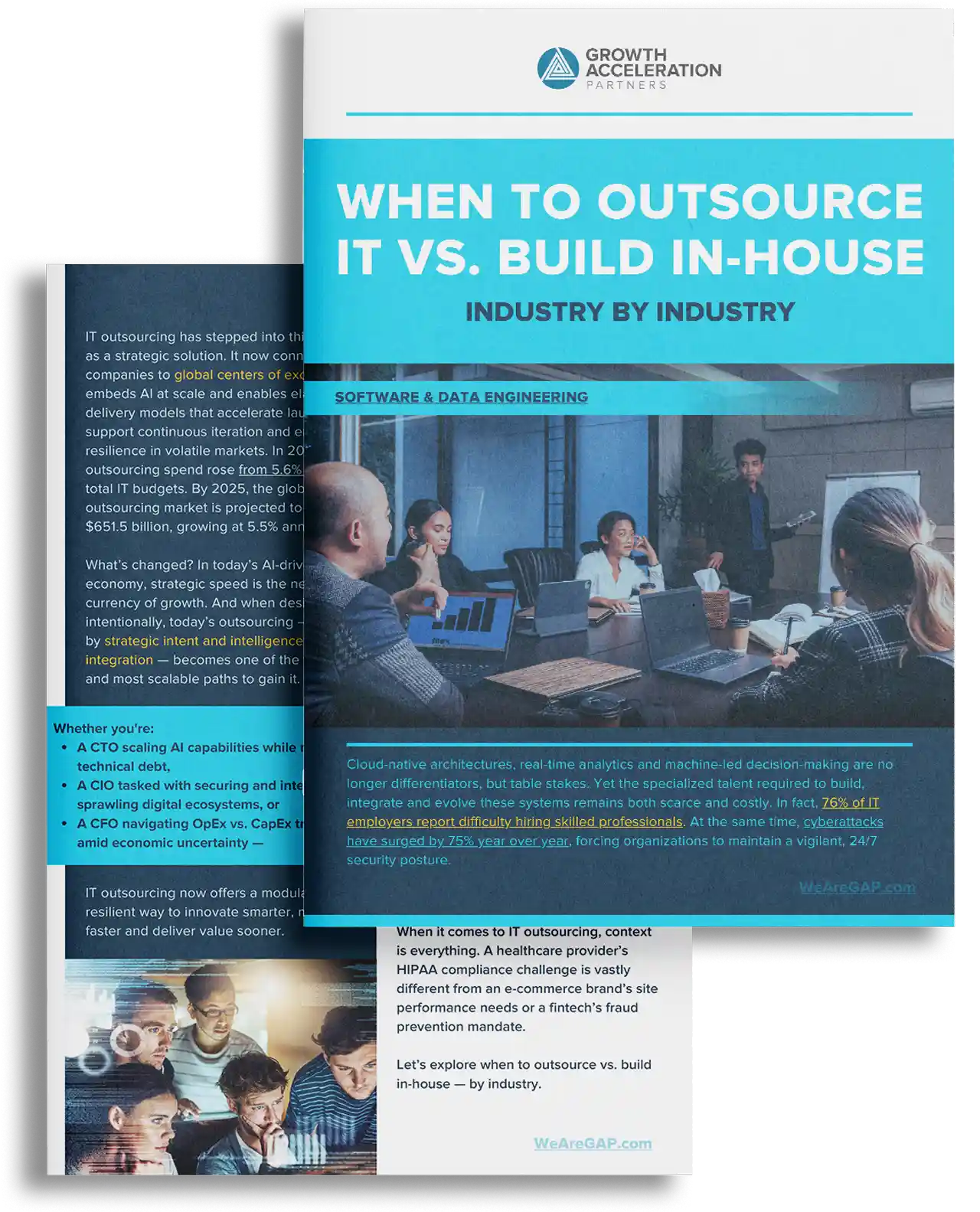
This document, ‘When to Outsource IT vs. Build In-House — Industry by Industry,’ explores the evolving role of IT outsourcing as a strategic growth accelerator in today’s AI-driven economy. It moves beyond traditional cost-cutting perceptions, presenting outsourcing as a modular and resilient path to innovation, speed, and value delivery. The guide provides industry-specific insights for healthcare, financial services, retail & e-commerce, manufacturing, and tech & software, detailing which IT capabilities are best suited for outsourcing versus in-house development to achieve strategic objectives and long-term agility.
Full Content Below
Read the Full Document
Explore the complete publication below
Cloud-native architectures, real-time analytics and machine-led decision-making are no longer differentiators, but table stakes. Yet the specialized talent required to build, integrate and evolve these systems remains both scarce and costly. In fact, 76% of IT employers report difficulty hiring skilled professionals. At the same time, cyberattacks have surged by 75% year over year, forcing organizations to maintain a vigilant, 24/7 security posture.
IT outsourcing has stepped into this breach as a strategic solution. It now connects companies to global centers of excellence, embeds AI at scale and enables elastic delivery models that accelerate launches, support continuous iteration and enhance resilience in volatile markets. In 2023 alone, outsourcing spend rose from 5.6% to 8.1% of total IT budgets. By 2025, the global IT outsourcing market is projected to reach $651.5 billion, growing at 5.5% annually.

What’s changed? In today’s AI-driven economy, strategic speed is the new currency of growth. And when designed intentionally, today’s outsourcing — defined by strategic intent and intelligence integration — becomes one of the fastest and most scalable paths to gain it.
Whether you’re:
- A CTO scaling AI capabilities while managing technical debt,
- A CIO tasked with securing and integrating sprawling digital ecosystems, or
- A CFO navigating OpEx vs. CapEx trade-offs amid economic uncertainty —
IT outsourcing now offers a modular, resilient way to innovate smarter, move faster and deliver value sooner.
But to unlock its full potential, leaders must move beyond legacy sourcing models. That means understanding how outsourcing plays out in your industry, which capabilities to retain or externalize, and how to structure vendor relationships for long-term agility and innovation — not just short-term efficiency.
In a recent blog post, we examined the trends and strategies defining IT outsourcing in 2025. This article explores industry-specific use cases for IT outsourcing.
How Industry Leaders Use IT Outsourcing
When it comes to IT outsourcing, context is everything. A healthcare provider’s HIPAA compliance challenge is vastly different from an e-commerce brand’s site performance needs or a fintech’s fraud prevention mandate.
Let’s explore when to outsource vs. build in-house — by industry.
HEALTHCARE
Few sectors face as much complexity — and opportunity — as healthcare. With strict regulatory frameworks, legacy infrastructure and accelerating digital expectations from patients and payers, healthcare CIOs and CTOs are under pressure to modernize securely and quickly.
The AI era amplifies this challenge: from predictive diagnostics to automated compliance monitoring, the demand for data integration and secure, intelligent systems has never been higher.
This makes outsourcing a strategic tool for moving fast while mitigating risk.
When to Outsource
Regulatory Compliance Programs
Outsource the entire lifecycle — risk assessments, policy creation, HIPAA/HITECH/FDA training and audit support — to partners with dedicated compliance infrastructure and tooling.
Telehealth Platform Development
Launch integrated, scalable solutions faster by partnering with vendors experienced in EHR integration, video streaming and patient authentication protocols.
Legacy System Modernization
Outsourcing API encapsulation, re-platforming or phased cloud migration (e.g., EHRs, billing systems) allows healthcare orgs to reduce technical debt without burdening internal IT teams.
Security Operations
Outsource advanced threat detection, SOC-as-a-Service, penetration testing and response management to MSSPs with proven healthcare-specific credentials.
When to Build In-House
EMR/EHR Custom Workflows
Patient-facing systems deeply embedded in clinical workflows — such as charting, scheduling and alerts — benefit from in-house ownership to ensure alignment with care models.
Proprietary Outcomes Analytics
Analytics tied to patient outcomes, risk stratification or cost models often require custom logic and direct clinical oversight — best built and evolved internally.
Differentiated Patient Experiences
If your digital front door (e.g., mobile app, portal) is a brand differentiator, maintain full control over design, data handling and iteration speed.

Applications in Healthcare
- Fox Group helped three hospitals reduce compliance headcount by 40% while maintaining 100% audit pass rates.
- RadixWeb deployed a telehealth system with Epic/Cerner integration and 24/7 outsourced support — cutting virtual visit wait times by 70%.
- Leobit led a phased migration of COBOL-based systems, achieving 60% lower infrastructure costs and 99.9% app availability.
FINANCIAL SERVICES
Finance is undergoing a tectonic shift: cloud-native banking, real-time payments, AI for fraud and hyper-personalized user experiences are becoming table stakes. But these innovations must operate under one of the world’s most demanding regulatory regimes — SOX, PCI-DSS, GDPR, and beyond.
In this environment, outsourcing becomes an instrument for speed, compliance and scale — especially for mid-tier institutions aiming to compete with fintech disruptors and digital-first banks.

When to Outsource
Cybersecurity and Risk Management
MSSPs deliver continuous monitoring, incident response and compliance audits tailored to finance-specific threats and standards.
Infrastructure and Cloud Migration
Outsourcing to specialized DevOps/cloud engineering partners accelerates the migration of legacy cores to scalable cloud platforms with SLAs.
Payments Modernization (PaaS)
Tap into payments-as-a-service platforms to launch digital wallets, real-time rails and fraud controls without multi-year builds.
AI-Powered Fraud Detection
Use external AI/ML tools to monitor transaction behavior, detect anomalies and improve approval accuracy — especially valuable for mid-market institutions.
When to Build In-House
Trading Algorithms and Risk Engines
If your edge comes from proprietary pricing, hedging or credit risk modeling logic, keep development internal to protect IP.
Customer Portal UX
Control over branded interfaces, onboarding flows and personalization logic is critical for differentiation and trust.
Data Governance Frameworks
If you require tight control over PII, consent mechanisms and reporting logic, core governance tools should be internally owned.
Applications in Finance
- Capital One shut down all 8 of its data centers by 2020 after full cloud migration, boosting innovation and reducing maintenance.
- WaFd Bank used AWS to build AI-powered analytics and voice banking, resulting in 6,600+ new customer accounts and a 235% NPS increase.
- Danske Bank halved its migration timeline by moving 16,600 servers and 25PB of data to AWS using hyperautomation. Cloud costs dropped ~50%, and 700+ employees were upskilled to accelerate innovation.
RETAIL & E-COMMERCE
For today’s retailers, customer expectations are shaped by Amazon-grade personalization, seamless omnichannel experiences, and instant fulfillment. As shopping journeys blend digital and physical, IT leaders face mounting pressure to deliver not just scale, but precision in experience, inventory and performance.
Retail CIOs and CTOs are now judged on their ability to optimize conversion, retention and supply chain responsiveness. IT outsourcing — especially in areas like performance engineering, customer data platforms and omnichannel enablement — has become a critical enabler of revenue growth.

When to Outsource
Omnichannel Tech Integration
Outsource systems integration across POS, eCommerce platforms, inventory and ERP systems — especially with pre-built connectors and fulfillment APIs.
Site Performance Optimization
Outsource caching, CDN strategy, mobile performance engineering and SEO tuning to agencies or firms specializing in e-commerce performance.
Fraud Detection & Payment Processing
Use PCI-compliant, AI-driven fraud solutions and global payment gateways to reduce losses and friction without building those engines internally.
Composable Commerce / Headless CMS
Tap external specialists to architect and deploy modular commerce stacks that support rapid front-end iteration and scalability.
When to Build In-House
Proprietary Personalization or Loyalty Engines
If your brand experience hinges on unique recommendation logic, personalized merchandising or deep CRM workflows, these systems should be tightly owned and continuously evolved internally.
Customer-Facing Features That Differentiate
Features like virtual try-ons, UGC communities or branded mobile apps that drive emotional connection and repeat visits require internal ownership.
In-Store IoT and Beacon Networks
For privacy-sensitive, real-time location-based features, in-house control enables greater data governance and tighter hardware/software integration.
Applications in Retail & E-Commerce
- Allbirds outsourced omnichannel inventory integration via Shopify and tech partners — unlocking ship-from-store fulfillment across 31 locations and improving online conversion by reducing stockouts.
- The Sill — a U.S. mid-market e-tailer — outsourced SEO and site speed optimization, resulting in a 45% boost in organic traffic and significant sales growth.
- Dollar Shave Club migrated to an outsourced SaaS commerce platform, cutting tech maintenance effort by 40% and redirecting resources to customer innovation.
MANUFACTURING
The Fourth Industrial Revolution is redefining manufacturing. Smart factories, edge computing, predictive maintenance and digital twins are transforming how plants operate and compete. But industrial IT leaders must integrate OT and IT securely, support legacy ERP systems, and unlock real-time insights from massive machine data — without exposing themselves to cyber risks or unplanned downtime.
Outsourcing provides manufacturers with the flexibility to implement specialized systems, extend digital capabilities to the edge, and tap into AI/IoT expertise without overextending internal teams.

When to Outsource
IT/OT Convergence Platforms
Engage providers experienced in SCADA, IIoT, and edge computing to integrate operational tech with enterprise systems securely.
Supply Chain Visibility and EDI Systems
Outsource real-time logistics dashboards, blockchain-based traceability, and partner data integration to vendors with global supply chain platforms.
Predictive Maintenance via AI/ML
Leverage third-party platforms to analyze sensor data, detect early failure signals, and create automated service workflows—especially when IoT maturity is still evolving internally.
Legacy ERP Modernization
Engage consulting partners for phased refactoring, cloud re-platforming, and performance tuning of legacy SAP or Oracle deployments.
When to Build In-House
Digital Twin Models and Process Simulations
If digital twins are used for IP-sensitive processes, such as optimizing production layouts or simulating proprietary algorithms, build them internally to maintain control.
Proprietary Control Logic (PLC/Robotics)
Outsource tooling, but own the logic. Manufacturing excellence often comes from nuanced, tightly tuned machine code that defines quality, safety, and yield.
Deep ERP Customizations
ERP modules tailored for unique workflows, regulatory contexts, or efficiency strategies are often best maintained in-house for responsiveness and version control.
Applications in Manufacturing
- Manufacturers using outsourced AI platforms for predictive maintenance reported reduced unplanned downtime and lower maintenance costs, without building internal data science teams.
- Firms outsourcing EDI and logistics systems improved shipment traceability and reduced order cycle time through cloud-based visibility tools.
- One industrial company leveraged an edge-platform partner to integrate real-time sensor data from the shop floor with enterprise analytics, reducing manual data entry by 80%.
TECH & SOFTWARE
TIn tech companies, IT isn’t a supporting function — it is the business. For product-led organizations, engineering capacity equals growth velocity. Yet as product portfolios expand, infrastructure becomes more complex, and AI experimentation accelerates, leaders must make tough calls about where to allocate internal talent.
Outsourcing has matured from a tool for overflow engineering into a precision instrument for scaling, testing and accelerating R&D, without compromising the core roadmap.

When to Outsource
QA, DevOps, and Automation Engineering
Offload regression testing, pipeline automation, CI/CD ops and environment management to external teams — freeing core developers to focus on innovation.
Short-Term Product Experiments and Prototypes
Outsource MVPs, AI/ML proofs-of-concept or blockchain trials that fall outside current capacity or require short-term specialization.
Cloud Infrastructure & Platform Ops
Engage experts to manage container orchestration (Kubernetes), observability platforms, cost optimization and SRE functions at scale.
Front-End Engineering & UI/UX
For modular UI projects or non-core interfaces, outsourcing can accelerate delivery while internal teams focus on architecture and performance.
When to Build In-House
Core Product Architecture and Logic
The intellectual backbone of your platform — business logic, data models, APIs and key architectural choices — must be owned and evolved internally.
Strategic Technology Roadmap and System Design
Vision-setting, tooling decisions and integrations that determine long-term scalability should never be offloaded.
Customer-Facing Differentiators
Features that define user experience, retention, or monetization (e.g., collaboration tools, analytics dashboards, native integrations) are your competitive moat — keep them in-house.
Final Word
Let’s be honest — the way we think about outsourcing has changed.
It’s no longer a tactical decision to cut costs or “fill gaps.” It’s a growth strategy — one that smart CTOs, CIOs and CFOs are using to build more resilient, scalable and innovative businesses. But realizing that promise depends on choosing the right partner — one that gets your business goals and knows how to build around them.
That’s where Growth Acceleration Partners (GAP) comes in.
GAP is a consulting and technology services company that doesn’t just show up to code — we show up to consult, build, modernize and co-create. We specialize in turning high-stakes ideas into revenue-generating software and data solutions. Whether you’re launching a new product, modernizing legacy systems or navigating a complex migration, GAP helps you move faster — without sacrificing quality or control.
So if you’re looking for an outsourcing model that’s designed for today’s pace, GAP is ready to help.