

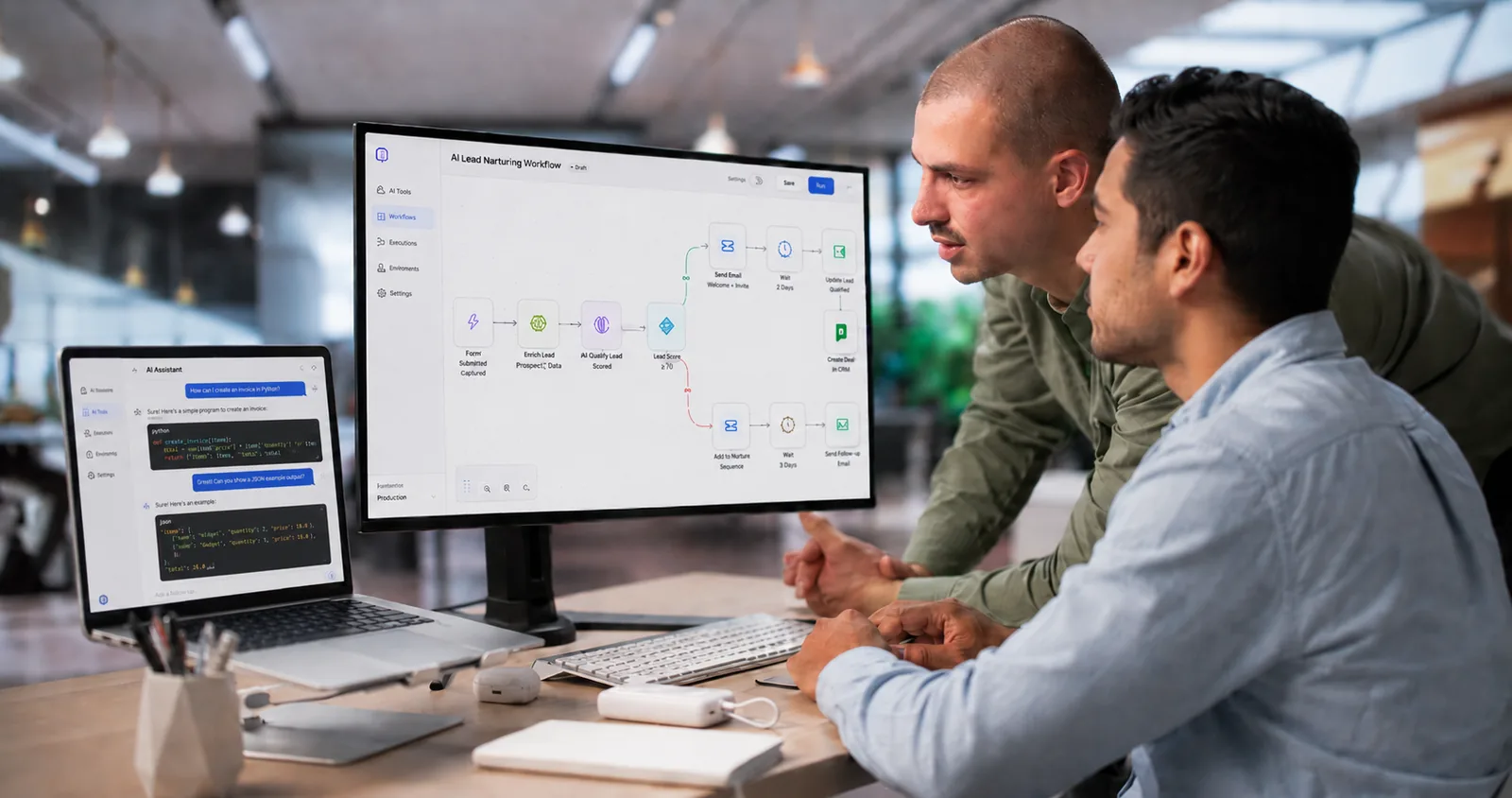
It looks like a capacity problem. It’s a connection problem.
More hands rarely fix systems that can’t talk to each other.
Companies struggle to scale or launch new products for a surprisingly consistent set of reasons. The software underneath is a patchwork of legacy systems, third-party connectors, and manual workarounds. It shows up in familiar ways:
- Labor-intensive, error-prone handoffs create backlogs, like people cross-referencing inventory, purchase orders, and field hours by hand.
- Off-the-shelf connectors break as data volumes and business needs grow.
- Data is scattered across CRM, accounting, and file repositories, so there’s no single source of truth anyone can audit.
The delays compound. Work that’s finished but not yet invoiced sits for weeks, and new product ideas wait behind the plumbing.
The usual fixes come with their own costs. Bringing in extra hands means hiring delays, ramp-up time, and team churn, and sometimes architecture rewrites halfway through. Buying AI coding tools helps, but code that’s written faster just moves the bottleneck to testing, review, and release, unless the delivery system around the code changes too.
Five signals that your systems are the bottleneck.
Tick the ones that sound like your organization. Nothing is stored or sent anywhere.
Tick whatever sounds familiar. There’s no wrong answer.
See what a first step looks likeWhere the delay turns into money.
The cost rarely appears as one line item. It spreads across billing, hiring, and rework.
Time-to-revenue
When transactions have to be checked and reconciled by hand, billing waits. Automated “ready-to-invoice” paths process work as soon as it’s complete, which can clear weeks of unbilled backlog.
Technical debt
Software that isn’t built to scale under load from day one tends to need a rewrite mid-flight. Designing for scale at the start avoids paying for the same system twice.
Hiring lag
Waiting months to recruit, hire, and onboard engineers isn’t viable for urgent product priorities. The cost is the revenue those months would have produced.

AI does the execution. Engineers stay accountable.
Every engagement runs on GAP’s AI Development Lifecycle, or ADLC. Pick a stage to see who does what.

-
1. Define
What the agents handle
Gather and structure requirements, existing documentation, and system context so the team starts from the same picture.
What an engineer decides
Sets the outcome and the success thresholds with you.
1 / 7 -
2. Map
What the agents handle
Inventory the systems, APIs, and data sources involved, and draft the schema and field mappings between them.
What an engineer decides
Confirms the architecture and approves the mapping before anything is built.
2 / 7 -
3. Orchestrate
What the agents handle
Break the work into tasks and line up the shared skills and guardrails each task needs.
What an engineer decides
Owns the plan and decides how the work is divided between agents and people.
3 / 7 -
4. Execute and test
What the agents handle
Draft code, tests, and documentation, and run checks inside the sandbox.
What an engineer decides
Reviews the evidence, not just the code, and approves before work moves on.
4 / 7 -
5. Evaluate
What the agents handle
Run evaluations against the quality thresholds agreed with you, including the controls in the risk register.
What an engineer decides
Judges the results and decides whether the work is good enough to proceed.
5 / 7 -
6. Deploy
What the agents handle
Prepare the release and run pre-deployment checks after sandbox validation.
What an engineer decides
Approves the move to production.
6 / 7 -
7. Observe and learn
What the agents handle
Monitor the live system against the agreed thresholds and flag drift or failures.
What an engineer decides
Acts on what’s found and feeds the lessons back into the skills and guardrails.
7 / 7
The loop repeats in tight cycles inside dedicated sandbox or staging environments, so nothing untested reaches your live systems. A change to a skill, prompt, or model is tested like code before it reaches the work.
What we build.
Most projects combine a few of these. Each one is scoped around a business outcome, not a headcount.
Connect the systems that don’t talk to each other
System integration and API engineering
Custom software bridges between legacy systems and modern SaaS applications, built on published APIs. One example is connecting field service management tools to construction ERPs. We work with REST and GraphQL APIs, microservices, third-party integrations, and event-driven architectures, in Java, .NET, Python, Node.js, Ruby, and PHP.
Replace the middleware that keeps breaking
Custom integrations instead of fragile connectors
We identify the third-party connectors that fail under growing data loads and replace them with maintainable custom integrations, so the connection is something your team can understand, operate, and extend.
Put your data in one place you can trust
Data engineering and centralized warehousing
A central, auditable source of truth that ingests, cleans, and consolidates data scattered across CRM, accounting, and file repositories. This includes pipelines, cloud warehousing, data mesh, and governance, so the data is ready for analytics and AI.
Build the product itself
Custom software and platforms
SaaS and product platforms built from scratch or reimagined, across web, mobile, and API ecosystems. Front-end work in React, Angular, and Vue is paired with UI and UX research, prototyping, and testing to improve conversion.
Run it reliably
Cloud-native engineering and DevOps
DevOps pipelines, containers, and cloud deployment on AWS, Azure, and Google Cloud, with automation and managed services where you want them. We support the full journey, from consultation and architecture through development and operation.
How we think about this work.

Prove it small first
We’d rather earn the bigger project. Many engagements begin with a fixed-price project of about five to six weeks, aimed at one high-impact bottleneck, so you can see the return before expanding scope.
Test where it can’t hurt
Development and validation happen in dedicated sandbox or staging environments, using zero-dollar test transactions. Your live production environment isn’t at risk while the work is built.
One accountable team, not extra hands
You get a disciplined, integrated team of senior engineers who act as an extension of yours, so there’s no hiring cycle, no ramp-up, and no third party for you to manage. They bring patterns from across industries.
Speed with accountability
AI agents do the execution. Autonomous engineers, who are senior engineers experienced in directing agents, set the outcome, review the evidence, and approve at each gate. AI work is gated by human approval, and one client’s context never mixes with another’s.
Reliability by design. For each use case, we write down what can go wrong in a risk register that you review and agree to. Each risk gets a control, quality thresholds are set with you, and we monitor against them once the system is in production.
A good first step is one bottleneck.
Pick the handoff, connector, or data problem that costs you the most, and start there. Everything else can follow if it makes sense.
A fixed-price entry project
A small, high-impact project of about five to six weeks that tackles one bottleneck and shows the return before you expand scope.
Core system integration
Custom-built bridges and central data warehousing: replacing brittle middleware, mapping schemas, and consolidating scattered data. Delivered iteratively in a sandbox.
End-to-end product architecture
Full architecture and delivery of custom software across web, mobile, cloud-native platforms, and API ecosystems, run as an integrated delivery pod on the ADLC.

If two or more of the five signals above sounded familiar, it’s worth a conversation.
Questions people ask before they start.
How is this different from hiring contractors?
Staffing a team is the easy part. Turning an objective into scalable software is harder. Individual contractors bring hiring delays, ramp-up risk, and churn. GAP provides an integrated team of senior engineers who bring patterns from other industries and act as a single accountable partner from the first day.
Will a custom integration disrupt our live data and operations?
It shouldn’t. We build and validate in a dedicated sandbox or staging environment, using zero-dollar test transactions, and we confirm that everything works before we touch live data.
Can’t we just buy AI coding tools and do this ourselves?
You can, and many teams do. But tools alone usually move the bottleneck instead of removing it: code is written faster while testing, review, and release stay manual. We bring the whole delivery system, so the speed actually reaches production.
How can we trust AI-generated code in our production systems?
By shaping the variability instead of pretending it isn’t there. For each use case we write down what can go wrong in a risk register you agree to, put a control on each risk, and validate in sandbox or staging first. A named GAP engineer approves at every decision gate, and a change to a skill, prompt, or model is tested like code.
We’ve been burned by long custom software projects. How do you show value early?
By starting small. A fixed-price entry project of about five to six weeks goes after one high-impact bottleneck, so you can see the return before committing to more.
Who runs the software once it’s built?
That’s up to you. We build software you can take to market or operate internally with confidence, and we can also provide automation and managed services if you’d prefer not to run it yourself.
What does it cost?
Entry projects are fixed-price and scoped around a single bottleneck, so you know the cost before you start. Larger engagements are scoped with you based on the systems and outcomes involved.
Related reading: AI Data Readiness
If scattered, ungoverned data is what’s holding your systems and AI efforts back, see how we prepare data, pipelines, and governance for production.