
- Who it is for
- Format
- Duration
- Team
What clients say
,
Trusted by engineering teams
Certified and recognized


It looks like a training problem. It’s a habit problem.
Access and instruction are the easy parts.
Most organizations have done the visible things: bought licenses for ChatGPT, Claude, or Copilot, and run a workshop or two. Then usage settles at personal drafting, and leadership asks the question that matters: where is the business impact?
Four things tend to stand between access and capability:
- Tools without workflow redesign.
- People have access, but the processes around them haven’t changed.
- Training without change management.
- People learn features in a workshop, but management expectations and daily habits stay put.
- Skills gaps on two fronts.
- Teams need technical skills like prompting and agent orchestration, and human ones like judgment, communication, and curiosity, to work well alongside intelligent tools.
- Learning without a roadmap.
- With no baseline and no clear path, people learn alone, and nobody can say what progress looks like.
That’s why a two-hour class rarely moves anything. Completion rates for self-paced courses tend to sit below 10%, and even the people who finish drift back to old routines without the workflow and management changes that make a new habit worth keeping.
The stakes are rising. The competitive edge is moving from people using AI tools to teams that can design, build, and govern AI-driven workflows, and that takes a different kind of readiness than a license rollout.
Five signals that licenses haven’t become capability.
Tick the ones that sound like your organization. Nothing is stored or sent anywhere.
Tick whatever sounds familiar. There’s no wrong answer.
See what a first step looks likeFour levels give you a way to see where people actually are.
Pick a level to see what it looks like day to day. The same four levels apply to technical and shared services roles. The top level is called Autonomous Engineer in one and AI Value Leader in the other.
Level 0 Non-Integrator
Level 0: Non-Integrator
AI isn’t yet part of daily work. That’s a starting point, not a verdict.
What you’d typically see:
- Little or no regular use of AI tools
- Unsure where AI applies to their role
- Relies on existing manual processes
The goal at this level is awareness and a first genuinely useful win, not mastery.
Level 1 Operative User
Level 1: Operative User
AI is part of the routine, mostly for personal productivity.
What you’d typically see:
- Uses AI regularly for drafting, summarizing, and search
- Results depend on the individual’s own prompting habits
- Little shared practice across the team
This is where most license rollouts plateau.
Level 2 Project Accelerator
Level 2: Project Accelerator
AI is applied to real project work, not just personal tasks.
What you’d typically see:
- Reuses prompts and workflows, and shares them with teammates
- Can point to time saved on specific deliverables
- Brings AI into team planning, not only individual tasks
The shift here is from using a tool to changing how work gets done.
Level 3 Autonomous
Level 3: Autonomous Engineer or AI Value Leader
AI is built into how this person designs and runs their work.
What you’d typically see:
- Engineers design and ship with AI assistance and agentic workflows
- Shared services staff automate processes and build workflows end to end
- Everyone applies human judgment to what AI produces, and helps others do the same
Level 3 isn’t permanent by default. Skills erode as the tools move, which is why we keep these people current.
We built it on ourselves first.
Here’s what happened.
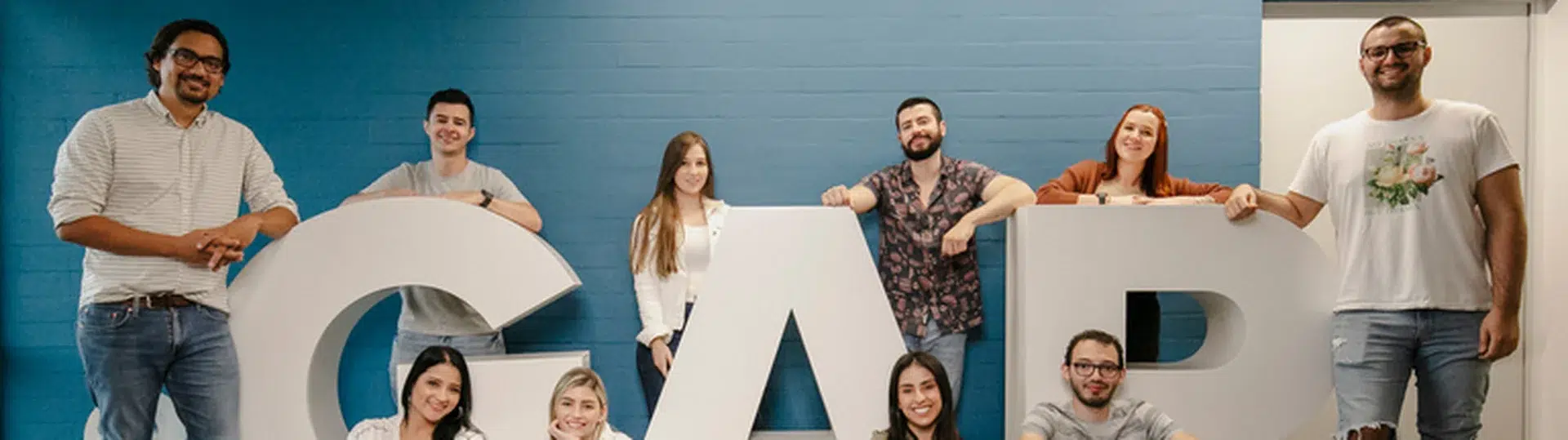
Before offering this to anyone else, we ran it across GAP’s own engineering, finance, marketing, HR, and operations teams, refining it over about two years of assessment cycles.
- Level 3 went from 12% to 41%Across two assessment cycles, the share of our people operating autonomously with AI more than tripled.
- Most people movedOf the 313 people evaluated in both cycles, 77% moved up at least one level.
One caveat: this is our own organization, and results will vary with starting point and commitment. What it shows is that the approach can move a whole workforce, not just the enthusiasts.
What the work includes.
Each piece does one job. You can take them together or one at a time.
- Role-based AI training
- Team playbooks
- Hands-on coaching
- Prompt and agent patterns
- Adoption metrics
- Change management
Find out where everyone actually stands
Evaluation across Levels 0 to 3
Each person is assessed across five impact dimensions by a multi-agent evaluation: one agent evaluates, another challenges the result, and a referee decides, with human calibration on top. The output is a level and specific feedback, not just a score.
Turn each result into a plan
The Educational Machine
Most maturity frameworks stop at a rating. The Educational Machine converts each person’s feedback into a matched development plan, so the gap between “here’s your level” and “here’s what to do next” closes. Team roadmaps roll up from the individual ones.
Train by role, not by tool
Dual-track training waves
Engineering teams work on agentic development and AI-assisted delivery. Shared services teams work on workflow automation and applying AI to their own processes. Both are supported by hackathons, showcases, and AI labs, plus training in the Human Edge qualities described below.
Make the habits stick
ADKAR change management
ADKAR (Awareness, Desire, Knowledge, Ability, Reinforcement) runs underneath everything. In practice: audience-tailored framing for leaders and teams, a Change Crew of peer ambassadors equipped with custom AI assistants, real-time sentiment tracking to spot resistance early, and the shared prompt libraries, Slack channels, and office hours that keep people learning from each other.
Keep Level 3 current
AI Radar
Reaching Level 3 isn’t permanent by default. AI Radar is a recurring refresh cycle with emerging-tech updates and advanced workshops, so already-autonomous people stay current as the tools change and gains don’t plateau or erode.
Tie it to how you recognize people
Measure and reward
Optionally, connect the levels to your job architecture, merit and promotion criteria, and recognition programs, so the behavior you want is also the behavior that’s rewarded. We design this with you, and how far to take it is your call.
Hire for it from the start
Find and attract (optional)
An AI-literacy bar for new hires, plus AI-assisted candidate evaluation, so people joining your teams arrive already thinking in an AI-first way.

How we think about this work.

Capability is built, not bought
Licenses and classes give people access. Capability comes from a baseline, a plan, reinforcement, and accountability working together.
Judgment is part of the skill set
AI output still needs a human to judge it. Alongside technical skills, we develop eight “Human Edge” qualities: radical curiosity, strategic orchestration, architectural empathy, agile creativity, uncompromising integrity, fearless communication, psychological resilience, and collaborative trust.
One program, two tracks
Engineering and shared services teams need different training but the same measurement and change approach. We build Autonomous Engineers in one and AI Value Leaders in the other.
Skills fade unless they’re refreshed
The tools change every few months. A regular refresh keeps already-capable people current, which is what separates a program from a project.
A good first step is a baseline.
Most engagements begin by measuring where people are. After that, take only what you need: a development plan, training, change management, or the full program.
Evaluate and audit.
Measure AI maturity from Level 0 to 3 across five impact dimensions.
Align and roadmap.
Turn each person’s results into a development plan for them and their team.
Enable and train.
Role-based waves for technical and shared services teams, alongside the Human Edge qualities.
Embed and sustain.
Change ambassadors, peer communities, shared prompt libraries, and regular refreshers.

The baseline evaluation takes about 30 days, and you finish it with:
- A baseline readiness report showing where your people stand across Levels 0 to 3.
- A friction audit of what’s blocking adoption today.
- A clear scope for what to do next, if anything.
If a few of the five signals above sounded familiar, it’s worth a conversation.
Questions people ask before they start.
How is this different from LinkedIn Learning or Coursera?
Courses teach features, and most people don’t finish them. This program starts with a baseline for each person, builds a plan around the result, trains by role, and reinforces new habits through change management, peer communities, and accountability. The courses can stay. This is the part that makes them stick.
Do technical and non-technical teams get the same program?
Same framework, different content. Engineering teams focus on agentic development and AI-assisted delivery. Shared services teams, such as HR, finance, marketing, and operations, focus on workflow automation and applying AI to their own processes. Both build the human judgment skills.
What does the evaluation involve?
Each person is assessed across five impact dimensions using a multi-agent evaluation, with human calibration. The result is a Level 0 to 3 rating plus feedback that feeds directly into a development plan.
Will people feel graded?
Levels describe what people do, not what they’re worth, and every result comes with a concrete plan for moving up. Whether levels connect to merit, promotion, or recognition is your decision. It’s an optional part of the program that we design with you.
Is it a workshop series or an online portal?
Neither, mainly. Classes can be delivered virtually or on-site, but most of the work is consulting: setting up change ambassadors, building roadmaps, starting learning communities, and running refresh cycles.
How will we know it’s working?
We repeat the Level 0 to 3 evaluation on a regular schedule and track tool adoption, process automation, and efficiency in the business units involved. Movement between levels is usually the first thing to show up.
How much time does this take from our people?
It depends on the module and the role. The baseline runs about 30 days, and training waves are role-based. We agree the time commitment with your leaders before anything starts.
What does it cost?
It depends on how many people are involved, which tracks, which modules, and whether delivery is virtual or on-site, so we scope it with you rather than quote a number up front. The baseline is the lowest-commitment way to start.
Related reading: AI Data Readiness
People are half of the readiness problem. The other half is whether your data, pipelines, and governance can support what they build. See how we approach it.
AI & Data Readiness
Data your AI projects can trust.