


Most manual work isn’t a tooling gap. It’s work nobody has had time to redesign.
The teams that feel it most are rarely the ones with engineers.
In Finance, Sales, HR, Marketing, and Operations, the workflows that run the business are often held together by spreadsheets, email, and people copying data from one system to another. Those departments usually can’t fix it themselves, and internal engineering teams are busy with their own priorities, so the work stays manual.
The costs show up in four familiar places:
- Slow time-to-revenue.
- Manual steps in billing, invoicing, and financial close create backlogs that hold up cash flow.
- Errors and stalls.
- Tedious data entry corrupts reporting downstream, and work waits on missing PO numbers or technician hours.
- Single points of failure.
- Critical process knowledge lives in one person’s head, and a resignation becomes an operational risk.
- Operations that don’t scale.
- As transaction volumes grow, administrative headcount grows with them.
There’s a trap in the obvious fix, too. Automation and AI amplify whatever process they touch, so automating a messy process just makes the mess run faster. The first step is deciding what shouldn’t exist at all.
Five signs a process is ready to be redesigned.
Tick the ones that sound like your organization. Nothing is stored or sent anywhere.
Tick whatever sounds familiar. There’s no wrong answer.
See what a first step looks likeWhat it looks like inside a company.
The details change by department. The pattern doesn’t. Pick a team to see it.

-
Finance
How it works today
The team reconciles revenue across billing, CRM, and accounting by hand each month.
After automation
Automated reconciliation matches records daily and surfaces only the mismatches for a person to resolve.
1 / 6 -
Operations
How it works today
The team chases missing PO numbers and technician hours across emails and spreadsheets.
After automation
Automated detection flags incomplete jobs as soon as they close and routes each one to the right person.
2 / 6 -
Sales
How it works today
Inbound leads are assigned by hand.
After automation
Leads are routed automatically using your own rules, with clean CRM records. A manager reviews only the leads that don’t fit.
3 / 6 -
HR
How it works today
Recruiters manually check candidate assessments and re-key the results into the applicant tracking system.
After automation
An integration moves candidates through each stage and flags edge cases for a recruiter.
4 / 6 -
Marketing
How it works today
Content moves between drafting, review, and publishing by email and spreadsheet.
After automation
A workflow routes each piece to the next reviewer and tracks its status, so people spend their time on the content, not the coordination.
5 / 6 -
Accounts payable
How it works today
Supplier invoices arrive by email in a dozen different formats.
After automation
An AI agent reads the invoices and extracts the details, and a person approves anything it isn’t sure about.
6 / 6
Every example follows the same shape: software or an agent handles the routine part, and a person handles the exceptions.
What changes when the routine work moves.
The goal isn’t fewer people. It’s people doing work that needs them.
Cash arrives sooner
End-of-month billing backlogs give way to automated queues that process completed jobs daily, so revenue doesn’t wait on the next close.
Growth doesn’t require headcount
The business can handle much higher transaction volumes without growing the administrative team in step.
Knowledge stops living in one head
Processes are recorded and documented as part of the work, and standard operating procedures are generated automatically, so no single person is the only one who knows how it runs.
People move to higher-value work
Instead of re-typing data, people review exceptions and spend their time on judgment, relationships, and strategy.
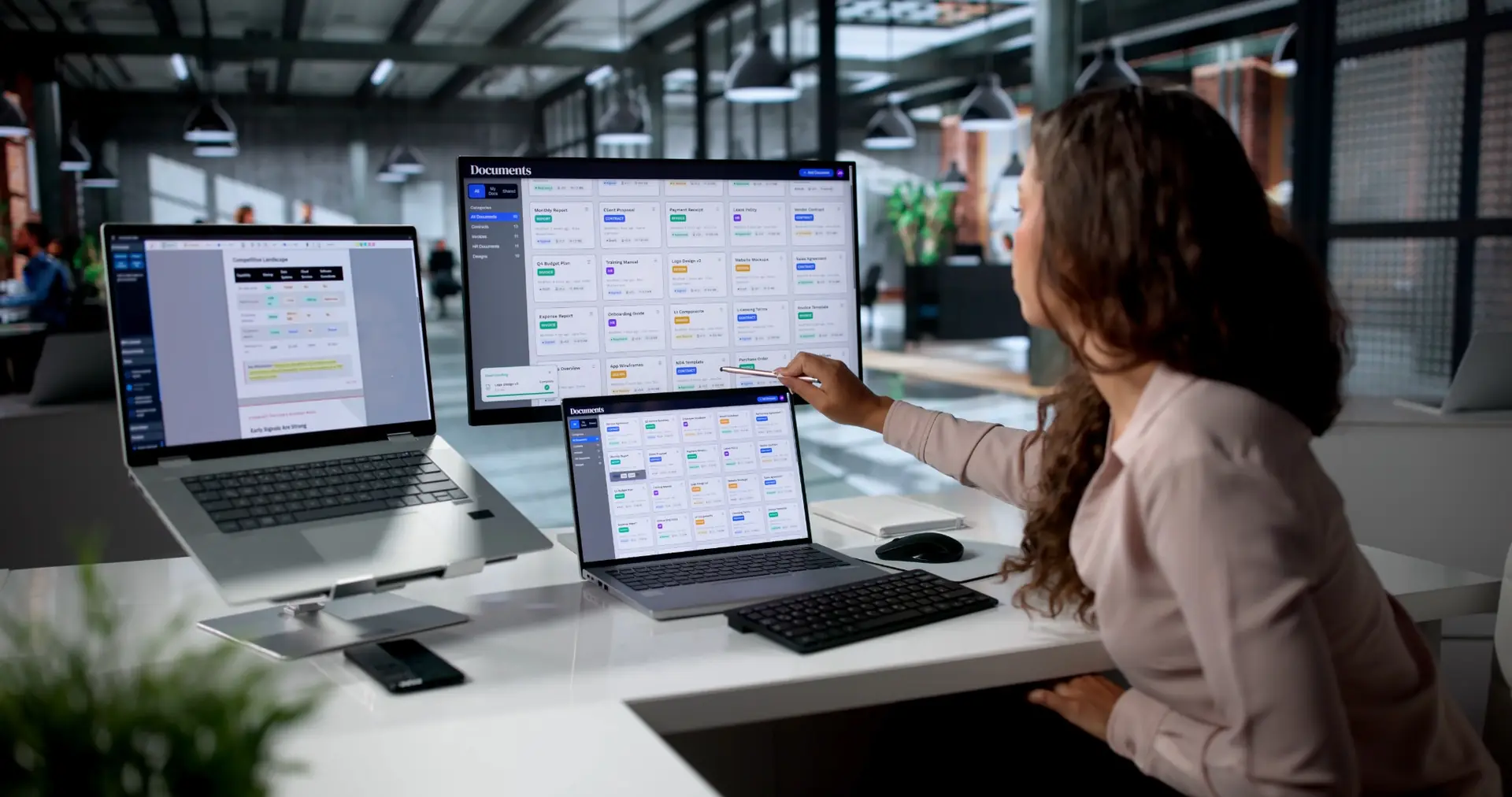
Not everything needs AI, and some things shouldn’t use it.
We choose the tool for each step based on the problem, not on a fixed preference. That balance will shift as AI agents mature.
Software automation
Rule-based integrations that apply your business rules the same way every time. They’re tested before release and carry no risk of hallucination, which makes them the right choice for billing, invoicing, and anything with strict rules.
AI agents
Reasoning tools that handle messy, unstructured inputs and exceptions, like supplier invoices in a dozen formats. They’re probabilistic, so a person reviews anything the agent isn’t sure about.

How the work happens.
Process first, code second. Each step does one job.
Map how the work actually gets done
Discover and document
We don’t ask you for documentation. We sit with your staff and record the process click by click, then use AI to generate standard operating procedures from the recordings. Many clients find the SOPs valuable on their own.
Redesign before automating
Simplify, eliminate, automate
We remove steps that add no value, clarify handoffs and ownership, and define where a person reviews exceptions. Only then do we build anything.
Check the data underneath
Data assessment and readiness
We locate the data sources and identify the system of record for each. The long-term aim is a single, automated data warehouse that the rest of the organization can rely on.
Start with the biggest, quickest wins
Prioritization by return
Opportunities are ranked by how quickly and how much they pay back. Low-value or high-risk ideas get deliberately deprioritized, so early projects can fund themselves.
Build it with embedded engineers
Forward-Deployed Engineers
GAP engineers work alongside your operations leaders, using published APIs and custom scripts on the platforms you already own, so there’s no new enterprise automation license to buy. They build and test in isolated staging sandboxes, so your live systems aren’t disrupted, and they help manage the change so your team adopts the result.
Leave it running
Headless workflows
The finished system triggers tasks automatically. People step in only to approve exceptions.

How we think about this work.

Use what you already own
We build on the platforms and APIs you have rather than adding another one. Most teams don’t need a heavyweight automation suite to fix a handful of high-impact workflows.
Redesign first
Automating a broken process locks the problem in. We look at what can be removed or simplified before deciding what to automate.
We ran it on ourselves first
GAP has deployed more than 200 automations across its own operations, so the approach comes from doing the work, not just advising on it.
People stay in charge
The goal is to remove rote work, not jobs. Every automation is built with your team, so you decide what changes and what stays in human hands, and an engineer approves each decision gate along the way.
A good first step is one quick win.
Early waves automate the work slowing you down. The last one is where the organization itself starts to change.
Wave 1: Quick wins
Single-platform automations, such as system API hooks, applicant-tracking integrations, or lead distribution. Delivered as fixed-price sprints of three to six weeks and designed to pay for themselves within four to five months.
Wave 2: Core revenue processes
Higher-impact financial and operational workflows, including automated revenue reconciliation, missing-information detection, and ready-to-invoice fast lanes, built by embedded engineers working with your operations leaders.
Wave 3: Advanced maturity
Centralized data warehousing, predictive revenue forecasting across sources, and formal AI governance. This is where work gets redesigned around AI agents, with people in charge.

If two or more of the five signs above sounded familiar, it’s worth a conversation.
Questions people ask before they start.
We’re evaluating UiPath or Automation Anywhere. How is this different?
Enterprise RPA platforms usually come with premium pricing and a new technology stack to run. We build integrations and scripts on the platforms and APIs you already own, which keeps cost down and avoids adding another system to your environment.
We can’t use AI on financial or billing data. It hallucinates.
That’s a reasonable position, and we agree. For calculations, invoicing, and strict business rules we use deterministic software that’s tested before release and applies your rules consistently. AI agents are reserved for unstructured inputs and exception handling, and a person approves what they’re unsure about.
Our processes are too unique, messy, and undocumented to automate.
That’s where we usually start. We record your team doing the work, generate the documentation from those recordings, and decide what to simplify or remove before writing any automation code.
Will this replace our people?
The goal is to remove rote work, not jobs. People move from re-typing data to reviewing exceptions and doing higher-value work. Every automation is built with your team, so you decide what changes and what stays in human hands.
Why GAP rather than Zapier, Power Automate, or our own IT team?
Those tools work well for simple connections, and we use them when they fit. What they don’t provide is someone to map the process, decide what to remove, build and test the automation, and make sure your team adopts it. We embed engineers alongside your operations leaders to do that, which leaves IT free for its own priorities.
How quickly will we see a return?
Wave 1 projects are scoped, delivered, and measured within three to six weeks, and they’re designed to pay for themselves within four to five months. We rank opportunities by return so that the earliest projects are the ones most likely to do that.
Do we need our own engineers to make this work?
No. Embedded GAP engineers do the building alongside your team, so functional departments don’t need internal engineering capacity.
How does this connect to AI plans?
Automating and structuring core workflows is a practical first step toward AI. It creates the clean, data-driven environment AI agents need to work well, and it pairs naturally with data readiness work.
Related reading: AI Data Readiness
Automation depends on clean, governed data. See how we prepare data, pipelines, and governance for production AI.