

TL;DR: EdTech Interoperability Standards and Product Boundaries
The Situation:
Each new institutional customer can turn EdTech interoperability into custom integration work that pulls engineering capacity away from the product. LTI, OneRoster, Edu-API, CASE and CLR address different boundaries, so the useful question is which one fits each workflow.
Key Takeaways:
- Match Standards to Boundaries: LTI launches tools from an LMS, OneRoster exchanges rosters, courses and grades, CASE covers academic standards and competencies, and CLR carries portable credentials.
- Check Standard Maturity: As of September 2026, Edu-API is in Candidate Final Public status, which makes adopting it a different decision than adopting OneRoster 1.2.
- Keep a Canonical Model: Adapters translate each standard into product-owned concepts, and the model keeps external identifiers such as CASE GUIDs so cross-standard links survive.
- Test the Boundary: Certification gives an external reference point, but contract tests still need to cover missing fields, version differences and customer-specific extensions.
Where to Start: Begin with the workflows that current customers and near-term commitments require, then weigh each standard’s maturity and how well the implementation can be reused across customers.
For an EdTech company, landing an institutional customer can create an unexpected scaling challenge. The contract is signed, the product fits the use case and the customer is ready to move forward. Then implementation begins, and the engineering team discovers that the institution needs a different roster flow, another LMS launch pattern, a new grade exchange or a custom mapping between systems.
One integration becomes five exceptions. Five exceptions become another backlog. Eventually, what looked like onboarding work starts consuming product-engineering capacity.
That is the problem interoperability standards are supposed to reduce. But adopting a standard does not mean choosing one universal EdTech protocol and applying it everywhere. LTI, OneRoster, Edu-API, CASE and CLR solve different problems at different boundaries of the learning ecosystem. The architectural decision is to understand where each belongs and how those standards fit into a reusable product model.
At Growth Acceleration Partners (GAP), we see EdTech interoperability as a product architecture opportunity. The goal is to build a reusable integration layer that makes it easier to connect with new institutions, support different learning ecosystems and scale as the product grows.
Why EdTech Integrations Become a Product Bottleneck
Educational products rarely operate alone. A learning platform may need to know who the learner is, which courses they are enrolled in, which tools they can launch, which standards the curriculum maps to, which grades or outcomes should be returned to another system and how credentials move after learning is complete.
Those responsibilities often span multiple institutional systems. A student information system may own enrollment data. An LMS may manage courses and assignments. External learning tools may provide assessments or content. Another platform may store credentials or learner records.
Without clear boundaries, product teams often solve each new requirement directly against the customer’s implementation. One institution sends data in one format, another expects a different authentication pattern and a third has its own interpretation of the same field.
The technical consequence is familiar: mappings multiply, exception logic spreads and integration knowledge becomes trapped inside individual connectors.
The business consequence is larger. Engineering capacity moves from product development into implementation work, onboarding becomes harder to estimate and each institutional customer adds another integration to maintain.
1EdTech describes a similar challenge in higher education: when systems do not share a coherent standard, institutions repeatedly recreate integration work, increasing customization, maintenance and fragility. The architectural goal should be to identify which product boundaries can become standardized capabilities.
Five Standards, Five Different Product Boundaries
The standards are easier to reason about when teams stop treating them as competing specifications.
They address different questions.
LTI: Connecting Learning Tools to the Learning Environment
Learning Tools Interoperability (LTI) is primarily about connecting an external learning tool to an institution’s learning environment.
A student or instructor should be able to move from an LMS into a learning application without creating another disconnected login experience. The platform also needs enough context to understand the user, their role and the course or activity involved.
1EdTech’s current LTI standard is LTI 1.3, which uses an updated security model based on OAuth 2.0 and JSON Web Tokens. LTI Advantage adds services for assignments and grades, names and roles and deep linking into external content.
For a CTO, the important architectural question is therefore not simply “Do we support LTI?”
It is: Which product workflows should cross the LTI boundary?
If your product is a learning tool that needs to launch inside multiple LMS environments, receive course and user context or return assignment results, LTI belongs close to that integration boundary. It should not become the internal data model for the entire product.
OneRoster: Rosters, Courses and Grades
OneRoster addresses a different problem: exchanging core teaching and learning data between systems. 1EdTech defines OneRoster around people, courses, enrollments, organizations and grades. The current OneRoster 1.2 specification separates the standard into rostering, gradebook and resource services, with support for both REST APIs and CSV-based exchange.
That makes OneRoster particularly relevant when a product needs information from a student information system or needs to exchange roster and grade information with an LMS. The distinction from LTI matters.
LTI helps a learning tool participate in the learning environment and associated workflows. OneRoster is better suited to moving roster, course and grade data across systems. For K–12 products in particular, that can turn institutional onboarding from a series of proprietary data imports into a more repeatable integration pattern.
But even with a standard, implementations still need boundaries. Teams must decide which system is authoritative for each entity, how identifiers are reconciled and what happens when customer data is incomplete or inconsistent.
A standard normalizes the exchange. It does not resolve every ownership decision.
Edu-API: Enterprise Data Exchange for Higher Education
Higher education presents a different integration problem. The relationships among people, programs, courses, enrollments and institutional systems can be more complex than a K–12 roster model. That is one reason 1EdTech is developing Edu-API as a standard for exchanging data between the transactional systems that support higher-education administration, teaching and learning.
As of September 2026, 1EdTech describes Edu-API as being in Candidate Final Public status, with early-adopter implementations underway and certification activity progressing. That maturity level matters architecturally. A CTO evaluating Edu-API is not making the same decision as adopting an established final standard, such as OneRoster 1.2. The team needs to consider the value of early alignment against the possibility that implementation details may continue to evolve.
For products focused on higher education, however, the direction is important: standardize the exchange of core enterprise education data rather than building institution-specific payloads indefinitely.
CASE: Standards, Competencies and Skills
Not every interoperability problem is about users or enrollments. Sometimes the product needs to understand what is being taught.
The Competencies and Academic Standards Exchange (CASE) standard defines a consistent way to exchange academic standards, competencies and skills in machine-readable form. CASE 1.1 supports structures such as competency frameworks, items and relationships among standards, courses and other frameworks.
This can matter for curriculum platforms, assessment systems and learning products that need to align content to standards. Without a common representation, curriculum mappings often live in spreadsheets, proprietary tables or manually maintained references. That makes it harder to update content when a standards framework changes or to reuse mappings across products.
CASE changes the boundary from “we have our own mapping” to “we can exchange and reference the framework consistently.” For product teams, that opens the possibility of building curriculum alignment as a reusable data capability rather than an implementation task.
CLR: Portable Learning and Credential Records
The Comprehensive Learner Record (CLR) sits later in the learner journey. Where OneRoster helps exchange current roster and course information, CLR is designed to represent learning achievements and credentials that can travel with the learner.
1EdTech released CLR Standard 2.0 in March 2025. The standard supports portable, verifiable learner records and uses a RESTful API to transport CLR and OpenBadgeCredential data among systems under learner control.
For higher education and workforce-learning products, this creates a different kind of product opportunity. Instead of treating course completion as a row in one platform’s database, a product can participate in a broader credential ecosystem where achievements can be verified, shared and used across institutions or employers.
CLR therefore belongs at the credential-and-learner-record boundary, not at the core enrollment or tool-launch boundary.
Choose the Standard Based on the Boundary
The simplest way to avoid confusion about standards is to start with the product capability rather than the acronym.
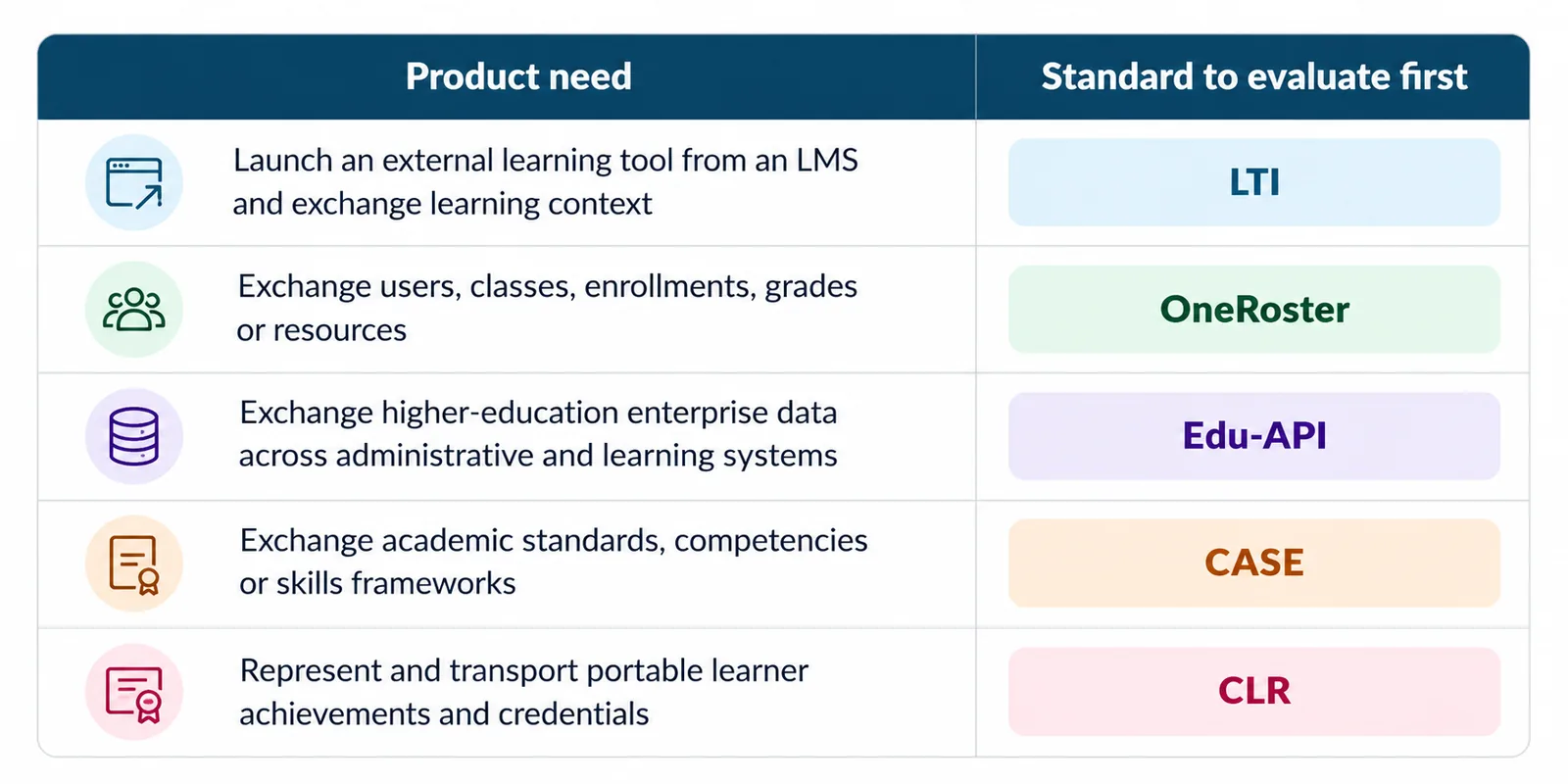
Real platforms can use more than one standard because their product boundaries overlap. A curriculum tool might use LTI to launch inside an LMS, OneRoster to receive enrollment information and CASE to align learning resources to standards.
These standards can overlap in the data they exchange, but they support different integration workflows. LTI Names and Role Provisioning Services (NRPS) provides membership and role information within the context of an LMS course, while LTI Assignment and Grade Services (AGS) supports grade-related interactions between a learning tool and the LMS. OneRoster supports broader exchange of roster, enrollment and gradebook data across institutional systems, including scheduled synchronization. Edu-API addresses related enterprise data exchange needs in higher education, although its maturity and implementation considerations differ from those of OneRoster.
For a CTO, the decision depends on the workflow. Does the product need course context during an LMS launch, or does it need to synchronize institutional records across systems? Answering that question helps determine which standard to evaluate first and where multiple standards may be needed. The important phrase is “evaluate first.”
That does not mean those standards should collapse into a single integration layer with a single giant data model. The cleaner architecture is usually to keep the standards at their external boundaries while translating them into product-owned canonical concepts internally.
Implementation order should follow the product’s actual integration requirements. Start with the workflows needed to support current customers and near-term institutional commitments, then evaluate which standards cover those needs and how mature the available implementations are. A product that launches inside multiple LMS environments may prioritize LTI, while one that depends on institution-wide enrollment data may begin with OneRoster. The decision should also account for engineering capacity, existing integrations and the ability to reuse each implementation across customers.
Standards Do Not Eliminate Architecture Decisions
A standards-based integration can still become brittle.
The specification may define a user, course or competency, but the product still has to answer questions such as
- Which external system is authoritative for this data?
- How are external identifiers mapped to internal entities?
- What happens when the same learner arrives from two systems?
- Which fields are required internally, even if they are optional in the standard?
- How are unsupported extensions handled?
- What happens when an institution upgrades to another version?
- How does the product detect incomplete or semantically invalid data?
These questions are where interoperability becomes architecture.
A common mistake is to place customer-specific logic directly inside the product domain. Over time, the product begins to understand “District A enrollment,” “University B user,” or “LMS C grade” instead of understanding its own concepts.
That coupling increases the cost of every new integration. A stronger boundary isolates the external representation from the internal product model.
Build a Canonical Model Behind the Standards
A canonical model gives the product a stable language of its own. Combined with standards adapters, it can form part of an anti-corruption layer, a domain-driven design pattern that protects the internal product model from external system structures and assumptions.
Suppose five institutional systems represent enrollment differently. Instead of allowing five variations to flow through the entire application, adapters translate them into the product’s internal definition of learner, course, enrollment or result.
The standards still matter because they reduce the number of external variations the adapters need to handle. But the internal product does not need to become dependent on the implementation details of every standard or institution.
A canonical model should also preserve the external identifiers needed to maintain relationships across standards. For example, OneRoster resource data can reference competencies and academic standards through CASE GUIDs. Retaining those identifiers allows the product to connect resources with the appropriate competency frameworks while maintaining its own internal representation. The goal is to isolate external data structures without losing the relationships that make interoperability useful.
A practical architecture often looks like:
External system → standards adapter → canonical model → product services
On the way back out, the same boundary works in reverse.
Product services → canonical model → standards adapter → external system
This approach also creates a better place to handle validation, identity resolution, mapping and observability. Instead of debugging an unexplained failure deep inside a feature, the team can inspect the integration boundary and answer more useful questions, such as Which payload arrived? Which mapping failed? Which field violated a contract? Which institution is affected?
That is the difference between having integrations and having an integration platform.
Treat Certification and Contract Testing as Product Work
Standards adoption also requires a quality strategy. 1EdTech provides conformance and certification programs for several of these standards. For example, OneRoster has formal conformance testing for its REST and CSV implementations, while CASE and CLR publish certification guidance.
Certification is valuable because it creates an external reference point for how the specification should behave. It does not replace your own testing. Your product still needs contract tests around the assumptions it makes about institutional systems. Those tests should include valid inputs, missing optional fields, unexpected values, version differences and customer-specific extensions the product has chosen to support.
Contract testing is particularly important because partner systems change independently. An LMS upgrade or SIS configuration change may not alter your code at all, yet it can still break a production workflow. Testing therefore needs to protect the boundary, not only the feature behind it.
GAP’s QA Automation practice already applies this principle more broadly through API testing and continuous testing integrated into delivery pipelines. For interoperability-heavy EdTech products, the same discipline can be applied to standards contracts and institutional integration flows.
From Integration Queue to Product Capability
The real value of interoperability is not how many standards an EdTech product can claim to support. It is the capability those standards create: a product architecture that can connect with new institutions, adapt to different learning ecosystems and make each implementation more reusable than the last.
LTI, OneRoster, Edu-API, CASE and CLR provide established and emerging standards for defining important boundaries across the learning ecosystem. The architectural work is turning those boundaries into repeatable product capabilities through canonical models, adapters, versioning, validation, certification and automated contract tests.
That capability becomes even more important as AI enters EdTech products. Intelligent learning experiences still depend on reliable access to learner, course, curriculum and credential data. Interoperability provides part of the foundation that allows those products to evolve without treating every new system or institution as a separate architecture problem.
Growth Acceleration Partners (GAP) is an AI transformation company that helps organizations build the capability to operate, innovate and compete with AI, not just adopt it. For EdTech companies, this can include modernizing the architecture behind learning products, strengthening how systems and data connect and building the engineering capabilities needed to keep adapting as technology and customer expectations evolve.
If your EdTech product is growing faster than its integration architecture, GAP can help identify where standards, reusable data models and a stronger engineering foundation can create the capacity for what comes next. Get in touch.