

What changes when enterprise AI stops answering questions and starts taking action?
As organizations move from controlled experiments to systems that can reason, call tools and act across business workflows, they are introducing more than just capable models. They are creating new operational dependencies, variable costs and forms of risk that traditional technology environments were not designed to manage. Gartner predicts that, by 2028, unpredictable agentic AI cloud costs will cause 40% of enterprises to experience severe budget overruns.
A pilot can prove that an AI model is capable of performing a task. It cannot prove that the organization is ready to integrate, govern, monitor and continuously improve that capability in production.
This shift is central to the Hype Cycle for AI Services, 2026, which describes a market moving away from generative AI experimentation and toward scaled adoption through operationalization, governance and enterprise outcomes.
From GAP’s perspective, the implication is clear: AI strategy, data readiness, application modernization, engineering, governance and workforce adoption cannot be managed as separate initiatives. They must function as one connected transformation journey.
The Market Is Moving From Experimentation to Operationalization
Early enterprise AI programs often centered on access: selecting a foundation model, launching a chatbot or testing a narrowly defined proof of concept. Those experiments were useful. They helped organizations build literacy, identify promising use cases and learn where the technology struggled.
But model access has become widely available. It is no longer the hard part or a durable source of differentiation. The harder work begins when a company tries to place AI inside a process that touches customers, revenue, regulated data or production systems.
At that point, the questions change:
- Can the system retrieve trustworthy, current and permissioned information?
- Can it connect safely to the applications where work actually happens?
- Can teams evaluate output quality under real operating conditions?
- Can leaders trace decisions, control access and intervene when behavior falls outside acceptable limits?
- Can Finance forecast and govern variable AI consumption?
- Can employees use the system effectively without creating new security, quality or accountability risks?
These are not model-selection questions. They are architecture, engineering, governance and operating-model questions.
The report identifies agentic AI, AI engineering, composite AI services and model operations (ModelOps) as potentially transformational areas over the next two to five years. The common thread is not simply more powerful intelligence, but the infrastructure and discipline required to turn probabilistic capabilities into reliable enterprise systems.
AI Transformation Fails When the Work Is Divided Into Disconnected Projects
Many organizations respond to each AI obstacle independently. A strategy team defines use cases. A data team prepares a new pipeline. An application team exposes an API. A risk committee writes governance requirements. An engineering group builds the solution. Learning and development later creates training.
Each activity may be valid, but the sequence creates handoffs, conflicting assumptions and gaps in ownership. Governance requirements appear after architectural decisions have already been made. Modernization is scoped without understanding the agentic workflow it must support. Training focuses on tool features rather than the decisions employees will now share with AI. Operations inherits a system without the telemetry needed to manage it.
The result is a collection of technically competent projects that do not form a viable operating capability.
This is why the next phase of AI transformation should not be framed as a menu of isolated services. The work is connected by design:
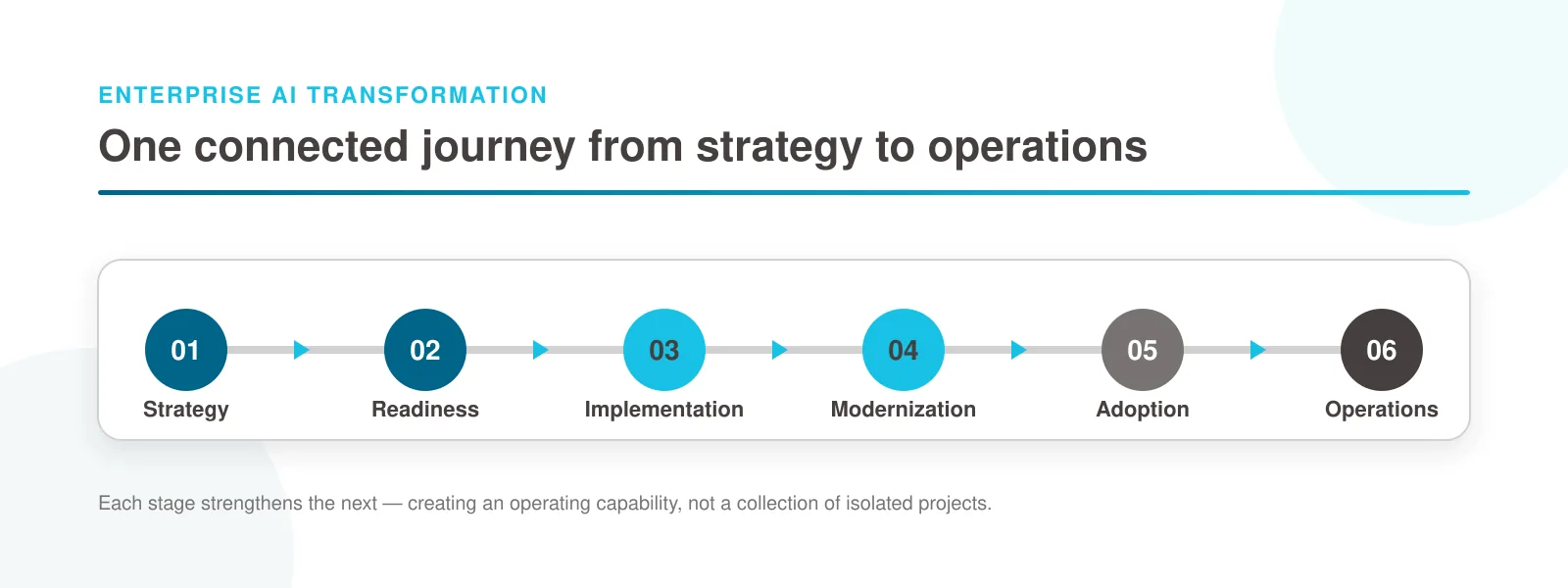
The sequence is not always linear. An architecture assessment may reveal a data-readiness problem. A production evaluation may send the team back to workflow design. New regulations may require a governance change. A model update may alter quality, latency or cost. The important point is that every decision must be made with the full life cycle in view.
Five Capabilities Must Operate as One System
-
Start With a Business Outcome and an Operating Decision
An AI initiative should begin with a measurable business problem, not a general mandate to “use AI.” The organization needs to identify the workflow, its current baseline, the people involved, the decisions being made and the acceptable boundaries for automation.
This changes use-case prioritization. A technically impressive application may be a poor first investment if it touches low-frequency work, depends on inaccessible data or requires a level of autonomy the organization cannot yet govern. A narrower use case may create more value if it removes a recurring bottleneck and has clear measures for quality, time, cost and business impact.
Leaders also need to decide what role the system will play. Will it recommend, draft, decide, act or orchestrate other tools? Where is human approval required? What happens when confidence is low or the system encounters an unfamiliar condition? These operating decisions shape architecture, testing, access and governance. They cannot be postponed until deployment.
-
Modernize the Foundations AI Depends On
AI does not bypass legacy complexity. It often makes that complexity more visible.
An agent that must complete work across multiple systems depends on stable interfaces, consistent identity and access controls, current data, usable metadata and predictable application behavior. If information is trapped in documents, duplicated across repositories or governed differently by each business unit, the agent inherits those contradictions. If a core application can only be changed through brittle manual steps, automation increases operational risk rather than reducing it.
Modernization for AI therefore, requires more than moving an application to the cloud. Teams may need to expose business capabilities through APIs, separate tightly coupled components, improve event and data pipelines, redesign permissions or create an authoritative knowledge layer. The right scope depends on the use case. Modernizing everything before beginning is unnecessary, but ignoring the dependencies behind a pilot is equally dangerous.
The goal is targeted modernization: change the parts of the technology estate that prevent a valuable AI-enabled workflow from operating reliably.
-
Engineer the Complete System, Not Only the Model
An enterprise AI product is a software system with a model inside it. Its behavior depends on far more than the model selected.
The system may include retrieval, deterministic business rules, orchestration, APIs, user experience, identity, data pipelines, evaluation services and human approval paths. Composite approaches are important because not every step should rely on a language model. Deterministic components remain the better choice when rules are stable, calculations must be exact or an action requires strict control.
This is where AI engineering becomes distinct from a prototype. Teams must design for failure, version prompts and context, test representative scenarios, define quality thresholds and manage changes across models and dependencies. They must also decide which capabilities should remain internal. The report emphasizes the strategic importance of developing prompt and context engineering capabilities internally rather than outsourcing the enterprise intelligence that gives AI its relevance.
An external partner can accelerate architecture and implementation, but the organization should retain ownership of its data, business rules, evaluation criteria and decision context. Those assets become part of how the company operates and competes.
-
Build Governance, Observability, Security and Cost Control Into Delivery
Traditional application monitoring can show whether a service is available or an API returned an error. It cannot determine whether an AI-generated answer was plausible but wrong, whether an agent selected an inappropriate tool or whether output quality drifted after a model change.
Production AI needs observability that connects technical signals with quality and business measures. That can include model and prompt versions, retrieval sources, tool calls, latency, token consumption, evaluation results, overrides and escalation patterns. The objective is not to collect every possible log. It is to provide enough evidence to detect failure, investigate its cause and improve the system.
Governance must act on those signals. Ownership, permissions, audit trails, approval gates, incident response and acceptable-use policies should be defined before autonomy expands. GAP has previously argued that accountability is the central governance problem in agentic engineering: when a system can act, the organization needs a clear answer for who authorized that action and who owns the result.
Security must also extend beyond protecting the model endpoint. AI systems can be exposed to prompt injection, unauthorized tool use, sensitive data leakage and data exfiltration through connected applications. These risks become more consequential as agents gain access to internal systems and permission to take action. Teams should apply least-privilege access, validate tool inputs and outputs, isolate sensitive data, restrict approved actions and require human authorization for high-impact decisions. Security testing should also evaluate how the complete system behaves when instructions, retrieved content or connected tools are manipulated, not only whether the underlying model produces an accurate response.
Cost governance requires the same discipline. Agentic workflows can create highly variable consumption as they call multiple models, tools and data sources, making traditional cloud budgets difficult to forecast. Financial operations for AI (AI FinOps) practices should connect that usage to a specific product, workflow and business outcome. This gives leaders the visibility to evaluate unit economics, set spending thresholds and balance cost against performance and quality instead of reviewing an undifferentiated cloud bill after the fact.
-
Redesign Work and Ownership Around Human-AI Collaboration
Operationalizing AI changes more than technology. It changes how work is assigned, reviewed and improved.
Gartner predicts that AI coding agents will autonomously execute 60% of routine software development tasks by 2029, shifting enterprise IT budgets from labor toward orchestration. This should not be interpreted as a simple headcount forecast. “Routine tasks” are only one part of engineering, and autonomous execution still depends on architecture, context, controls and human accountability.
The more useful implication is that roles will shift. Engineers will spend more time defining intent, decomposing problems, supplying context, evaluating results and designing the systems within which agents can operate. Product and business teams will need to specify acceptable outcomes more precisely. Risk and security teams will need to participate earlier. Managers will need measures that capture system-level performance rather than activity volume.
AI literacy also needs to become role-specific. A developer, customer-service representative and executive do not need the same training. Each needs to understand the capabilities, limits, policies and judgment required in their part of the workflow. Adoption is achieved when people know how to work with the system responsibly, not when they have attended a generic tool demonstration.
AI Is Changing the Engineering Services Model
The same changes reshaping enterprise teams are reshaping external engineering services. If AI-augmented development, testing and application management become standard, clients should expect more than additional delivery capacity. They should expect a partner to help redesign the way value is delivered.
That includes identifying where AI can responsibly accelerate work, instrumenting the delivery system, separating routine execution from high-value judgment and creating transparent measures for quality and outcomes. It also requires commercial models that reflect orchestration, reusable capabilities and delivered value, not just the number of people assigned.
This does not mean every project should be priced around an outcome or that human expertise becomes less important. Outcomes can be difficult to isolate, and clients still need skilled teams with deep domain and engineering knowledge. The shift is toward a more explicit connection between engineering activity and business value. AI makes that connection more important because generating more output is easy; proving that the output is useful, secure and sustainable is not.
A Practical Starting Point for Enterprise Leaders
Organizations do not need to launch a company-wide transformation program before taking the next step. They need a shared view of the journey and one use case that is important enough to matter but bounded enough to govern.
A practical first assessment should answer six questions:
- Outcome: What measurable business result should this workflow improve?
- Readiness: Which data, application and integration dependencies could prevent it from operating in production?
- Architecture: Which steps require probabilistic AI, deterministic software or human judgment?
- Control: Who owns the system, what can it access and where must a human approve or intervene?
- Operations: How will the organization monitor quality, reliability, latency and cost over time?
- Adoption: Which roles and processes must change for the capability to create value?
The answers create more than a technical roadmap. They reveal the organizational work required to move from a successful demonstration to a durable capability. They also help leaders sequence investments: what must be built now, what can be modernized incrementally and what should remain experimental until governance or technology matures.
Turning AI Ambition Into an Operating Capability
The organizations that create sustainable value from AI will not necessarily be those that launch the most pilots or adopt the newest models first. They will be the ones that connect business strategy, architecture, engineering, governance, cost management and workforce adoption around workflows that genuinely matter.
A model can demonstrate what is possible. Turning that possibility into a dependable enterprise capability requires the surrounding technology, operating discipline and human judgment to keep it useful, secure and accountable in production.
At GAP, we hold ourselves to the same discipline this article describes. Our own shift to an AI-augmented delivery model didn’t begin with a mandate to “use AI,” it began with the same questions we’re asking enterprise leaders to answer: Which workflow? What boundaries? Who is accountable and how is quality verified? Engineers moved from writing every line of code themselves to acting as conductors: defining specifications, orchestrating multi-agent workflows, setting guardrails, and remaining accountable for every change that ships.
The results are now public. Across six recent client engagements spanning fintech, legal technology, manufacturing and consumer products, this model has cut delivery timelines by 30 to 70 percent and expanded engineering capacity without adding headcount, without loosening review, testing or oversight. See the case studies →
Being transparent with clients means telling them where AI creates real value, where it doesn’t yet, and what has to be true in their organization before a solution can scale. We will not recommend AI simply because it is available. We help clients make informed decisions, build the right foundations and pursue AI opportunities that align with real business needs.
If your organization is ready to move beyond experimentation, talk with GAP about building a responsible path to enterprise AI value.