
TL;DR
- AI team enablement helps employees build the skills to use AI effectively in their everyday work.
- 88% of companies use AI, but only 7% have fully scaled it across their organizations.
- Effective enablement starts with identifying useful workflows, assessing existing skills and tailoring training to each team’s needs.
- GAP helps companies build these skills through hands-on workshops, workflow improvements and ongoing support.
Giving employees access to AI tools has become relatively easy. Organizations can roll out ChatGPT, Claude, Microsoft Copilot or another generative AI platform across a workforce in a matter of days. The harder problem is making sure those tools actually improve how people work.
This becomes more visible as companies move beyond early experimentation. Employees may already use AI to draft, summarize or write code, but scattered individual usage does not automatically translate into organization-wide capability.
Research points to the same disconnect. McKinsey found that 88% of organizations now use AI in at least one business function, but only 7% have fully scaled it across the organization.
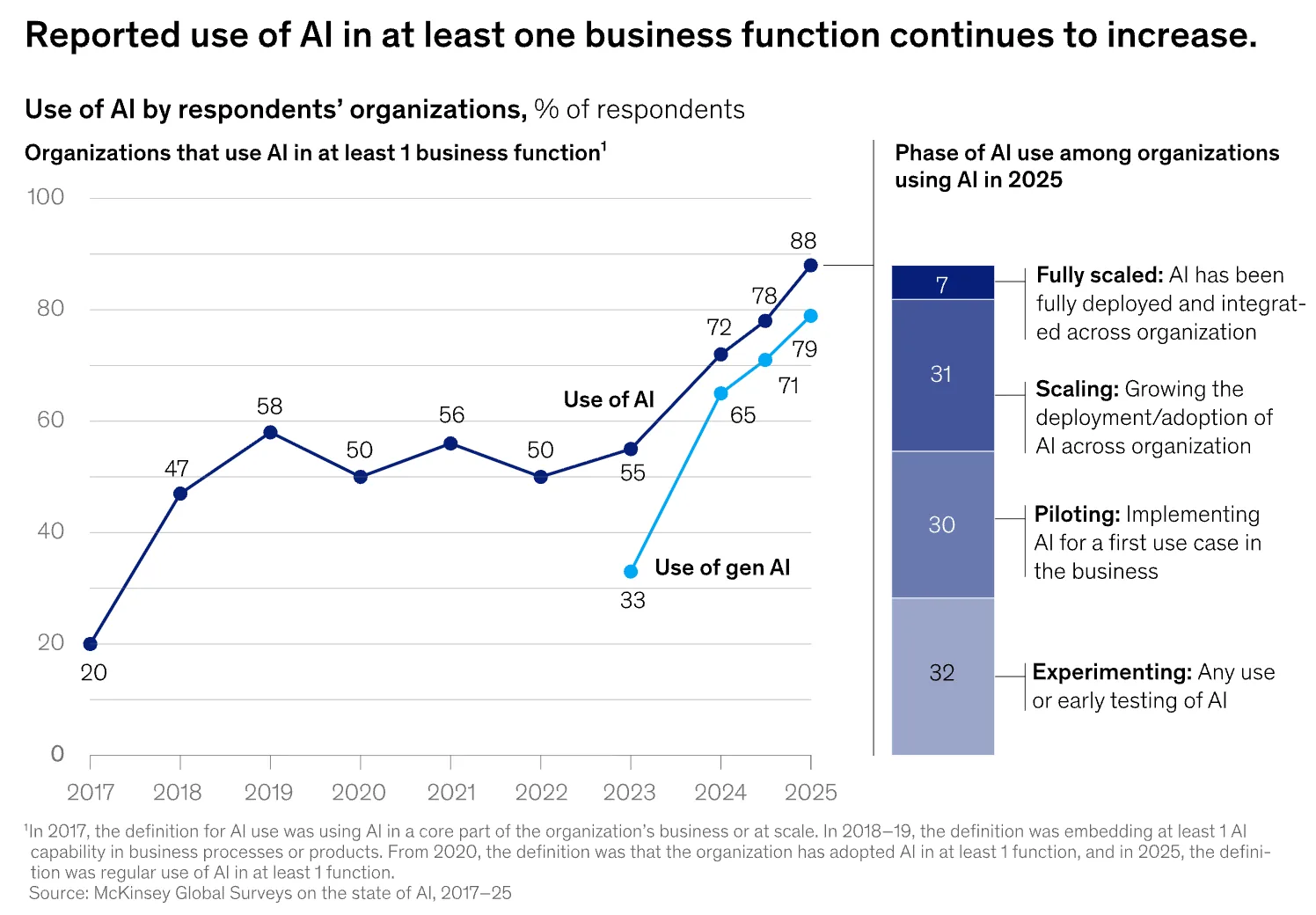
Source: McKinsey
Deloitte’s 2026 State of AI in the Enterprise similarly identifies insufficient worker skills as the biggest barrier to integrating AI into existing workflows.
Closing that gap takes more than a company-wide AI workshop. Organizations need to understand which capabilities different teams need, where AI can improve existing workflows, and how to turn useful experiments into repeatable ways of working.
What Is AI Team Enablement?
AI team enablement is the process of preparing employees to use AI effectively within their roles and workflows.
It combines skills development, practical use cases, governance and ongoing support so employees can move from occasional experimentation to consistent, useful application of AI in their day-to-day work.
That is different from simply teaching AI literacy. Someone may understand how a large language model works or know how to write a good prompt without knowing where AI creates meaningful value in their role. The skills a software engineer needs will also differ from those needed by a finance analyst, recruiter or operations manager.
An effective enablement program therefore connects AI capabilities to actual work. That is the thinking behind GAP’s AI Team Enablement Framework, which focuses on building capability through role-based enablement, practice and coaching rather than assuming access to a tool will produce adoption on its own.
How to Build AI Capability Across Your Teams
That starts with identifying where AI can improve the work employees already do, then building the skills and support around those use cases.
1. Start With the Work, Not the AI Tool
One of the easiest ways to get AI enablement wrong is to start with the tool. A company buys licenses, runs generic training and then expects employees to work out where the technology fits.
Sure, some people might find useful applications, but adoption will usually remain uneven because the organization has never defined what better work should look like.
A better starting point is to examine how work happens. Look for tasks that consume disproportionate time, repeated handoffs, information-heavy processes and recurring work that requires searching, drafting, reviewing or classifying. Those areas provide a clearer view of where AI could remove friction or improve the quality and speed of a workflow.
For example, a software team might initially assume its biggest opportunity is code generation. Mapping the development process may show that testing or code review creates more delay.
That changes the enablement need: the goal becomes helping engineers use AI in the stages that actually constrain delivery rather than training them on a capability simply because the tool offers it.
2. Assess the AI Skills and Readiness You Already Have
Most organizations are not starting from zero. Some employees already use generative AI every day and have built effective personal workflows.
Others use it occasionally, while some avoid it because they are uncertain about accuracy, security or company policy. Treating all three groups as if they need the same training wastes time and makes the program less relevant.
A useful assessment should look at which tools employees use, the tasks they use them for, how confidently they evaluate outputs and whether they understand the organization’s rules around sensitive data and approved systems. The aim is to map the distance between current capability and the skills required for the use cases the business wants to pursue.
This is increasingly a strategic issue rather than a learning-and-development side project. The World Economic Forum’s Future of Jobs Report found that skills gaps were the most commonly cited barrier to business transformation, reported by 63% of employers.
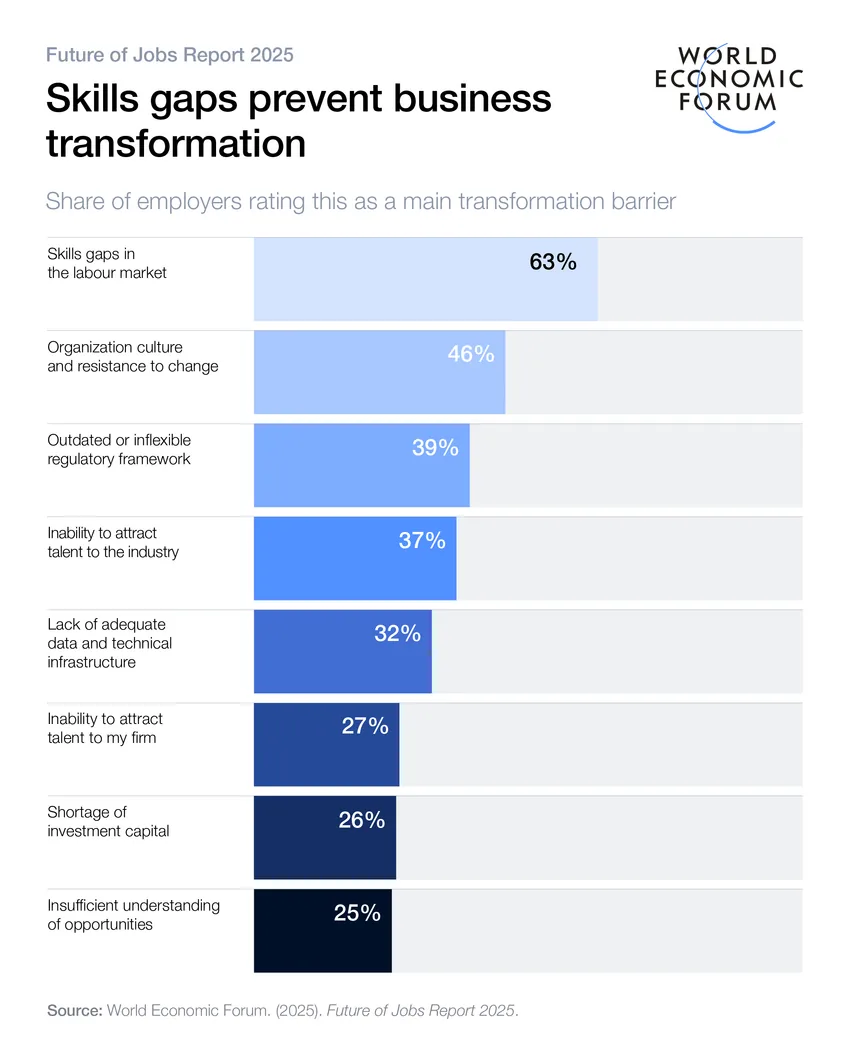
Source: World Economic Forum
3. Build Role-Based Training Around Real Workflows
Once capability gaps are clear, training should move quickly from general concepts to the work employees are responsible for.
A broad session on prompting can establish a baseline, but it rarely gives people enough context to redesign a recurring workflow or judge whether an AI-assisted result is good enough to use.
Role-based training makes the application concrete. Instead of teaching a marketing team a list of prompting techniques, an enablement session could take one recurring task, such as preparing a campaign brief, and work through how AI can support research, synthesis and first-draft creation while keeping the final judgment with the employee. The team leaves with a workflow it can reuse, not simply a set of tips.
Successful workflows can then be documented as internal playbooks: which tool to use, what context it needs, where human review is required and what a good output looks like.
GAP’s AI Acceleration Workshops follow a similar hands-on model, combining readiness assessment, use-case identification, workflow integration and practical training rather than treating enablement as passive learning.
4. Put Governance and Ongoing Support Around Adoption
As employees become more capable with AI, organizations also need clear boundaries for how it should be used.
Governance should be part of enablement rather than a policy document people are expected to remember later. Employees need to know which tools are approved, what information can be entered into them, when outputs require verification and which decisions should remain with a person.
They should also understand how third-party AI providers handle that information, including how long it is retained and whether it may be used to train models.
Support also has to continue after formal training ends. AI tools change quickly, and useful applications often emerge only after employees begin testing them against real work.
Internal champions, office hours or a central enablement group can give teams somewhere to take new use cases, share successful workflows and resolve questions before informal practices become inconsistent across the organization.
5. Measure Whether AI Skills Are Changing the Work
Finally, measure more than course completion, licenses activated or prompt volume. Those numbers show activity, but they do not tell you whether employees have become more capable or whether the business is getting a better outcome.
The more useful measures sit closer to the work itself, such as shorter cycle times, fewer manual steps, improved quality, faster analysis or reusable workflows that benefit more than one employee. The exact metric will vary by use case, but it should answer the same question: has AI materially changed how this work gets delivered?
Establishing a baseline before training makes those changes easier to see. If a team currently spends three hours preparing a recurring report, for example, measure the time, number of manual steps and review effort before introducing the AI-assisted workflow.
Comparing the same measures afterwards gives the organization evidence of whether the new capability is actually improving performance.
GAP’s AI Impact Framework is built around that distinction. Rather than relying only on self-reported adoption, it evaluates evidence of AI-assisted work and classifies maturity based on the impact employees are creating, from basic assistance through automated workflows and reusable systems.
Building AI Capability That Lasts
AI team enablement is not about teaching everyone the same set of prompts. It is an ongoing process of understanding how work happens, identifying where AI can improve it, building the right skills for each role and giving employees the governance and support needed to apply those skills safely.
Organizations that approach enablement this way are better positioned to move beyond isolated experimentation and build repeatable AI capability across the business.
GAP helps companies assess their starting point, redesign workflows and build the skills and practices needed to make AI useful in day-to-day work. Talk to GAP to explore where AI team enablement could create the most value in your organization.