TL;DR
- Application modernization for AI prepares legacy systems to work with AI by improving data access, APIs, architecture and security.
- 48% of private-company leaders cite legacy integration or technical debt as a barrier to getting full value from digital and AI investments.
- Not every legacy application needs replacing. Adding APIs, updating specific components or improving infrastructure may be enough.
- GAP helps companies modernize existing applications while preserving valuable business logic and preparing them for AI integration.
AI is forcing companies to look at old applications differently. For years, a legacy system could remain perfectly useful as long as it continued doing the job it was built for.
The problem appears when the business wants that same system to expose data to an AI assistant, let an agent take actions across a workflow, connect to newer models and services, or return information in real time.
That is when technical debt that was previously tolerable starts becoming a constraint. Data may be difficult to reach, important functions may only be accessible through the user interface, or components may be so tightly coupled that small changes carry a large regression risk.
The issue is already showing up in current investment plans. Deloitte found that 48% of private-company leaders cited legacy-system integration or technical debt as a barrier to realizing the full value of digital and AI investments. Data quality or availability was an even larger obstacle, cited by 72%.
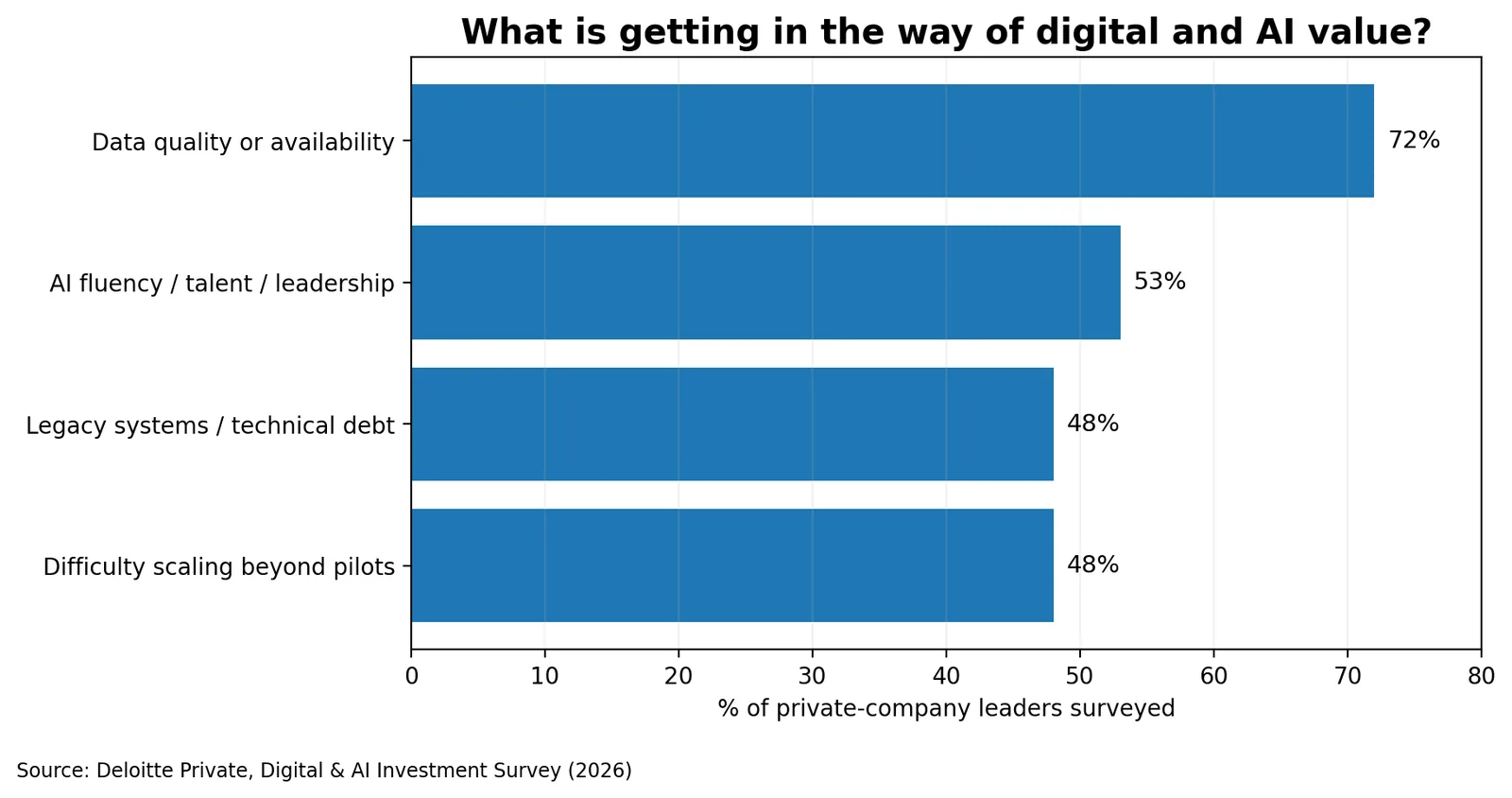
Source: Deloitte
The answer is not automatically to replace the application. In many cases, the more useful question is which parts of the existing system are actually preventing the AI use case from working, and what is the smallest modernization effort needed to remove those constraints.
Where Legacy Applications Start to Struggle With AI
A legacy application can still do its original job well and be a poor foundation for AI. The problems usually show up in four places: data access, application access, architecture, and security.
Data that AI cannot reliably reach
Many enterprise AI use cases depend less on the model’s general knowledge than on the information already inside the business. If that information is fragmented across old databases, documents and applications, the AI layer inherits the same fragmentation. Teams may spend more time locating, reconciling and preparing data than building the capability itself.
Modernization at this layer is about making the data required for a specific use case accessible and trustworthy. Teams also need to understand what happens when that data reaches the AI model, including whether it is sent to a third-party provider, how long it is retained and whether it can be used to train models.
Depending on the use case, preparation might involve creating a governed data service, consolidating a small number of critical sources or changing how the application exposes records. It does not mean every dataset in the company has to be cleaned before the project can begin.
Interfaces built for people, not systems
Older applications were often designed around screens and manual workflows. A person signs in, clicks through a series of steps and receives a result. An AI assistant or agent needs a structured way to do the equivalent, which is why APIs often become one of the first modernization requirements.
The useful move is not necessarily to rebuild the application. A stable API layer can expose the small set of functions the AI system actually needs, such as retrieving a customer record, checking an order status or submitting an approved update, while leaving the underlying business logic in place.
Microsoft includes both API-first design and legacy wrapping among its common modernization patterns, specifically because they allow organizations to extend existing applications without immediately replacing the systems underneath them.
Architecture that makes every change risky
Age alone does not make an application difficult to modernize. A ten-year-old system with clear interfaces and modular components may be easier to extend than a newer application where every component depends on several others.
The real problem is changeability. AI products evolve quickly: models improve, providers change, new governance requirements appear and useful workflows become clearer after teams start testing them. If each change requires touching the core application, the architecture becomes a bottleneck.
The right response may be to separate one service, refactor a tightly coupled component or move a specific workload onto more flexible infrastructure. The objective is not architectural purity. It is creating enough separation that the AI capability can evolve without destabilizing the rest of the system.
Controls that assume a human is always in the loop
AI also changes the security model. A chatbot that only retrieves information is different from an agent that can edit records, initiate a workflow or trigger a transaction.
Documents and tool outputs may contain instructions that try to manipulate the AI system, so they should not be automatically trusted. Agents should also have clear boundaries between recommending actions and executing them, with proper authorization required for execution.
Older applications may have permissions designed entirely around human users, with little support for service identities, granular scopes or detailed audit trails.
Before AI is connected to critical workflows, organizations may need to modernize authentication, permissions, logging and approval controls. That work is part of application modernization because it determines whether the new capability can operate safely once it moves beyond a prototype.
You Probably Don’t Need to Modernize Everything
One of the easiest ways to make an AI initiative unnecessarily expensive is to turn it into a complete modernization program. If the business has not yet proved the use case, rewriting a working application can create years of work before the AI capability produces any value.
A better decision starts with the constraint. If the core application still works but lacks a clean interface, wrapping it with an API may be enough. If one component prevents the system from scaling or changing safely, refactoring that component may solve the problem.
If the runtime or infrastructure is the limitation, replatforming can make sense. Rebuilding is usually the most aggressive option and should be reserved for applications where the cost of preserving the existing design is greater than starting again.
That logic is close to Microsoft’s current 6 Rs of application modernization: retain, rehost, replatform, refactor, rebuild or retire based on the needs of each application rather than applying the same transformation to the entire portfolio.
| Constraint | Likely modernization move |
| Core system works, but AI cannot access functions | Add an API wrapper or service layer |
| One component creates most of the rigidity | Refactor the constrained component |
| Runtime or infrastructure limits scale and flexibility | Replatform the workload |
| Application cannot reasonably support future requirements | Rebuild or replace selectively |
This targeted approach is also consistent with recent AWS guidance. Its 2026 analysis of legacy infrastructure and AI argues that solving AI constraints does not require ripping everything out; the more practical route is targeted modernization of the layers that matter most for the workload.
What an AI-Ready Legacy Application Actually Looks Like
An AI-ready application does not have to be new. It needs to be open enough for AI to interact with it predictably and controlled enough that the business can trust what happens next.
In practice, that means a few things:
- Important data can be reached through reliable, governed interfaces.
- Business functions the AI needs are exposed without giving it unrestricted access to the core system.
- Permissions distinguish between what an AI system may read, recommend and change.
- Actions are logged and auditable, with human approval where the risk requires it.
- AI services and models can be changed without rewriting the entire application.
The important point is that readiness is specific to the use case. A system may be perfectly ready for an internal retrieval assistant and nowhere near ready for an autonomous agent that can modify financial or customer records. Modernization should follow that difference in risk and complexity.
Modernization Should Follow the AI Use Case
Companies do not need to modernize an application simply because AI is now part of the technology roadmap. They also should not assume an older system needs replacing before AI can touch it.
Start with the capability the business wants. Work backward into the application to find the data, interfaces, architecture and controls that prevent that capability today. Then modernize the smallest sensible surface area that removes those constraints while leaving enough flexibility for what comes next.
That is where GAP’s Application Modernization work fits naturally. GAP combines application assessment, migration and modernization expertise with tooling for legacy Windows and Java environments, allowing companies to preserve valuable business logic while changing the parts of the system that limit what they can build next.