
TL;DR: Judging an Engineering Partner’s Technical Depth
The Situation:
Finding an engineering partner with the right technology experience is easy. Finding one whose technical depth holds up when the work gets complicated is much harder, and certifications are only one piece of the evidence.
Key Takeaways:
- Certifications Have Limits: They give an external check on technical knowledge, but no exam can reproduce your architecture, legacy dependencies, or team dynamics.
- Seniority Shapes Their Value: Where credentials sit among architects and principal engineers says more than a company-wide total.
- Expertise Must Stay Current: Look at how a partner keeps skills current as platforms and AI capabilities change.
- AI Raises the Bar: Ask how AI-generated work is reviewed, tested, and kept under the accountability of experienced engineers before it reaches production.
Where to Start: Ask who makes the important technical decisions and how senior expertise reaches your team. Then evaluate the whole engineering system behind the people.
Finding an engineering partner with the right technology experience is easy. Finding one with the technical depth to make the right decisions when the work gets complicated is much harder.
Certifications, seniority and years of experience can all signal expertise. But the real test comes when a cloud migration uncovers hidden dependencies, modernization starts competing with the product roadmap, or AI accelerates implementation faster than teams can confidently validate what gets built.
That gap between technical credentials and engineering impact is what companies need to evaluate when choosing a partner. At Growth Acceleration Partners (GAP), we view certifications as one piece of evidence, alongside practical experience and engineering judgment. Ultimately, expertise has to show up in the decisions your project depends on.
Your Engineering Partner Becomes Part of Your Technical Decision-Making
There is a meaningful difference between hiring engineers who can work with a technology and choosing a partner you expect to help make decisions about it.
For clearly defined work on a stable architecture, confirming that external engineers have the required skills may be enough. That changes when the partner is expected to help navigate uncertainty. Many engagements start under exactly those conditions.
A company may need to modernize a legacy platform while continuing to release customer features. Another may be moving workloads to the cloud while trying to control infrastructure costs. An organization introducing AI into an existing product may need to reconsider its data architecture, evaluation practices and quality controls simultaneously.
In those situations, the external team is doing more than executing against a backlog. Its engineers are influencing decisions that affect reliability, scalability, maintainability, cost and future development speed.
Technical depth becomes part of the engagement’s risk profile. A partner may be able to provide ten engineers who meet the requirements on paper. What matters over the life of the project is whether those engineers have access to the technical leadership and expertise required when the obvious solution is no longer the right one.
Technical Expertise Goes Beyond Knowing the Stack
Technology names are easy to compare. Engineering judgment is harder to put into a spreadsheet.
Two engineers with years of AWS experience can approach the same architectural problem very differently. Two QA engineers may know the same automation framework while having very different abilities to design a quality strategy. Software engineers with similar technical backgrounds may perform equally well implementing a defined feature and very differently when requirements are ambiguous or the existing architecture is causing the problem.
Experience changes the way engineers approach those situations. A technically valid solution may cost too much to operate. An architecture designed for scale may introduce complexity a product does not yet need. A modernization initiative can improve the technology while consuming so much engineering capacity that customer development slows. An AI implementation may perform impressively in a prototype and still create evaluation, integration or reliability problems in production.
Senior technical expertise becomes especially valuable when those tensions arise, because engineers must understand the consequences beyond whether a solution works. During partner evaluation, asking “Does your team know our technology?” establishes a baseline. A more revealing question is: Who will make the difficult technical decisions about that technology and how will their expertise influence our project?
What Industry Certifications Can Actually Tell You
Industry certifications provide useful evidence for answering part of that question.
Certification programs establish defined competencies against which technical knowledge can be assessed. Google Cloud, for example, says its Associate and Professional certifications validate knowledge and skills associated with cloud roles, including the ability to apply them to technical or business requirements. Testing certifications can serve a similar purpose; ISTQB describes certification as independent verification of testing competencies.
This gives buyers an external signal beyond self-reported expertise. A capabilities page can list “cloud.” A résumé can list a platform. Certification shows that at least part of an engineer’s knowledge has been evaluated against an established standard.
Its value also has limits. No certification exam can reproduce your architecture, legacy dependencies, product requirements, customer expectations or internal team dynamics. An engineer still has to translate technical knowledge into decisions under those conditions.
The useful question, then, is not whether certifications prove expertise. It is what they tell you when considering experience, seniority and demonstrated engineering judgment.
Certifications Become More Meaningful Alongside Seniority
Consider two prospective partners. One can tell you the total number of certifications across the company. Another can explain where those credentials are concentrated, what disciplines they represent and whether the people responsible for architecture and technical leadership have validated expertise relevant to your work.
The second view tells you considerably more about the engineering organization you may actually work with.
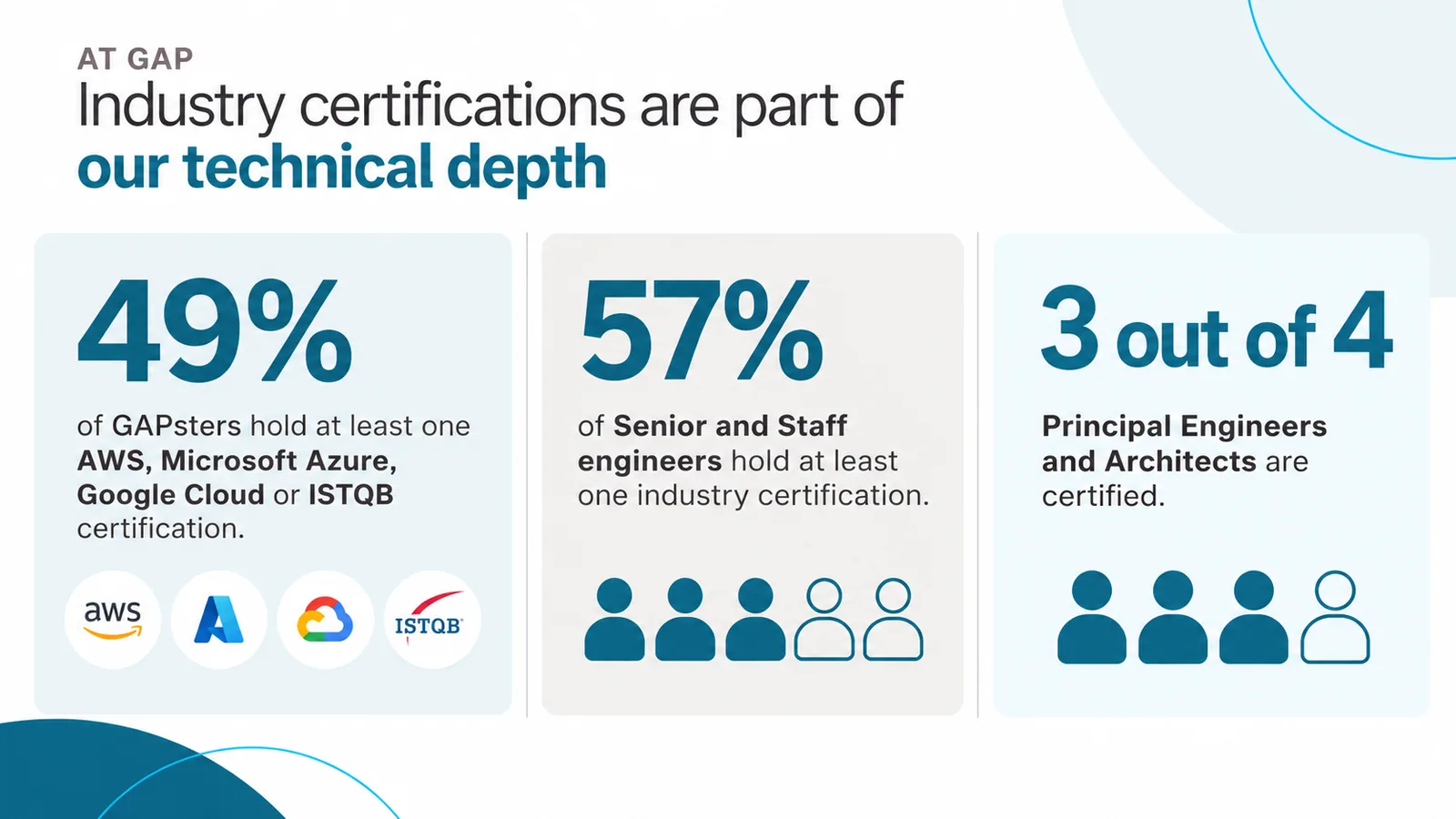
The significance is not simply the number of credentials.
Senior engineers often influence work far beyond the code they personally write. Principal Engineers and Architects may establish architectural patterns, review technical approaches, identify risks and help teams resolve complex problems. Senior and Staff engineers make implementation decisions that can affect maintainability and quality long after a feature ships.
That means expertise can extend through the delivery organization when the right mechanisms exist for technical leadership, review and escalation.
When evaluating a partner, look at where expertise sits in the organization and how it reaches your project, rather than treating the organization’s total certification count as the final measure.
Look for Evidence That Expertise Stays Current
Technical expertise also needs to stay current. Cloud platforms introduce new services. Security expectations evolve. AI capabilities change rapidly. Engineering practices adapt as teams learn where new tools improve delivery and where they create additional complexity.
Experience accumulated over the years remains valuable, but an engineering organization also needs a way to keep that experience relevant.
Certifications can contribute to that process, particularly when they are part of a broader learning culture rather than a one-time credentialing exercise.
GAP, for example, has continued building certifications across Azure, AI, data and security as part of maintaining and expanding its Microsoft expertise. For a prospective client, the larger question is how a partner develops its people after they are hired. How do engineers learn when an important capability enters the market? How are new tools evaluated before they become part of delivery? How does knowledge move from specialists and senior technical leaders into the teams doing the work?
The answer gives you insight into whether the expertise you are hiring today is likely to remain useful as the technology surrounding your project evolves.
Technical Depth Should Change What Happens on Your Project
Credentials become meaningful to a client when expertise affects the decisions being made.
In cloud architecture, understanding the services available on a platform is a starting point. An experienced engineer also has to decide which services a product actually needs, how they interact, what they will cost to operate and whether their additional complexity is justified.
Quality engineering requires similar judgment. Knowing a testing framework does not determine what should be automated, where tests belong in the delivery lifecycle or which risks deserve greater coverage. Persistent quality problems may also indicate architectural or process issues that another automation script cannot resolve.
Modernization introduces a different set of tradeoffs.
Teams have to determine what should change first, what can remain untouched, how old and new systems will coexist and how to make technical progress without unnecessarily freezing product development. In each case, technology knowledge provides options. Engineering expertise determines which options make sense in context. AI is making that distinction even more visible.
AI Is Raising the Bar for Technical Expertise
AI-assisted development changes what buyers should look for in an engineering partner. Access to coding assistants, agents and large language models is no longer a meaningful differentiator on its own.
What matters is what an engineering team can do with that leverage.
As AI takes on more implementation work, experienced engineers can devote more attention to architecture, context, constraints and validation. GAP describes a similar shift in its work on the Autonomous Software Engineer, where engineers move toward planning, setting guardrails, supervising agent execution and validating the resulting work.
That change does not make deep engineering expertise less important. It puts more leverage behind it. AI-generated code can be technically correct yet still be a poor fit for the system it surrounds. The model may not know why a particular architectural decision was made, which conventions matter to the team or what long-term maintenance tradeoffs shaped the existing codebase.
GAP’s field guide to managing AI code quality makes this problem concrete: as generation accelerates, review, testing, integration and maintenance can become the new bottlenecks. It recommends treating agent output as a first draft and focusing human review on questions such as architectural fit and maintainability that require contextual judgment.
That gives technology leaders another dimension to consider when selecting partners.
Ask how AI-generated work is reviewed and tested. Find out how architectural context and project constraints reach the agents being used. Ask what happens to your code once an agent touches it, too: what reaches the model provider, what data is retained and what safeguards are in place. Understand where human approval remains necessary and how the team determines whether AI is improving delivery rather than merely producing more code.
The strongest evidence of AI capability is not a list of tools. Look at the engineering system around them: how effectively experienced people can direct AI, verify its work and remain accountable for what reaches production.
Five Questions to Ask Before Choosing an Engineering Partner
Certifications, seniority and AI capabilities become more useful when they lead to a substantive conversation about how the partner actually operates.
-
Who will make the important technical decisions?
Understand who owns architecture, who reviews difficult decisions and what access your team will have to senior technical leadership once the engagement begins.
The people involved during sales may not be the people solving problems six months into delivery. Ask how senior expertise reaches the team when it is needed.
-
Which certifications are relevant to our work?
Relevance matters more than volume. Cloud credentials become particularly meaningful when cloud architecture or modernization is central to the engagement. Testing credentials may carry more weight when quality engineering is a major part of the work. A complex, multi-platform environment may make breadth more valuable.
Connect the credentials being presented to the engineering problems you expect the team to solve.
-
Can you show how expertise changed a real engineering decision?
Ask for an example where the team changed an architecture, simplified a proposed solution, identified a risk or recommended a different approach based on what engineers discovered. A strong answer should explain the reasoning and tradeoffs behind the decision rather than simply name the technology used.
-
How does senior expertise reach the broader delivery team?
A project does not need every engineer to be a Principal Engineer or Architect. It does need a delivery model that gives engineers access to deeper expertise when circumstances require it.
Architecture reviews, technical escalation, engineering standards, mentoring and knowledge-sharing practices can reveal how effectively an organization distributes expertise instead of concentrating it in a few individuals.
-
How are your engineering practices changing because of AI?
This question is increasingly useful because almost every engineering organization can say it uses AI. Go further. Ask which work engineers delegate to agents, which decisions remain with people, how generated work is validated and what the organization has learned from introducing AI into real delivery environments.
The answer can reveal considerably more about technical maturity than asking which AI tools appear in the company’s technology stack.
Evaluate the Engineering System, Not Just the Credentials
No single signal can tell you whether an engineering partner is right for your organization.
Certifications can provide independent evidence of technical knowledge. Relevant experience shows that engineers have applied that knowledge under real constraints. Seniority brings repeated exposure to difficult decisions and tradeoffs. AI practices now provide another indication of how effectively the organization can adapt its engineering model as technology changes. Taken together, those signals reveal something more useful: the engineering system behind the people you are hiring.
That system matters because selecting a partner can mean giving another organization influence over architecture, products, data, technical decisions and a roadmap your company may depend on for years. The evaluation deserves to go deeper than a technology matrix.
Choose the Capability You Will Need Next
Choosing an engineering partner means looking beyond the expertise needed for today’s project. As AI changes how software is built, organizations also need teams that can apply technical judgment, adapt their engineering practices and turn new capabilities into measurable outcomes.
At Growth Acceleration Partners, we’re an AI transformation company helping organizations modernize products, strengthen engineering teams and build the capability to operate, innovate and compete with AI. We combine strategy with hands-on execution so that progress continues beyond a single project.
The right partner should bring the expertise to solve what’s in front of you while helping your organization become more capable of solving what comes next.
Ready to strengthen your engineering capabilities for what’s next? Let’s talk.